

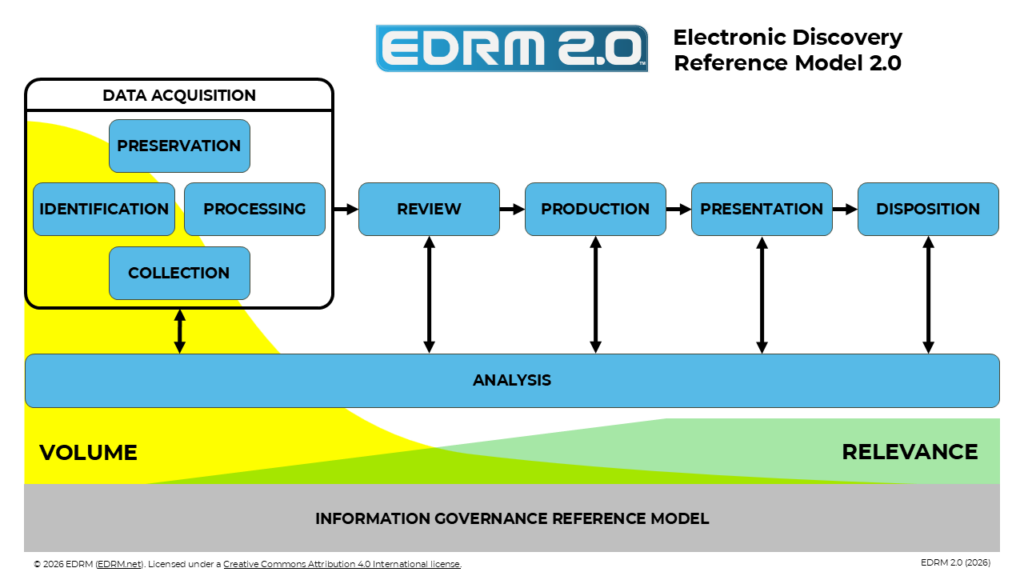
Released September 1, 2026, EDRM 2.0 is the first substantive update to the Electronic Discovery Reference Model since it incorporated the full Information Governance Reference Model. Developed by approximately 150 multidisciplinary practitioners across the global EDRM community, the updated model reflects how electronic discovery is practiced today and where that practice is heading.
The EDRM 2.0 diagram is licensed under Creative Commons Attribution 4.0 International (CC BY 4.0), allowing the eDiscovery community to adapt it to varied use cases. No permission or compensation is necessary to use the model, even for commercial use. The only requirements are attribution to EDRM.net and an indication if the diagram has been modified from the original.
Definitions
Analysis – Assessing ESI/documents throughout the lifecycle using human insight and/or technology
Identification – Determining the scope of the matter and relevant ESI and document sources
Preservation – Safeguarding relevant ESI and documents against alteration or destruction
Collection – Retrieving potentially relevant ESI and documents
Processing – Normalizing and converting ESI/documents for review and analysis
Review – Evaluating ESI/documents for relevance, responsiveness, privilege, confidentiality, privacy, and/or issue significance
Production – Delivering ESI/documents in agreed, defensible, or appropriate formats
Presentation – Strategically displaying ESI, documents, and demonstratives in legal proceedings
Disposition – A systematic, defensible process to retain, delete, transfer or return data after use
What’s New in EDRM 2.0
The EDRM 2.0 project team updated the model to better reflect current practices, emerging technologies, and the growing importance of defensibility and governance. Beyond updated phase definitions, EDRM 2.0 introduces several important structural enhancements designed to better align the framework with today’s discovery realities:
- Reading the model. Although the diagram flows generally left to right, the EDRM is a conceptual view of the eDiscovery process, not a literal or linear workflow. Practitioners may perform the steps in a different order, repeat them, or circle back to earlier phases as their understanding of the data improves.
- Unified visual design. The updated model uses a single, consistent color across all phases, creating a cleaner, more streamlined presentation that reinforces the model as an integrated, cohesive whole. The simplified palette also improves accessibility: by reducing reliance on color differentiation, the model is easier to interpret for viewers with color-vision differences or other visual impairments.
- IGRM as the foundation. The Information Governance Reference Model (IGRM) now anchors the EDRM, reinforcing that effective discovery begins with strong information governance practices.
- Data Acquisition framework added. Identification, Preservation, Collection, and Processing are now visually grouped within a new “Data Acquisition” framework. This addition highlights the interconnected nature of these early-stage activities and reinforces the importance of defensible, strategic handling of data before substantive review begins.
- A clear “left lean.” The updated structure emphasizes the increasing importance of early case assessment, targeted data scoping, and efficient acquisition workflows to improve downstream outcomes.
- Disposition added as a core phase. This addition recognizes the increasing importance of defensible data management and lifecycle governance after a matter concludes.
- Analysis elevated across the lifecycle. Analysis is now recognized as a continuous activity that informs decision-making throughout every phase of discovery, a shift underscored by the model’s bidirectional arrows, which signal that practitioners move iteratively between stages rather than through a one-way sequence. This elevation reflects the growing influence of analytics, machine learning, and generative AI technologies in legal workflows.
- Review positioned as the nexus. The Review phase is highlighted as the intersection where data volume, legal relevance, and strategic decision-making converge to drive actionable outcomes.
Project History, Contributors and Resources
EDRM is grateful for the work of the EDRM 2.0 project trustees and contributors, as well as those who developed and maintained previous versions of the model.
EDRM 2.0 Resources
- EDRM 2.0 Project Page
- EDRM Releases EDRM 2.0, Modernizing the Global Framework for Electronic Discovery
- Inside EDRM 2.0: The Trustees Discuss the New Model
- EDRM 2.0 Public Comments: Key Issues and Trustee Responses as of August 16, 2026