
[EDRM Editor’s Note: EDRM was proud to serve as an Educational Sponsor of RelFest Chicago 2026, held from September 28 – October 1. We are pleased to share these reflections from Khrhysna “Khrys” McKinney, EDRM Trustee of the AI Ethics & Bias Project and founder of EDRM Trusted Partner K. L. McKinney. The opinions and positions are those of the author. Images courtesy of Khrhysna “Khrys” McKinney.]
Relativity Fest has always given the eDiscovery community an opportunity to look ahead. This year, the Electronic Discovery Reference Model (EDRM) came to RelFest 2026 not only as a sponsor, but with a vision of what that future may look like, orchestrating a reminder that the people who will carry our industry forward are as important as the technology and frameworks we build. That combination stood out to me throughout the week.
Evolving the Framework for an Evolving Industry
EDRM has helped our industry make sense of an increasingly complex eDiscovery lifecycle for more than two decades. At Relativity Fest, we had an opportunity to look toward its next evolution: EDRM 2.0. David Cohen, Shannon Bales, Matthew Golab, and Beth Patterson shared perspectives on the evolving framework and on the growing adoption of the Message ID Hash (MIH) as a method for identifying duplicate messages across platforms.
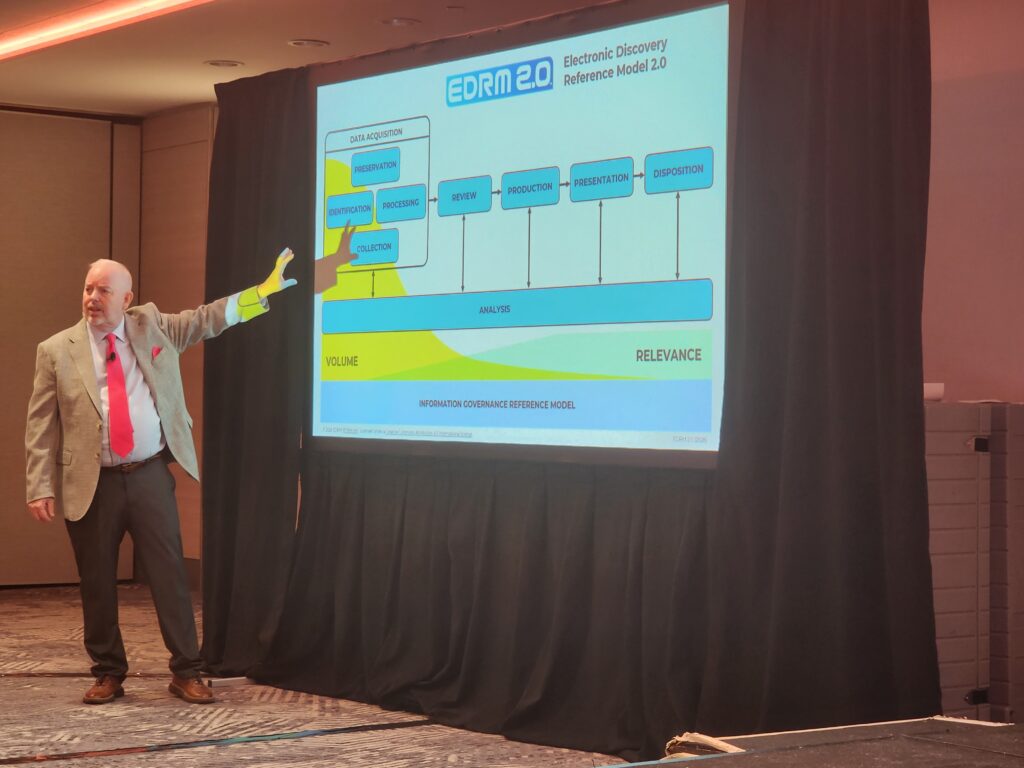
Our data no longer lives neatly within the boundaries represented by the traditional progression of the eDiscovery lifecycle. The sources have multiplied. Communications cross applications and platforms. AI resides throughout legal workflows. The relationships among information governance, discovery, privacy, evidence, analytics, and legal decision-making continue to become more interconnected.
If our work is evolving, the frameworks that help us think about that work should evolve with it. Mary Mack closed the session by bringing that broader picture together and sharing several of the projects EDRM’s global community has underway.
Among them was the release of new GDPR guidance addressing cross-border data transfers. Mary also introduced Trustee Joy Murao, Trustee of the Testimony Evidence Reference Model currently under development.
I was honored to provide a brief look at the work underway through EDRM’s AI Ethics and Bias projects, with additional resources from that work approaching release.
EDRM’s work is built through the contributions of practitioners, technologists, educators, service providers, attorneys, consultants, and others willing to lend their experience. Those interested in becoming involved can connect through EDRM.net.
Khrhysna “Khrys” McKinney, EDRM Trustee, AI Ethics & Bias Project.
And then Mary did something that is very characteristic of EDRM: she opened the door. If you see an issue our industry needs to solve, a framework that needs to evolve, or knowledge that should be shared, there is room to participate. EDRM’s work is built through the contributions of practitioners, technologists, educators, service providers, attorneys, consultants, and others willing to lend their experience. Those interested in becoming involved can connect through EDRM.net.
The Future Was Also Sitting in the Room
Some of my favorite moments of Relativity Fest had nothing to do with a stage or podium.
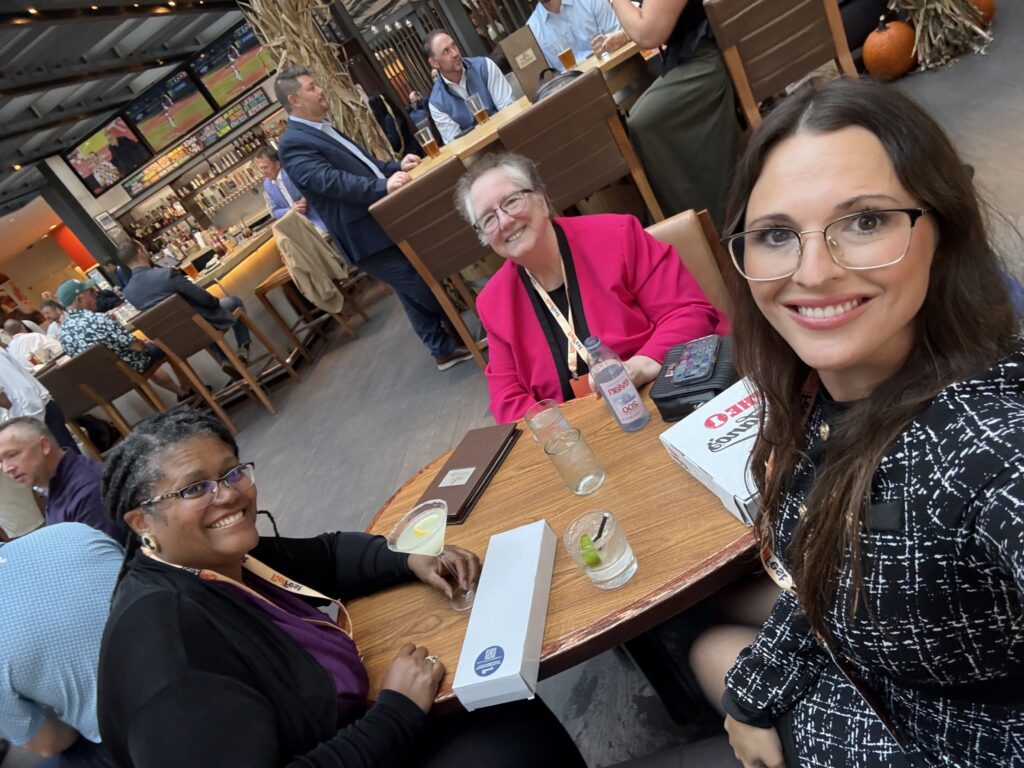
On Thursday, Joy Murao of Practice Aligned Resources coordinated with Mary Mack and EDRM to curate an impromptu and wonderfully warm RelFest party “pregame” for scholars, mentors, educators, mentees, and friends who share an interest in educating and supporting new and evolving talent in eDiscovery. Mary and Joy included me in the gathering, along with Janice L. Hollman and an impressive group of Relativity Scholars.
I found myself in awe of how bright these emerging professionals were and the ecosystem surrounding them. Former scholars talked about where their careers had taken them. Mentors shared their experiences. Current scholars asked questions. People who had benefited from someone investing in them were now turning around and investing in someone else. That is how a profession grows.
And, in classic Mary Mack fashion, Mary made sure people actually met one another. Introductions moved around the room, and what might otherwise have been a collection of impressive people became a network.
I hope the professionals who are just beginning their careers recognized how extraordinary that room was. They were sharing space and conversation with Janice Hollman and a stream of accomplished eDiscovery leaders from law firms, corporations, consulting organizations, technology companies, and throughout the broader legal community.
But I hope the experienced professionals recognized something too. We were sharing the room with part of the future of our profession. A young professional gets access to experience, perspective, encouragement, and relationships. An established professional gets exposure to new questions, new expectations, new ways of thinking, and the energy of someone seeing this industry with fresh eyes. Everybody leaves with something.
Throughout the week, I heard a recurring interest in developing the next generation of eDiscovery professionals. In a year when so much of our conversation understandably centered on AI, automation, analytics, and the future of legal technology, it was encouraging to see just as much enthusiasm around developing people.
Technology may change what our jobs look like. It does not eliminate our responsibility to help people find their way into them.
When Community Needs a Bigger Room
By Wednesday evening, the size and strength of that community became quite literal. The 5th Annual Ankura & EDRM Relativity Fest Reception, hosted by Alex Marjanovic, Michael Huber and Mary Mack, drew such a large turnout that there was a line waiting to enter the venue. Alex, Michael and Mary were a wonderful complement as hosts, bringing together an international guest list of eDiscovery experts, advisors, legal practitioners, technologists, and friends. People wanted to be together.
For an industry built around technology, data, remote collaboration, sophisticated platforms, and increasingly powerful AI, relationships remain one of our most valuable forms of infrastructure.
We learn from one another. We refer one another. We challenge ideas. We introduce people who should know each other. We give someone their first opportunity. We call an old colleague when we encounter a problem they know how to solve. We mentor. We sponsor. We teach. Sometimes we simply make sure the new person standing at the edge of the room gets introduced.
The Future of eDiscovery Is More Than Technology
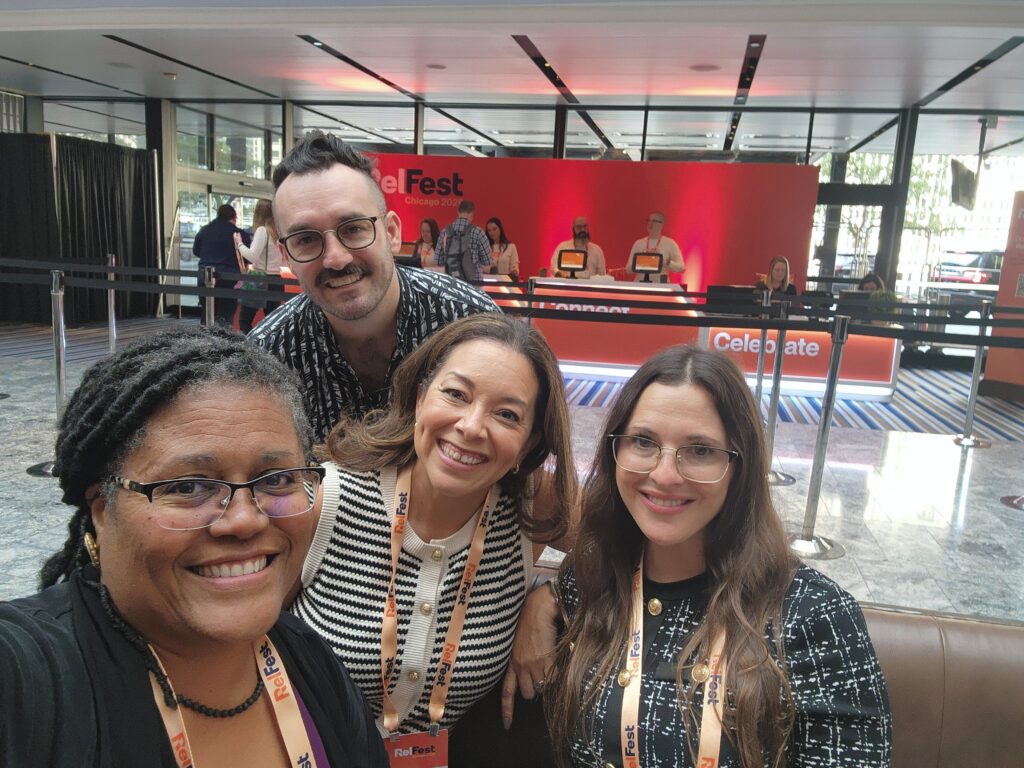
RelFest 2026 spent a great deal of time looking forward. So did EDRM.
EDRM 2.0 asks how the framework supporting our work should evolve. MIH asks how we can solve increasingly complex data problems across platforms. The Testimony Evidence Reference Model asks us to think more systematically about another important dimension of evidence. The GDPR work addresses the realities of information moving across borders. Our AI Ethics and Bias projects ask how we can benefit from increasingly capable technology while continuing to examine its risks, assumptions, outputs, and consequences. All of these projects attempt to prepare for what comes next.
After Relativity Fest, I would add one more element to that future-looking work.
We have to prepare the people who come next, too.
Frameworks guide, standards normalize best practices, technology facilitates performance, and responsible AI considers them all. Mentorship, access, education, introductions, and community enable the practitioners in this business.
Khrhysna “Khrys” McKinney, EDRM Trustee, AI Ethics & Bias Project.
Perhaps one of the most encouraging things I saw at RelFest Chicago 2026 was that our community appears willing to invest in both people and tech. I left Chicago thinking about the future of eDiscovery and the people I met who will help create it. This all makes me very optimistic about what comes next.
Frameworks guide, standards normalize best practices, technology facilitates performance, and responsible AI considers them all. Mentorship, access, education, introductions, and community enable the practitioners in this business.
Perhaps one of the most encouraging things I saw at RelFest Chicago 2026 was that our community appears willing to invest in both people and tech. I left Chicago thinking about the future of eDiscovery and the people I met who will help create it. This all makes me very optimistic about what comes next.
Assisted by GAI and LLM Technologies per EDRM’s GAI and LLM Policy.