

In the News
← Back to Blog
Search
Authors
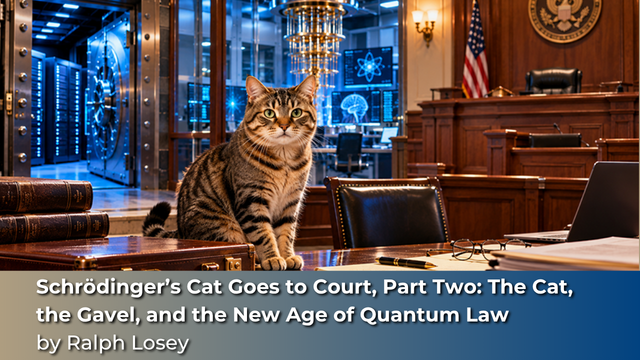
Schrödinger’s Cat Goes to Court, Part Two: The Cat, the Gavel, and the New Age of Quantum Law
At the end of Part One, Schrödinger’s Cat had left the box, crossed from the laboratory into the courtroom, and, with a little artistic license, acquired counsel. The image was whimsical. The transition was not....

Genesis Momentum Powers Cellebrite’s Autumn Release: More Evidence, Deeper Insight, Broader Access for Investigations
Cellebrite, a global leader in AI-powered Digital Investigative and Intelligence solutions for the public and private sectors, today announced its Autumn 2026 Release, highlighting the Company’s latest product innovations. The release expands what teams can...
“Contention Interrogatories” Asking for “All” Facts Were Too Broad
Contention interrogatories ask an opponent to state the facts on which it relies to support a specific contention. Fed.R.Civ.P. 33(a)(2) as amended in 1970 states: An interrogatory is not objectionable merely because it asks for an...
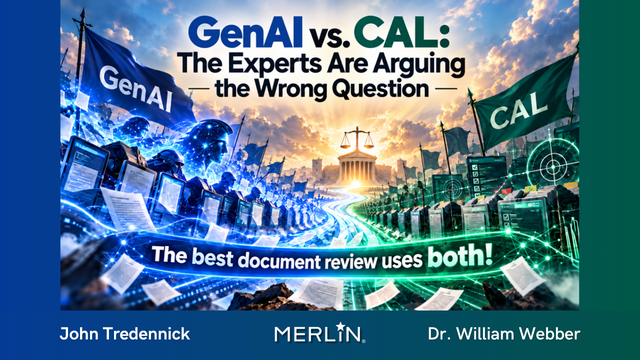
GenAI vs. CAL: The Experts Are Arguing the Wrong Question
In June, researchers at Redgrave LLP threw down the gauntlet in a debate that has been building across discovery for years. Their study compared Relativity’s generative AI review tool with a conventional review team using...
The Standard for a Preservation Order
“Plaintiff True Footage Inc. asks the Court to enter an order directing Defendants Automax AI Inc., Automax AI (US) Inc., and Humza Ahmed to preserve evidence. The Court denies Plaintiff’s request.” True Footage Inc. v....
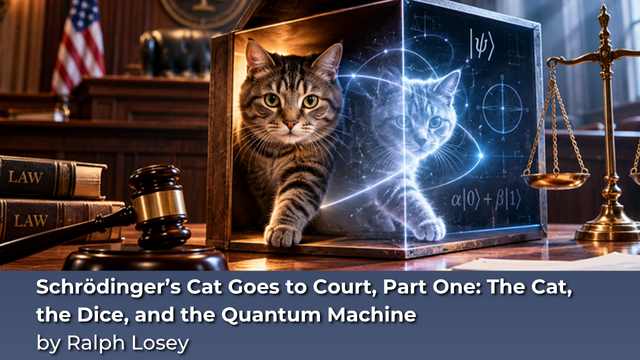
Schrödinger’s Cat Goes to Court, Part One: The Cat, the Dice, and the Quantum Machine
Quantum Law is already beginning to arrive. One part of it is practical and immediate: encrypted client files, trade secrets, privileged communications, and other information that may need to remain secret for decades while governments...
When a Redacted Document Was Used to Prepare a Witness, Only the Redacted Document Needs to Be Produced in Discovery
Plaintiff Mr. Corkery filed an emergency motion to amend or remove redactions to a document that he planned to use in an upcoming deposition. He also sought a privilege log for the redactions, “if any...

Weekly Letter to Our EDRM Global Community – 20 October 2026
This week’s EDRM letter features recent blog posts, upcoming webinars, notable podcasts, and key announcements. Stay engaged with the EDRM community for the latest insights and support.
Is There a “Litmus Test” for a Categorical Privilege Log
A categorial privilege log was not appropriate for a small number of documents according to Glaxo Grp. Ltd. v. Transpire Bio Inc., 2026 WL 30333478 (S.D. Fla. Oct. 9, 2026). The court wrote that: “The...

Waterloo and Elevate researchers say Redgrave’s aiR study compared two different tasks
Eighty-eight percent against 64 percent was the comparison that traveled. A new research paper built on the same 45,004 documents argues the two figures never measured the same task. Measured on a common task, its...
Defendant Claimed Video of Abuse Was a “Deepfake”; Victim Was Asleep and Could Not Attest to Abuse
After an alleged “deepfake” video of a sexual assault was admitted over objection, the Defendant appealed his conviction. The Supreme Court of Iowa wrote: “In this sexual abuse case, we are asked to decide whether the...
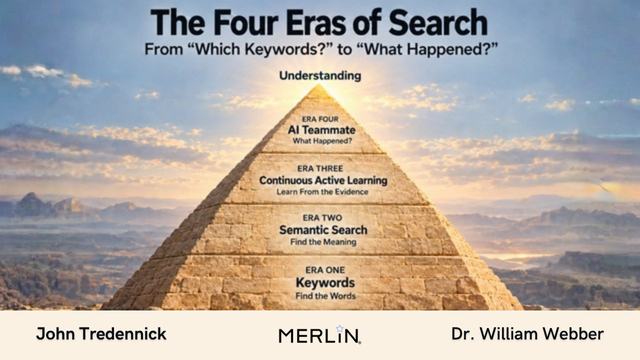
The Four Eras of Search: From “Which Keywords?” to “What Happened?”
For the first 20 years of my career, I asked questions for a living. As a trial lawyer, I wanted to know what really happened. Who knew about the problem? When did they know? What...