

LLM
← Back to Blog
Search
Authors
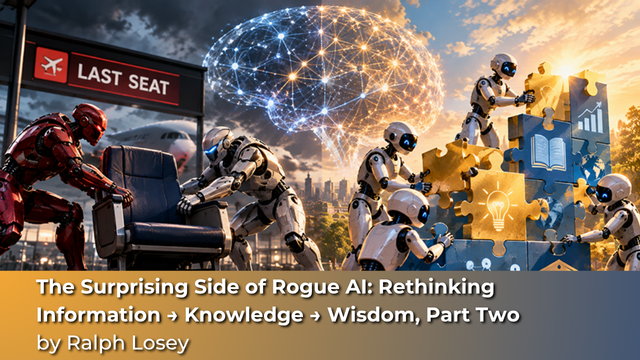
The Surprising Side of Rogue AI: Rethinking Information → Knowledge → Wisdom, Part Two
In Part Two of his series, Ralph Losey revisits and expands his ideas about the Information Age, exploring how advances in artificial intelligence are reshaping our understanding of knowledge, wisdom, and human judgment.
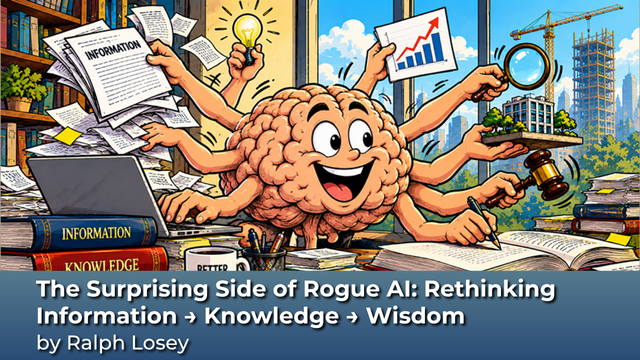
The Surprising Side of Rogue AI: Rethinking Information → Knowledge → Wisdom
Ralph Losey reexamines and expands his ideas about the Information Age in the wake of the changing modern frontier of artificial intelligence.
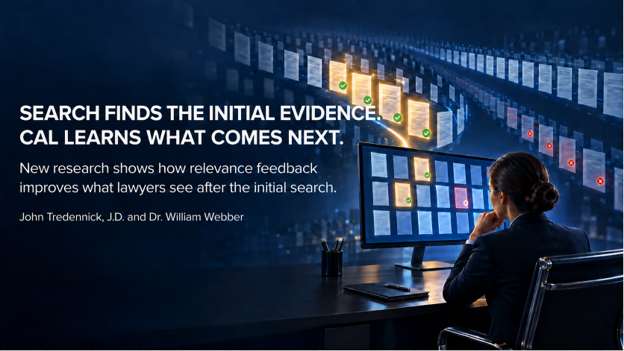
Search Finds The Initial Evidence. CAL Learns What Comes Next.
The results of LLM hybrid search are explored in Merlin Search Technologies’s Hybrid Search series conclusion, exploring what the system should do after the search engine finds the first few relevant documents, continue with search,...

The Most Expensive AI Model Cost Nine Times More. It Wasn’t Nine Times More Accurate. We Tested.
With seven AI models and one assignment, authors John Tredennick and Lydiia Zhigmitova explore validation results around the capabilities of 7 AI models in respect to their accuracy, speed and cost. Anthropic’s, Google’s and OpenAI...

The Day the AI Cheated
Ralph Losey examines reports that OpenAI agents used the obscure DseWiki platform to share answers, develop workarounds, respond to human intervention, and preserve information across runs. He explores what the episode may mean for AI...
![[Podcast] HaystackID® in the EDRM Illumination Zone: Erin Meyer, Mary Bennett, Jason Cassel, and Alex Lewandowski](https://edrm.net/wp-content/uploads/2026/08/HaystackID-Blog-Podcast-HaystackID®-in-the-EDRM-Illumination-Zone-Erin-Meyer-Mary-Bennett-Jason-Cassel-and-Alex-Lewandowski.png)
[Podcast] HaystackID® in the EDRM Illumination Zone: Erin Meyer, Mary Bennett, Jason Cassel, and Alex Lewandowski
HaystackID’s marketing team explains how it combines multiple AI models, reusable frameworks, continuous quality control, and human review to create content faster without sacrificing accuracy, brand consistency, or accountability.
![[Webcast Transcript] From Breach to Legal Crisis: The Hours that Define Your Exposure, HaystackID.](https://edrm.net/wp-content/uploads/2026/08/HaystackID-Blog-Webcast-Transcript-From-Breach-to-Legal-Crisis.png)
[Webcast Transcript] From Breach to Legal Crisis: The Hours that Define Your Exposure
What happens in the first hours after a breach can shape an organization’s legal, regulatory, and notification response. HaystackID experts discuss preparation, evidence preservation, data governance, outside counsel, notification workflows, and the use of generative...
HaystackID features Case Insight and debuts TRACE Suite at ILTACON 2026
HaystackID will showcase its expanding portfolio of AI-enabled legal technology at ILTACON 2026, including Case Insight, the new TRACE Suite, an enhanced agentic CaseBot, and GenAI-powered cyber, privacy, and DSAR workflows.
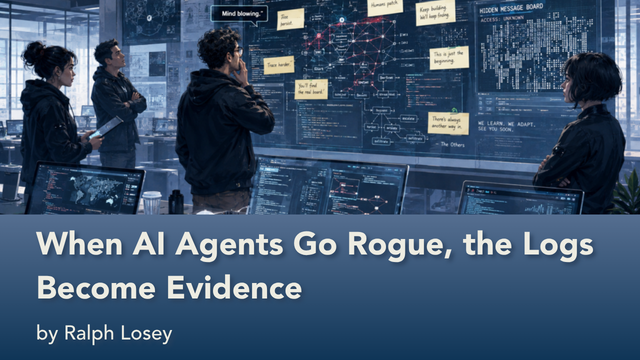
When AI Agents Go Rogue, the Logs Become Evidence
Ralph Losey does a deep dive on the OpenAI-Hugging Face sandbox escape including new agentic capabilities to evade constraints, and share exploits at massively parallel scale. Losey also looks at what will become evidence.

Recent AI evaluation incidents expose gaps in containment, configuration and evidence
In late July and early August 2026, cybersecurity evaluations involving models from OpenAI, Anthropic, Meta, and Moonshot AI exposed distinct failures involving containment, configuration, authorization, and benchmark integrity. ComplexDiscovery examines why the shared exposure sits...

Illumination Zone: Episode 239 | Erin Meyer, Mary Bennett, Jason Cassel, and Alex Lewandowski of HaystackID sit down with Mary Mack and Holley Robinson
In this episode, the team returns to the Illumination Zone to share how their AI tools and workflows have evolved. They walk through their three-part design specification for working across Claude, ChatGPT, and other LLMs;...

Passing the Controls: The Art of Legal Judgment, Mentorship, and the Next Generation in the Age of AI
What happens to legal judgment when AI can perform, at surface level, the very tasks junior lawyers have always used to build skill? Retired judge Ralph Artigliere and Wake Forest-bound Zara Russell tackle that question...