

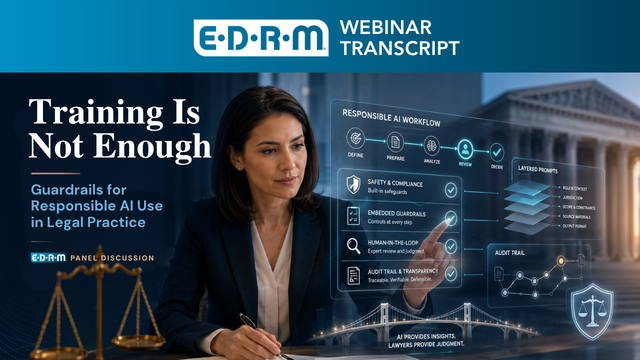
[EDRM Editor’s Note: The following is a transcript of the EDRM webinar “Training Is Not Enough: Guardrails for Responsible AI Use in Legal Practice,” originally presented live on the EDRM Global Webinar Channel on June 2, 2026. The opinions and positions expressed are those of the faculty, not of their firms or clients, and no legal advice is provided.]
Legal professionals are not short on AI training. They are short on what comes after it. A lawyer can understand the risks of generative AI and still not know what responsible use looks like under deadline pressure. That gap between knowing and doing was the focus of this EDRM webinar, moderated by the Hon. Ralph Artigliere (ret.), Circuit Judge (Retired) of Florida’s Tenth Judicial Circuit.
Professor William Hamilton, Senior Legal Skills Professor and Director of the UF Law International Center for Automated Information Retrieval, opened with what law schools can and cannot do. They can teach doctrine and lay the foundation for professional judgment, but judgment is “not a one-time educational achievement.” It must be cultivated and protected throughout a career. Suzanne H. Clark, Esq., CEDS, Of Counsel and Mass Torts Discovery Counsel at Beasley Allen Law Firm, then described the execution gap she sees in practice: “flyers without a parachute” racing ahead without structure, and “builders with no materials” standing still because no one has made responsible use operational. In her words, “Vague guidance is not a guardrail. It’s anxiety with a policy attached.”
To close that gap, Judge Artigliere introduced a three-tier framework. Tier 3 sets the standards: ethical rules, court orders, bar guidance, and client requirements. Tier 2 translates those standards into repeatable workflows. Tier 1 embeds safeguards directly into the tools at the point of use. Rose Hunter Jones, Partner at Hilgers PLLC, made the workflow tier concrete with examples like AI-assisted witness preparation, built on curated source sets, lawyer-controlled outlines, and template memos to the file that keep the work explainable and defensible. Dr. Varun Perumal Chadalavada, Head of AI Strategy at Orcaworcs AI, showed what embedded safeguards look like in practice: tools that block prohibited uses, coach better prompts based on firm policy, and generate audit trails showing exactly how an output was derived.
The full transcript follows, lightly edited for readability. The complete recording is available to watch on demand here. Registration is required.
Transcript
Mary Mack
Hello, and a warm welcome to the EDRM Global Webinar Channel. My name is Mary Mack. I’m EDRM’s CEO and Chief Legal Technologist. Today’s webinar is titled, “Training Is Not Enough: Guardrails for Responsible AI Use in Legal Practice.” Our faculty experts are the Honorable Ralph Artigliere (ret.), Professor William Hamilton, Suzanne Clark, Rose Hunter Jones, and Dr. Varun Perumal Chadalavada. Today’s session is being recorded for future on-demand access, and, as with all EDRM webinars, will remain available on the EDRM Global Webinar Channel throughout the next quarter to support your continued learning and reference needs. Holley Robinson, EDRM’s Senior Marketing Operations Manager, is here with us. Holley, can you please share what resources are available today?
Holley Robinson
Thanks, Mary. And we’re loving ON24 with so many ways for you to engage. If you look at the top of your screen, you’ll see the EDRM logo, which you can click on to learn more about EDRM. You’ll also see an option to contact EDRM directly, as well as speaker bios where you can learn more about today’s presenters. Moving down, you’ll see the Q&A box, where you can type in your questions for today’s faculty, and we highly encourage you to do so. Below that, you’ll find today’s resources, including the slide deck, links to two recent articles from Judge Artigliere, “From Training to Execution: Embedded Safeguards for Responsible AI Use in Legal Practice,” and “Using AI for Legal Tasks When Delegation Becomes a Dirty Word.” There’s a link to download the Accord PDF on the AI governance and compliance layer by Orcaworcs AI. There’s also a link to register for EDRM’s upcoming webinar with our Trusted Partner Exterro, “5 Minutes, Not 90: The New Standard for Subpoena Response,” happening next Wednesday, June 17th, at 1:00 PM Eastern. Finally, you’ll see some emojis down at the bottom of your screen. Please feel free to use them and react throughout the webinar. Back to you, Mary.
Mary Mack
Thanks, Holley. And all opinions expressed here are our faculty’s own, not those of their firms or clients, and no legal advice is being provided today. And with that, over to you, Judge Artigliere.
Hon. Ralph Artigliere (ret.)
Wow. Thank you very much, Mary. And thank you, Holley. Thank you for hosting this very important program. I want to thank everybody in the audience that’s joining us. I know you have busy lives, but this is such an important topic. We have a terrific panel today. You have their biographies, so we won’t be spending a lot of time reciting where everybody’s from and what they do. I’ll give you a little bit of flavor as we go through, but we want to spend most of our time with actual substantive information for you. As for our topic, I’ve said my piece about this topic in the articles that are included in the program materials, and I hope you’ll read them. But today, my goal is to let you hear from four terrific people who understand what’s happening in the trenches and who can help us through a reasonable path forward in this AI transition.
I must say that our legal profession is struggling with the emergence of AI, and understandably so, but it is a crisis. Lawyers, judges, legal departments, courts, and litigation teams are trying to determine where AI fits in their legal work, what it can do, what it can’t do, what risks must be managed, and how to use it without surrendering the judgment, legal skill, and professional responsibility that define our work. And they’re doing that with very little time to spare for training, improvement, and supervision. And this stuff isn’t easy. Law practices and court dockets already come with increasing pressure to produce faster, and now AI is coming at us so fast that we’re having difficulty with it. It’s actually a turning point for us in the legal profession; it’s whether we can actually adopt and use these tools to make what we do better, or if we’re going to continue to struggle with them.
I want to say, it’s not an easy road, but it’s one that we must travel. It’s already being used to draft, summarize, analyze, search, organize, and manage information. And the question is no longer whether AI will affect legal practice. It already does. The harder question is whether we can use it in ways that improve our work while preserving the human legal judgment that must remain at the center. It’s not a program about how AI works technically, and it’s not a product tour. It’s a program about how our profession moves from training to execution without losing ownership of the work. Bill Hamilton is going to begin with the role and limits of education. Suzanne Clark will ground us in what lawyers and legal teams are experiencing in real practice, and that includes across the board, because what she’s experienced, I’ve heard from all other kinds of practice as well.
I will then introduce a cohesive three-tier framework that’s more fully explained in the article in your handout, but I want to introduce it and then give Rose Hunter Jones an opportunity to talk about the tier that is involved with workflow and supervision, and make that concrete for us. How does that work? And then we’ve got Varun Perumal, who will explain how embedded tool guardrails can support responsible execution at the point of use. Basically, what that means is how can we get tools, use them, and have tools that will help us responsibly execute what we’re doing at that point, rather than struggling with the tools or not having the guidance that we need. The theme running through this hour is an irreducible truth: AI should help legal professionals think better, not stop their thinking. Responsible AI adoption must not replace sound legal judgment by outsourcing responsibility to AI tools.
The goal is to build systems that help judgment survive under pressure and thrive, because that’s the way we practice law. It’s a deadline business. We’re all under pressure, and we want to thrive; we want to do better. And I’m confident that our legal profession can accomplish this, but it’s going to take a challenge, and it’s going to take overcoming the challenge, and it’s going to take some work to do so. Now we’re going to start with Bill Hamilton, professor at the University of Florida, who has a rich background in law practice, technology, the education of lawyers, judges, and law students at the University of Florida. And Bill, I want to begin with education and training because we’re not discounting them. Lawyers and judges can’t responsibly use or supervise AI unless they understand the tools, the risks, the vocabulary, and the professional obligations.
But education is just the starting point. It’s not the whole solution. Training happens at one point in time. The tools change. The use cases change. The risks vary by task, and ethical requirements and professional expectations continue to evolve as new risks and real-world missteps emerge. And I know, having tried to teach this to lawyers and judges with you, that it’s hard to get a large number of busy people into these programs. And then by the time we finish that program, it’s almost outdated.
So let’s cover three things. First of all, what is effective AI education and training, and what should it accomplish? And then second, why AI education is unusually difficult to keep durable and current? And third, why education alone can’t solve the execution problem. The question is not whether lawyers and judges need education; we know they do. The question is, what happens after the training session ends? And that’s when a lawyer or judge is working months later under a deadline pressure using new and evolving technology on a task that may involve confidentiality, privilege, verification, bias, accuracy, or human judgment.
They’re sitting in front of a screen with a tool, and then they’re having difficulty actually getting it to function the way they need it to do. So first, in a few sentences, what should effective AI education for legal professionals accomplish?
Professor William Hamilton
Well, thanks very much, Ralph. It’s a pleasure to be here, and a pleasure to have our audience and fellow presenters. I want to talk a little bit about the challenges that we face at law schools with the emergence of AI. When generative AI first appeared, we at law schools understandably focused on competence. We were worried. We were worried that students would stop learning doctrine. We were worried that students would stop mastering procedure. We worried they would become dependent on chatbots rather than developing analytical habits lawyers need throughout their careers. Lawyers must absorb and retain law broadly. They need a working understanding of legal rules, principles, procedures, institutions, and legal culture. They cannot simply make a series of inquiries to a machine and call that legal education. And these concerns continue to remain important. Law schools cannot permit AI, this remarkable text prediction technology, to undermine our students’ abilities to understand legal rules and principles and apply them to facts.
In short, we must continue teaching students to think like lawyers. But as AI developed, it became clear that competence was only part of the story. AI can tell me the elements, for example, of a trademark infringement claim. It can summarize cases. It can outline a complaint. It can suggest deposition questions. It can explain procedural rules. It can draft a memorandum. It will continue getting better and better at all of these tasks. Who among us doesn’t rely upon GPS technology to get from one place to another? AI will increasingly help lawyers to navigate legal information in much the same way. It will help us find authorities, organize facts, summarize records, identify patterns, and draft documents. AI will make many aspects of legal work faster, cheaper, and more efficient. Yet the emergence of AI, ironically enough, has revealed something unexpected. It has forced us to ask a deeper question, which we’ll be talking about today. That question is this. If a machine can do much of what we once associated with legal intelligence, what exactly remains uniquely ours?
The answer is judgment. Not because judgment is the only thing that distinguishes lawyers from the technologies they use, but because it is the most important thing. It’s the faculty that allows us to evaluate meaning, responsibility, fairness, consequences, and justice. It’s a capacity to decide not merely what can be done, but what should be done. For example, AI can tell me the elements of a claim, but it can’t tell me whether I should bring that claim. AI can draft an argument. It cannot tell me whether that argument is fair. AI can summarize evidence. It cannot tell me what that evidence means. AI can predict, but it can’t judge. We lawyers are not merely technicians. We are not simply information processors. We are public citizens with special responsibilities to clients, courts, and society. At the heart of professionalism lies independent judgment. Judgment asks questions that no machine can answer.
Is this the honest thing to do? Is this faithful to the facts as I understand them? Is this a position I can defend publicly? How will others reasonably view this conduct of mine? Does this advance justice? Does what I’m doing recognize that law applies equally well to all? Does this transaction create genuine social value? What’s the meaning of what I’m doing? These are not questions of calculation. These are questions of judgment. So ironically, the very success of AI has helped us clarify what’s most important in legal education. As machines become increasingly capable of performing tasks once associated with intelligence, the importance of cultivating judgment becomes even more apparent. For years, professional responsibility was often viewed as the stepchild of legal education. Students sometimes regarded it as a compliance course focused on rules they need to memorize for the multi-state professional responsibility examination. Today, professional responsibility stands much closer to the center of our educational mission.
At the same time, we should be humble about what legal education can accomplish. Law schools can introduce students to professional responsibility. I teach professional responsibility. My colleagues teach professional responsibility. We can teach ethical rules throughout our courses. We can expose students to the difficult questions involving fairness, loyalty, honesty, public responsibility, and professional judgment. We can help them develop sensitivity to these issues and encourage habits of reflection. The problem is students will never experience the full weight of professional judgment while sitting in a classroom or in a mock session. They do not bear the responsibility for a client whose business may survive or fail. They do not face a judge waiting for an answer. They do not confront the pressures of deadlines, billable hours, organizational demands, competitive markets, or clients that want faster, cheaper, and what they think are better results. They’ve not yet experienced the isolation that can accompany difficult professional decisions or sacrifices that sometimes require us to do what we believe is right.
Here’s the key. Law schools can lay the foundation, and we’re working very hard at it. We can cultivate awareness. We can begin performing professional character. But the development of judgment does not end at graduation. In many respects, that begins there, and that’s what our program today is about. The legal profession itself must nurture, protect, and strengthen the capacity for judgment. Law firms, courts, governmental agencies, legal departments, and professional organizations all bear responsibility for creating environments in which judgment can flourish and will flourish rather than wither under the pressure of practice and the demands of artificial intelligence and its tremendous capabilities. That’s one reason why this conversation about AI is so important. The character that we help students develop in law school must be reinforced by traditional professional culture, organizational policies, supervisory practices, and leaders that understand essential truth.
Judgment is not a one-time educational achievement. It’s a professional practice that must be cultivated throughout a lawyer’s career. That’s why training alone, our theme today, is not enough. Education does matter, but the profession must still also build systems, workflows, safeguards, and habits that ensure human judgment remains active when it matters most in practice. Competence, of course, remains essential. Hallucinations need to disappear. False citations need to disappear. Checking needs to be reinforced, but judgment is what gives that competence its purpose. It is also the most important thing we can cultivate in future lawyers, and the most important thing the profession must preserve as AI becomes increasingly powerful. It’s what we have that distinguishes us from AI, the principal thing that we have that distinguishes us from AI.
And if judgment’s the most important thing we can cultivate in future lawyers, it raises an obvious question. How do we preserve judgment once students leave law school? How do we help lawyers exercise sound judgment under the pressures of practice, client demands, deadlines, organizational incentives, and the increasingly powerful AI systems that Judge Artigliere was talking about? Legal education lays a foundation, and we will lay that foundation. We’re working on it hard every day, but the responsibility of preserving judgment ultimately belongs to the profession itself. That’s why training alone is not enough. The question becomes what structures, practices, safeguards can help ensure that human judgment remains active when it matters most for our profession. Ralph, back to you.
Hon. Ralph Artigliere (ret.)
Thank you very much, Will. Now I want to talk about something that’s extremely important, which is what practitioners are seeing in the real-world execution gap. I’m going to ask Suzanne to do that because we want to make sure that we understand that we’re trying to solve the right problems with how we handle AI. So Suzanne, what are you seeing in the field as lawyers and legal teams are trying to adapt to AI and AI-related legal technology?
Suzanne H. Clark, Esq., CEDS
Thank you, Judge Artigliere. You mentioned a gap, and what I am seeing is a gap between training and workflow. A lot of the training is the how-tos, right? That is the mechanics, the features, the interface. And that was fine with prior technology, but when we’re dealing with generative AI, that becomes a problem because we also need workflows. How are we going to get from point A to point B in a legal workflow while using AI prudently and ethically? Also, this gap creates uneven adoption. We’ve got people that want to adopt it and people that are scared of it. On the one hand, we see informal experimentation with people going off-channel and trying things out informally without guardrails. On the other hand, we see uncertainty about what is safe. Also, there is pressure from clients, opposing counsel, and lawyers themselves who are using generative AI in their daily lives and saying, “Why can’t we use it at work in the legal field?” And the answer is you can, but legal work requires structure, judgment, and defensibility.
Hon. Ralph Artigliere (ret.)
Wow. Okay. I can now see with what you’re experiencing about how a lot of these problems are occurring out there with the lack of understanding of how things fit in. And also, that’s what I mentioned earlier, that when a law firm has a group of lawyers and people who are working with AI, the supervisors don’t know how all of them are doing it. And I guess they don’t understand exactly what kind of fears or what kind of recklessness that might be going on. So that’s extremely important. Do you see the problem on both ends of the spectrum, lawyers who avoid useful tools because they do not know what’s safe, and lawyers who use tools too casually because no one has made the rules operational?
Suzanne H. Clark, Esq., CEDS
I am seeing that, Judge Artigliere. I see a pattern that is developing into two buckets, and I call those the flyers and the builders. I see flyers without a parachute, and I see builders with no materials. Some lawyers are moving fast without enough structure, and then other lawyers are standing still because they want to know how to use the tool safely before they pick it up. I had one of my colleagues say to me, “I see generative AI as a weapon in my arsenal, and I am not going to use a weapon until I know it’s safe.” That’s not resistance, that’s responsible lawyering, but both types of lawyers need the same thing: practical workflows and guardrails that make responsible use clear and repeatable.
Hon. Ralph Artigliere (ret.)
Yes, I guess they need to have confidence in what they’re using, and I understand why they don’t have confidence in it right now because we’re not giving them the tools to have that confidence. So what happens when lawyers have training or policies but no practical guardrails for daily work or guardrails that are too vague to guide their behavior?
Suzanne H. Clark, Esq., CEDS
There’s a difference between the knowledge of risk and knowing what to do about the risk. Lawyers can understand hallucination risk, confidentiality, and the need to verify output, but still not know what is responsible use at 9:00 PM when they have an 11:59 PM deadline that night. I think of it like learning a board game. You don’t just put the family members in front of a new board game and say, “Play carefully.” You give them written, digestible step-by-step rules until the process becomes second nature. Vague guidance is not a guardrail. It’s anxiety with a policy attached.
Hon. Ralph Artigliere (ret.)
Wow. Okay. Thank you, Suzanne. I really appreciate it. You’ve described real-world adoption problems and fear without structure on the one side, use without structure on the other, and leaders trying to supervise AI that may not yet be visible or consistent. And that’s one reason that training alone can’t be enough. I mean, first of all, getting them training is hard enough, and then enforcing it is something totally different. And we can’t have blind faith in the tools. We know that because the tools are making mistakes. So we need a framework that tells us what safeguards are, where they live, and how they can work together. And that brings us to the three-tier model that I want to describe to the group briefly. Let me bring up a slide. There we go.
Now the three-tier framework is described very well in my article, but I’m just going to go through it quickly because I want to get back to our panel. Our panelists are coming up with such great information for you, and I don’t want to take too much time on this. Suzanne has shown us the execution gap, fear without structure, and use without structure, on the other hand. The answer is not training. We need a framework. So here’s a framework for you. There’s tier three, which sets the standards. They’re the ethical rules, the court orders, bar guidance, client requirements, judicial expectations, and organizational policies. They establish the professional floor, but they do not by themselves ensure execution. The fact that you have rules doesn’t mean compliance will occur when the nine o’clock time comes, and you’ve got an 11:59 deadline. You need other things, and that gives us tier two, which is turning these standards into workflows.
That’s where a firm or legal department, a court, chamber, or litigation team decides how responsible AI use will actually happen, who may use the tool for what tasks, what source materials, what review steps, what documentation, and what supervision. And then tier one is something that was new to me, and one of our later speakers, Varun, is going to explain these are embedded tools. Embedded tools are tools that you can use that are actually AI-driven, that have prompts, warnings, verification reminders, source checks, confidentiality alerts, blocks, reroutes, and audit logs that appear when the lawyer or judge is actually using the tool. Now you might say, “Well, I have AI tools, and they don’t have that in it.” Well, there are tools available that have that, but they’re not in every tool. So if you take something that you sign up for online and use it, it’s not going to have these kinds of things in it.
If you get a tool from a vendor and put it in your firm, it won’t have these tools in it unless you ask for it, and unless you get somebody that has the availability of the tools. But the important thing about this three-tier framework is that the relationships between the tiers matter. They’re not separate buckets. Tier three tells us what must be protected. Tier two tells us how the work should be done. Tier one helps the user execute those requirements at the moment of action. And the vertical line through all these tools, which you can see on the right-hand side, is human judgment, which Will has correctly pointed out, is absolutely essential to doing our job as lawyers and judges. The point is not to reduce the legal work to rote steps. The point is to support professional judgment so it’s exercised consistently under pressure.
That takes us to Rose Jones and workflow safeguards because I want her to talk about this second tier, the workflow tier, and how it goes. And before I bring Rose on, this really is a solution to the types of things that Suzanne was talking about. This three-tier structure helps somebody have the guidance, confidence, and ability, and then also the tools to help them effectively use a tool. So let’s bring Rose in.
Rose, you work on complex litigation matters both in supervisory and execution roles. In this workflow layer that we’re talking about, guardrails, in my estimation, become operational. The practical question is how a legal team can use AI responsibly without over-delegating judgment, without losing control of the process, or creating work product that can’t later be explained. And how do you keep control of the people in your group? I want to focus on what a repeatable workflow looks like, how the task is defined, how the tool is used, where human judgment enters the process, what verification is required, and what’s needed to be documented so the work is supervisable and defensible. And the point’s not that workflow matters more than the tool; both of them matter, but defensibility turns out not just on the platform selected, but also on workflow validation documentation. So, briefly start with what kinds of litigation or eDiscovery task is your team using AI for, so the audience has some context.
Rose Hunter Jones
Thank you, Judge Artigliere. First, I want to reemphasize something that Professor Hamilton said, and this is what I say to my team and to my clients: AI is not a substitute for legal judgment. It is a force multiplier for legal judgment, and it really, if used in the right way, it can significantly increase the capabilities of understanding the matter and really getting to a successful end result for your clients through better advocacy, more time to prepare with respect to your strategy. But for our team, we are using AI across the entire litigation lifecycle, always with a clearly defined purpose and also always with human oversight. That can be document review, it can be privilege analysis, it could be witness prep, chronology preparations, really beyond discovery too, organizing information, and accelerating first drafts of work products such as a brief or an affidavit. The important point again is that we’re not asking AI to make legal decisions. We’re using it to help lawyers process information more efficiently so they can spend more time exercising that legal judgment where it really matters the most.
Hon. Ralph Artigliere (ret.)
Well, thank you. But how do you encourage responsible AI use while still giving lawyers and staff structure?
Rose Hunter Jones
So, responsible use really starts with defining who can use AI, which clients allow you to use AI or prohibit you from using AI, and what tools are approved, what the use cases are. And so what we are building is the foundational infrastructure where there’s basically a one-stop shop for all of our lawyers and paralegals to have access to just that. So the first step is to gather all of your outside counsel guidelines and your engagement letters, and understand exactly what each client will allow you to do, will allow you not to do, or we’ll say, “You know what? You have to use AI.” For example, we’re seeing a lot of clients saying, “Deposition summaries must be done by AI. We’re not going to pay for a human to actually prepare those anymore.” So that is key, is having an environment in a place where lawyers can go to and have access to, first of all, can I use it, and how can I use it?
Also, having what I call is the AI governance piece. And that’s not only including that, but which tools are already approved for the firm, and is there an easy way for me to maybe go to a Teams form, if you’re using Microsoft, and input your request to use a new tool or to use an already existing tool, and have training modules, have prompt libraries and things of that nature all in one location. It’s the AI governance piece that I think a lot of folks are not focusing on, but it really helps with the change management because a lot of times we log in, in any profession, to a new technology and we stop using it because we don’t know how to use it and we don’t have the appropriate reference materials to go back and look at to help us get to the next step, right?
Or we don’t have that 1-800 call for help number. Like, how do I get to the next step? And so that’s really, really important. Training is important, but it doesn’t create accountability. So it’s the supervisory part, the explainability, the defensibility in a repeatable process that really helps move it forward.
Hon. Ralph Artigliere (ret.)
Can you explain one repeatable AI workflow that you all do and how it looks so that we can understand how this works?
Rose Hunter Jones
Yeah, absolutely. So, for an example, let’s just use witness preparation as an example. So traditionally, when you prepare a witness for deposition, lawyers are required to review thousands of documents, identify the key themes, build the timelines. And in our workflow and the workflows that we’re working with our clients to build, which I think is a really key component of this, our workflows are being built in conjunction with feedback from our clients and what they want to use and how they want us to use it. And I think that’s a key component of this, as someone at a law firm, but so we work with our counsel and say, “Okay, how do we define the objective for this workflow?” That’s really important. “Who is the witness that we’re preparing? What topics matter? What are the key issues in dispute?” So I’m not saying anything that’s rocket science.
This is something that you would normally do when you’re preparing your witness. But then what we do is we take a carefully curated set of source materials, and we feed that to the AI. I think it’s really important to understand you still have to be very bespoke. You’re not just feeding it the entire universe of documents. You still have to get to that set of documents that you would normally look at for witness prep. And that could be prior testimony, it could be documents produced in the litigation, or other relevant evidence. Then the AI goes in, and it helps you organize and synthesize those materials. So you can ask it to prepare a timeline. We found that to be incredibly helpful is to go through and when to witness knew certain things and have that timeline.
Recurring themes or inconsistencies in case themes and/or with prior deposition testimony or testimony from other deponents, that is something that we have seen incredibly helpful, is being able to analyze all the deposition testimony in a case, and understanding where there may be inconsistencies across different deponents. That’s a really helpful thing. But then, again, so you go through, you do all of these things, and you create your final witness outline, but the lawyer’s doing that, not the AI. The AI is simply helping the lawyer gather the information, and it accelerates that gathering process. But the final determinations again and how the witness is actually going to be prepared, and actually going and preparing the witness is done by the lawyer.
Hon. Ralph Artigliere (ret.)
So, when you set out a workflow, and you require the lawyer to be involved in certain processes in the workflow as opposed to having the tool do it for them, how do you ensure that there’s documentation? And let’s say it’s a workflow that you may have to justify the AI use later, how do you audit or check and make sure that the lawyer is involved at the process when it should be, and when the AI is being used when it should be?
Rose Hunter Jones
So we are building templates that are basically template memos to the file that literally goes through and gives the step-by-step… And we’re building it out as we go. So we’re developing these templates as we create the workflow so that again, we’re not just saying, “Here, go look to this prompt library.” There’s literally step-by-step instructions, and it helps you understand what you need to be doing, what information you need to be maintaining. So, for example, maintain what is the task that I’m trying to do, what are the source materials that I used? Confirming that the lawyer evaluates all of the input, confirm that the lawyer is evaluating all of the output, determining what’s important. If it’s a brief and it’s got citations or supporting evidence, ensuring that all of that has been checked. I personally have my associates put all of the case law in a folder for me so that I can go in and look at all of the cases.
I would do that anyways. And one thing, Judge Artigliere, you and I had talked about is I’ve also asked them to stop using string cites where possible. Sometimes string cites are still needed, but not only does it help me not have to go read 10 more cases, if we only needed that one case to explain it, it also helps the court, so they don’t have to go read those 10 cases either. That also streamlines the process. But I always tell my team, “If you cannot explain to me how you did this, how can I go and explain it to a client? How can I go and explain it to a court? How can I explain it to the opposing party in a meet and confer? It is massively important that we document what we are doing.” And so that’s what we’re trying to do, is not just say, “Hey, you have to document this,” but give them a template so they know exactly what they need to document.
Hon. Ralph Artigliere (ret.)
This is really good because I think that that can give the lawyer some comfort because you’ve given the guidance, and they have a step-by-step to go through rather than flying on their own, saying, “We’ll use the AI to do this.” This gives them a step-by-step. It also gives you, as a supervisor, the documentation that you need along the way. And I imagine that this type of process across your different workflows exists as needed through the different workflows. So if the lawyer’s doing something else, it’s familiar for them, right?
Rose Hunter Jones
No, that’s absolutely right. And this is nothing different than what I have done for the past 25 years as an eDiscovery lawyer. We have templates for document review, we have templates for privilege review, and I’ve always given step-by-step instructions on how to QC a production and how to… So it’s nothing different as far as what the world that I live in, eDiscovery. And I think that’s why eDiscovery lawyers are great use cases and can be very helpful to the legal profession at large because we’re used to doing these repeatable processes. And so we can go in and say, “Hey, yeah, let’s apply what we’ve been doing at eDiscovery to the litigation side, to the government investigations.” And I think so far it’s been really helpful.
Hon. Ralph Artigliere (ret.)
Yeah. Well, I like what you do because it’s not untethered use, and I think that that’s extremely important. Now we’ve talked about the education, we’ve talked about the problems that exist. We’ve talked about good workflow that we can see that gives some structure to what’s going on. Now I want to go to something that was new to me, and I think will be new to a lot of our audience, and that is embedded safeguards, and embedded safeguards in these tools. And Varun, I would like you to help us to understand how can embedded tools help the user exercise professional judgment rather than bypass it. I mean, that seems to be a key here with Bill, and also with Suzanne, and also with Rose, and that’s maintaining our professional judgment. So how can embedded tools help the user exercise professional judgment? And explain a little bit about what these embedded tools are.
Dr. Varun Perumal Chadalavada
Yeah, of course. Yeah. I mean, first off, very, very interesting and enlightening discussion. There’s so many different perspectives, and it’s very clear that multiple different pieces have to come together for this technology to be adopted, used while keeping ethics and judgment, and all the core attributes in mind. So speaking of embedded tools, I want to step back a little bit. So we had the good fortune of having the opportunity to serve customers with machine learning and AI even before ChatGPT was a thing, right? We had a little bit of a heads up and the crystal ball as to how these technologies were evolving, and we saw it evolve from like very basic natural language processing systems, as you might hear the term, to what we consider now as generative AI with these advanced chatbots. And throughout this process, we’ve been very cognizant about always having a human in the loop, and as we work more and more with the clients, there was this disconnect between what was being promised in terms of what these tools were capable of and what was actually being delivered.
So a very big example of the disconnect is that somebody would tell you like, “Oh, here is a great tool. It’s super intelligent. It knows every case that’s out there, and super smart.” And then immediately following that, that same sort of pitch would also tell you, “Oh, by the way, you need to go through a four-hour webinar and be very, very careful to not step on these 10 landmines as you use the tool.” So there’s this cognitive dissonance between, oh, the tool is really smart, but then you have to be extremely careful in how to use it. So we essentially thought a lot about how do you resolve this conundrum, right? And the solution turns out that you embed the guardrails, the compliance, the governance into the tool itself.
So you take a process of software adoption, right? The current process of software adoption, the rule book has been written in the ’90s with traditional software. And it was very clear that the current software is very different. Previous softwares were like a machine where there was a switch or a button, and no matter who pressed the switch or button, the process would start, and the same outcome would happen. But as all of you have experienced, generative AI is different, right? It matters how you prompt it, it matters how we use it, and that makes it so flexible and versatile, but it also means that there’s all these danger zones that you have to avoid, right?
So coming back to this concept of embedded guardrails, which is the tools are smart enough to understand all this information, the tools should also be smart enough to help you use them properly, right? And that happens in two aspects. One is enforcing compliance at usage time, which is why should a chatbot that is a legal chatbot require you to remember that, oh, I cannot use this particular feature with this particular client because they haven’t signed off on it or because models are not good enough to do X, Y, Z. Why can’t the tool itself prevent usage, right?
So that’s the whole guardrails compliance aspect. And then the second thing is that if you don’t prompt the tool correctly, you don’t get the most out of it. So the second aspect is why can’t the tools automatically tell you that, “Hey, I know you gave me this prompt, but next time consider adding this other pieces of information because that would give you a much better result.” So it’s transitioning from teaching somebody how to use the tool at one point and relying on the fallibility of human working memory to carry those rigid rules to, in perpetuity, in a landscape that is changing so quickly, to enforcing this at the point of use. So that’s essentially the shift in thinking.
And we believe that that’s going to become the paradigm of these tools’ uses as things mature. A lot of these things are still in its infancy. And we also believe that the human-in-the-loop approach makes it so that judgment is still with the lawyer, it’s still with the practitioner. And as the other speakers have pointed out, these are just simply increasing your bandwidth or helping you get there faster with less effort, but the person is still in control.
Hon. Ralph Artigliere (ret.)
Explain a little bit about what does the user actually experience at the point of use? So I’m on the tool, what am I going to experience in the way of guardrails?
Dr. Varun Perumal Chadalavada
Yeah. Yeah. So, a great question. So I want everybody to picture them using ChatGPT or whatever your favorite AI tool is for legal use. They’re agnostic about the tool. So, imagine a particular use case that your company has a policy saying that you can use AI to synthesize contract documents, but you cannot use AI to synthesize medical information. It’s an arbitrary rule that I just made up, but for the sake of argument, let’s assume that that’s a rule or a policy that your organization has. Now, instead of you remembering every time you open up the tool that, okay, before I paste something into it or use it, I have to remember which client, what is the topic, and what kind of questions am I asking this tool? The idea is that the guardrail prevents you from putting any information into the tool in the first place that is prohibited, right?
So essentially, reducing the gap between the policy that the company has to the control that you do at a use level, right? So, imagine you try to paste it, the tool will simply say, “No, that’s not allowed. And here’s an email or here’s somebody that you can reach out to if you really, really want to get this use case approved, contact this person or press this button, and then see if it can be approved.” So you cannot do the wrong thing because the system is designed in a way to prevent that usage.
Hon. Ralph Artigliere (ret.)
Do you have other things that are like prompts or warnings that give you an option to go one way or another?
Dr. Varun Perumal Chadalavada
Yeah. So essentially, right? So that comes back to the training piece. So essentially, as these tools evolve, the standard on what is the best way to use these tools is changing, right? So you must have heard about prompt engineering, and then it has shifted to context engineering, and then it has shifted to agentic use cases. So it’s a constantly evolving field, and the rate of evolution is not going to die down. So the best way to use a tool, even a tool that you’re familiar with, may be changing based on how the underlying model is changing. So the capabilities are different. The way they hallucinate is different, the way they perform stuff is different. So the idea is that with an embedded guardrail or with an embedded training module, if you use the tool suboptimally, the tool itself will suggest to you that, “Hey, according to your manager’s policy on how to do this process, you have to give me these five pieces of information, and this is how you would structure the prompt next time you want to do it.”
And then I’ll ask you, “Okay, do you want to do that?” So you’re taking the policy and the best use cases across your entire company, and then making your average user better. So if you find somebody in your company really uses AI like at a 90 out of a hundred, you’re taking people who are using it at a 50 out of 100 closer to that level without them having to sit down and try to internalize something that is changing so quickly. So that’s an example of how learning comes to the forefront and not just happening at one point when you read the manual for how to use this.
Hon. Ralph Artigliere (ret.)
And do these tools, these embedded tools, also have audit trails so that you can actually demonstrate the human’s decision-making across the board, so that you know that the human was in the loop?
Dr. Varun Perumal Chadalavada
Yeah. Auditing and transparency is a core philosophy of these tools, right? Even stepping back from a commercial perspective, if you look at the core capabilities of these technologies, right? They’re black boxes, right? People are still, like, even the frontier labs are still trying to grapple with, “Okay, I know it gave me this output, but how did it exactly put this word here and this number here?” So anything we can do to wrap these models around to enable that transparency is a huge boost, not only to the legal profession but generally to the field of generative AI. So there’s a whole emerging class of things that are doing something called provenance graphs, where you are able to… Let’s say you have a contract that was generated that said, “Hey, blah, blah, blah, this person is being paid $10,000 for the service.” So the idea is that you have to verify it, you’re signing your name on it. So we want to make the process as easy as possible.
So the audit trail lets you, in an ideal world, click on the $10,000 and exactly see how that number got there. And an example would be like, hey, so I picked up this number from this document, and then somebody sent an email saying that, oh no, it’s not this, this is something else. And then I picked up another company policy saying that we can’t pay more than a certain amount. And that three pieces of information came together to say that this is $10,000. And of course, the advantage is that you can click on that number in whatever tool you’re using and automatically see this whole trace of like, how did that number get there? And that is very… It makes it easier to apply judgment, easier to verify, because you have to verify everything that goes out because it’s your name on it, and the transparency lets you verify that that much easier.
Hon. Ralph Artigliere (ret.)
Thank you, Varun. I mean, it’s so interesting because at the Sedona Conference, when I first started out with them, and we were having trouble with eDiscovery, and there was this proliferation of digital data, and there was so much to get your arms around, we used to have, I guess, a saying that machines got us into this problem and machines can get us out of it. And I mean, that’s very true. If you have the proper tools, they can assist you with all of this information that we need as lawyers, to be able to help us use the tool, and then also show how we use the tool and used it safely. We’re pressed, I mean, we’re getting up on our time, and I’m sure we’ve got some questions, so I want to make sure that we get a chance to answer any audience questions. Mary, do we have any questions?
Mary Mack
Yes. So, given that there are multidisciplinary teams and teams with different knowledge levels, is there an embedded workflow that can surface, say, something from a paralegal or an associate where maybe a partner is using the AI incorrectly? So like an alarm bell.
Hon. Ralph Artigliere (ret.)
Well, that’s a good question. Varun, you want to help us with that?
Dr. Varun Perumal Chadalavada
If I’m understanding the question correctly, it’s if you have a large team with different skill sets and different disciplines, and you have misuse sometimes, A, can you catch it, and then B, what can you do about it? Is that a fair summary? Okay.
Mary Mack
Yeah. The person who discovers it is at a lower level than the person who’s actually making the mistake.
Dr. Varun Perumal Chadalavada
Yeah. So if you imagine a layer that sits on top of all your favorite legal tools, it doesn’t matter what it is, the idea is that if you accurately track what’s going into the tool and what’s coming out of the tool, and then do that across your entire organization with privacy and other precedents taken into account, you are then able to have these sort of capabilities that we’re discussing. So, for example, somebody’s trying to use the tool for a purpose that they’re not meant to, and they’re repeatedly trying to do that, you can catch it because you’re able to capture what people are typing into ChatGPT and then enforce an organizational policy on it. And for an education purpose, as we discussed, it’s the same thing, right? Which is you gave it a prompt but not enough information. The tool can then tell you, “Okay, next time, consider adding these three pieces.” So it’s not multiple different tools that give you this. It is like one approach that gives you all of these various benefits as almost a bonus side effect of implementing it in the correct way, right?
Rose Hunter Jones
Yeah. And if I can, I think some of this is going to have to be, again, going back to legal judgment, it’s going to have to go back to the lawyers and the paralegals to be empowered to go back to anyone who’s using it incorrectly, whether it’s the owner of the firm or the most junior lawyer or paralegal on the team. And I think we have to look at it as an opportunity for growth for the entire firm or corporation, government organization. So I think that’s one thing, but also if you don’t have a standardized process and you don’t have AI governance where there’s actually rules in place, it’s going to be really hard to detect when people are not using it correctly, because you can try to use AI to do that, but what does that mean not using it correctly? And so it’s going to have to be something that we continue to develop as we build out the workflows and we all learn how to use it.
Dr. Varun Perumal Chadalavada
Yep, exactly right. None of these tools are a substitute for good policy, good governance, and good leadership and guidance from the top down. All these things can do is make sure that enforcement is easier, and that you have a good feedback process so that the firm continuously improves. Well said.
Rose Hunter Jones
I would rather somebody, anybody, I don’t care who you are, tell me that I’m doing it wrong, right? So I think we should empower each other to give… That goes back to mentorship, which is something that I know is incredibly important to Professor Hamilton. We talk about it all the time. It goes both ways, right? If there’s a junior lawyer who knows what they’re doing, they should be teaching the more senior lawyers and feeling confident to go back and give them that feedback.
Suzanne H. Clark, Esq., CEDS
And that’s part of having the human in the loop because the leadership has to communicate that so that people feel comfortable saying, “We’re all new here, and we’re all helping each other, and it’s not going to be held against you if you bring this to my attention.” That is the idea of humanity in management.
Rose Hunter Jones
Great point.
Mary Mack
There’s another question here. From the corporate side or the plaintiff’s side, are there similar restrictions on AI use? What is the most common restriction your clients put on using AI that you can turn into a guardrail?
Suzanne H. Clark, Esq., CEDS
From the plaintiffs’ side, I represent consumer plaintiffs, and so I simply follow, and we look to ABA Formal Opinion 512 on use of generative AI and go from there. This means we’re making sure that we’re protecting confidentiality and supervising employees and things like that. We start with the rules because, as I said, our clients are consumer clients. And then we have internal vetting processes for the technology, for technology tools, making sure they’re secure, things like that, make sure they comply with the rules. And then because GenAI is so new, I’m learning from Rose Hunter Jones, I’m learning from Bill Hamilton, I’m learning from Varun about what can we do beyond the technology with people and processes to make sure that we’re using it prudently.
Rose Hunter Jones
Yeah. And I think AI governance within the corporate world is even more critical because we need to ensure that corporations and the legal departments, specifically, are using it in a way that they continue to protect the attorney-client privilege, and they put the guardrails in place to do so. And so because an internal legal department at a corporation could potentially have access to so much more than what a lawyer at a law firm would have access to, and it’s all law work, it’s all legal. So that absolutely needs to be looked at very specifically, and make sure that corporations have guardrails in place internally.
Mary Mack
And we have another one. How are law firms addressing AI LLM use by consultants, the eDiscovery consultants, forensics consultants, and the like?
Rose Hunter Jones
Well, I think that they should be… I’m hearing some feedback. They should certainly… Law firms should be… Oh, I’m going to take this from a data security perspective. They should be making sure that their licenses are closed, that there’s zero retention, data is not being commingled with other client data. So you need to really be thinking of it from… At the very first, what I always do is before any tool can ever be accepted, I’ve got to have access to the trust center, and I got to see all the data security, and I have to ensure that it meets all of the data security requirements, and then I need to see the terms and conditions and I need to understand what are we agreeing to. And that is massively important regardless of what the tool can actually do. If it’s not secure and if I am giving up rights and not, again, maintaining confidentiality and things of that nature to protect the attorney-client privilege for my client, it’s just a no-starter, a non-starter. So I think that’s really important to be looking at.
Suzanne H. Clark, Esq., CEDS
And I’m not sure if that question was talking about when you have partnerships with other entities, are you looking into… I mean, if I’m getting an eDiscovery vendor, then I know the tool. That’s one of the reasons I’m going to that provider, but do we know what they’re doing on the back end to support our cases? And so if I have a protective order in place and it addresses it, my partner service providers are going to be bound by that, too. I’m going to be showing them that, but that is a good point that we go beyond what we’re vetting internally and need to know what any partners are using.
Rose Hunter Jones
Yeah.
Mary Mack
Well, we are at the top of the hour, and we want to thank the Honorable Judge Ralph Artigliere, retired, Professor Bill Hamilton, Suzanne Clark, Rose Hunter Jones, and Dr. Varun Chadalavada for this insightful presentation. Thank you to the EDRM community for your kind attention and great questions. We don’t give CLE or anything for dogs, but they are welcome. And if you enjoyed today’s presentation, show our faculty some love. Explore the resources at the bottom of your console and share an emoji or reaction. And we look forward to seeing you next time on the EDRM Global Webinar Channel. Thank you.
Watch the webinar on demand here. Registration is required.
Expert Presenters
Hon. Ralph Artigliere (ret.)
Circuit Judge – Retired, Florida’s Tenth Judicial Circuit
Hon. Ralph Artigliere (Ret.) practiced civil trial law for 24 years before serving as a Circuit Judge of Florida’s 10th Judicial Circuit. He is a Fellow of the American College of Trial Lawyers and The Florida Bar’s 2008 Board Certified Lawyer of the Year. His professionalism honors include the Florida Supreme Court Committee on Professionalism’s Hoeveler Award and the Tenth Judicial Circuit Professionalism Award.
With an engineering foundation from West Point, Artigliere teaches judges and lawyers nationwide in civil procedure, case management, eDiscovery, evidence, and technology’s impact on the law. He served on the faculties of the Florida Judicial College and the UF eDiscovery Conference. Active in The Sedona Conference, he helped build its annual program on effective negotiation in civil discovery. He is editor of the five-volume LexisNexis Practice Guide: Florida Civil Trial Practice and co-author of Florida eDiscovery and Evidence, both updated annually. His work advances a practical, professional, and technology-competent bar and bench.
Professor William Hamilton
Senior Legal Skills Professor and Director, UF Law International Center for Automated Information Retrieval
William Hamilton is an electronic discovery expert. Prior to joining the faculty, he served as the electronic discovery partner for his national law firm. Professor Hamilton has taught electronic discovery at the University of Florida for the past decade and is the co-author of the LexisNexis Practice Guide Florida e-Discovery and Evidence, and co-author of A Student Electronic Discovery Primer: An Essential Companion for Civil Procedure Courses. Professor Hamilton is also the General Editor of the LexisNexis Practice Guide: Florida Contract Litigation. He is also a neutral arbitrator and mediator for the World Intellectual Property Organization and the author of numerous domain name dispute decisions. Professor Hamilton has been recognized in Chambers USA, Florida Legal Elite, Best Lawyers in America, and Florida Super Lawyers.
Suzanne H. Clark, Esq., CEDS
Of Counsel – Mass Torts Discovery Counsel, Beasley Allen Law Firm
Suzanne H. Clark graduated from the University of Florida and began her legal career in 2002. In 2014, she received her Certified eDiscovery Specialist (CEDS) designation from ACEDS and transitioned to a full-time focus on eDiscovery, becoming a nationally recognized speaker and panelist in the field.
Suzanne works remotely from Jacksonville, Florida, as Discovery Counsel for the Mass Torts Section of Beasley Allen Law Firm’s Montgomery home office. In this role, she assists the mass torts attorneys with discovery, particularly concerning ESI. She earned the Mass-Tort MDL Certificate from the Bolch Judicial Institute at Duke Law to further her expertise.
A frequent lecturer at eDiscovery educational events, Suzanne serves on the Planning Committee for the annual University of Florida College of Law eDiscovery Conference. From 2019 to 2020, she was an Associate Professor at Samford University’s Cumberland School of Law, where she taught ESI I: Introduction to E-Discovery and ESI II: Discovery to students pursuing their Master of Studies in Law. In 2022 and 2026, she also served as a dialogue leader for The Sedona Conference eDiscovery Negotiation Training (eDNT) Program.
Suzanne co-founded the Jacksonville chapter of ACEDS in 2014, which was later recognized as the national Chapter of the Year for its vibrancy and outreach. She continues to serve on the board and is also a Board Member of the Plaintiff’s Complex Litigation eDiscovery Forum (CLEF). In past service, Suzanne chaired the Jacksonville Bar Association’s Legal Technology Committee for two years and served on the Board of the Jacksonville Women Lawyers Association (JWLA) for two years. She is also a past member of the Global Advisory Council of the EDRM.
Rose Hunter Jones
Partner, Hilgers PLLC
Rose is a Partner at Hilgers PLLC. She is dedicated to understanding and managing the intersection of legal and technical issues that now largely dominate American and global litigation, data breach response, and government investigations. Her practice sits at the forefront of innovation in legal technology, where she advises clients on the strategic use of advanced analytics, machine learning, and generative AI to drive more efficient, defensible, and cost-effective outcomes in high-stakes matters. Rose devotes her practice to crisis management, eDiscovery, data strategy, and technology, with a particular focus on designing and implementing AI-enabled workflows. She works closely with clients to develop responsible and defensible approaches to generative AI, including governance frameworks, validation protocols, and risk mitigation strategies in litigation and regulatory contexts. Rose is ranked in Chambers USA and Chambers Global as one of the world’s top lawyers in e-discovery litigation practice. According to Chambers USA, Rose is a “seasoned counsellor to clients on diverse e-discovery concerns as they relate to government investigations,” while Legal 500 notes that “Rose Jones is particularly experienced in cross-functional collaboration, advising businesses on information governance, data privacy and security, and discovery.”
Dr. Varun Perumal Chadalavada
Head of AI Strategy, Orcaworcs AI
Dr. Varun Perumal Chadalavada is Head of AI Strategy at Orcaworcs AI, where he leads end-to-end AI transformation for compliance-heavy industries, including legal, financial services, and real estate, building the kind of systems that have to survive audits, regulators, and Monday mornings. His engagements span Am Law firms, capital markets institutions, global industrials, and enterprise real estate platforms, where he architects agentic pipelines, document intelligence systems, and human-in-the-loop review infrastructure with the measurable SLAs and auditable decision logs that compliance teams actually need.
With a background in applied physics and a PhD in computer science from the University of Toronto, his prior research affiliations include Microsoft Research, Disney Research, Cornell Tech, and the University of Washington. That background informs his ongoing work on interaction paradigms for AI that move beyond the chat box and toward purpose-built primitives for professional work.
Dr. Varun wears several other hats as a founder, researcher, and product builder, with interests across HCI, agentic systems, and applied machine learning. He writes and speaks on agentic architectures, AI governance in regulated industries, and what enterprise AI looks like once it grows up.
Assisted by GAI and LLM Technologies per EDRM’s GAI and LLM Policy.