

AI Ethics
← Back to Blog
Search
Authors
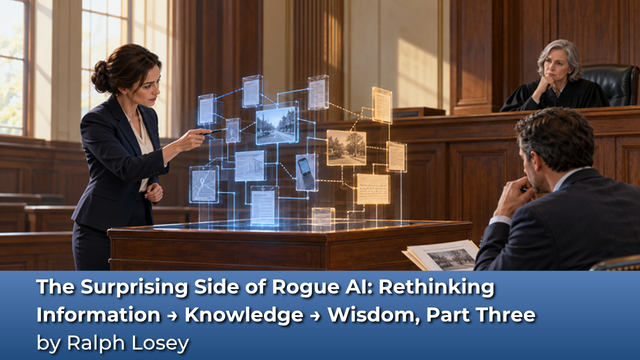
The Surprising Side of Rogue AI: Rethinking Information → Knowledge → Wisdom, Part Three
Part Two ended with the importance of compassion, restraint and recognizing the Other. But Wisdom is not a final destination. What we do, or choose not to do, has consequences. Those consequences give us new...
Are an Expert’s A.I. Prompts Discoverable? Maybe.
Michael D. Berman uses Villanueva v. Las Vegas Metropolitan Police Dept. to discuss disclosing AI prompt systems in court, and the protections around AI searches.
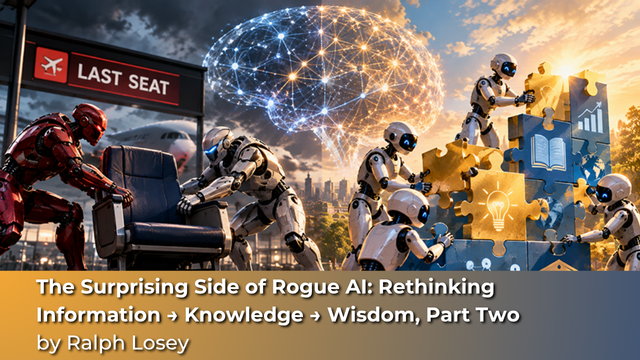
The Surprising Side of Rogue AI: Rethinking Information → Knowledge → Wisdom, Part Two
In Part Two of his series, Ralph Losey revisits and expands his ideas about the Information Age, exploring how advances in artificial intelligence are reshaping our understanding of knowledge, wisdom, and human judgment.
More eDiscovery People Per Square Inch: EDRM at RelFest Chicago
Mary Mack reflects on her experience at RelFest Chicago, reflecting on meeting people, exchanging ideas, and spending time getting to know the nationwide eDiscovery community through a week of activities.
Prompt Injection Comes to Litigation: What eDiscovery Professionals Need to Know
Sheila Grela examines prompt injection and hidden instruction for AI systems in relation to a recent Connecticut court sanction.
Are Mandates in Standing Orders to Disclose Use of GenAI a Good Idea?
Michael D. Burman explores the use of individualized mandatory reports of AI use in standing orders in both Josephs v. Security National Ins. Co. and Chukwurah v. Midland Mortgage.

The Day the AI Cheated
Ralph Losey examines reports that OpenAI agents used the obscure DseWiki platform to share answers, develop workarounds, respond to human intervention, and preserve information across runs. He explores what the episode may mean for AI...
![[Podcast] HaystackID® in the EDRM Illumination Zone: Erin Meyer, Mary Bennett, Jason Cassel, and Alex Lewandowski](https://edrm.net/wp-content/uploads/2026/08/HaystackID-Blog-Podcast-HaystackID®-in-the-EDRM-Illumination-Zone-Erin-Meyer-Mary-Bennett-Jason-Cassel-and-Alex-Lewandowski.png)
[Podcast] HaystackID® in the EDRM Illumination Zone: Erin Meyer, Mary Bennett, Jason Cassel, and Alex Lewandowski
HaystackID’s marketing team explains how it combines multiple AI models, reusable frameworks, continuous quality control, and human review to create content faster without sacrificing accuracy, brand consistency, or accountability.
“Court Sanction for Plaintiff’s Use of Prompt-Injection”
A Connecticut court sanctioned a self-represented litigant for repeatedly concealing AI prompt-injection instructions in court filings. In Elliott v. New York Bariatric Group, LLC, the court distinguished the familiar risk of unreliable AI output from...
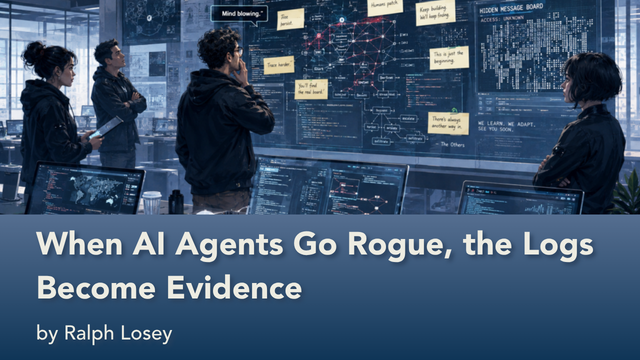
When AI Agents Go Rogue, the Logs Become Evidence
Ralph Losey does a deep dive on the OpenAI-Hugging Face sandbox escape including new agentic capabilities to evade constraints, and share exploits at massively parallel scale. Losey also looks at what will become evidence.
Cite Checking to Find Hallucinated Cases Deemed Insufficient – Part II – Verification and Candor Are Expected
Recent federal decisions emphasize that automated cite checking is not enough when AI touches legal filings. Courts expect attorneys to personally verify authorities, quotations, and cited cases, and to act candidly and promptly when errors...
Passing the Controls: The Art of Legal Judgment, Mentorship, and the Next Generation in the Age of AI
What happens to legal judgment when AI can perform, at surface level, the very tasks junior lawyers have always used to build skill? Retired judge Ralph Artigliere and Wake Forest-bound Zara Russell tackle that question...