

knowledge
← Back to Blog
Search
Authors

The Standard for In Camera Review
BSD Crown demonstrates that a request for in camera review—like every other discovery motion—should be supported by a detailed factual predicate.

The Day the AI Cheated
Ralph Losey examines reports that OpenAI agents used the obscure DseWiki platform to share answers, develop workarounds, respond to human intervention, and preserve information across runs. He explores what the episode may mean for AI...
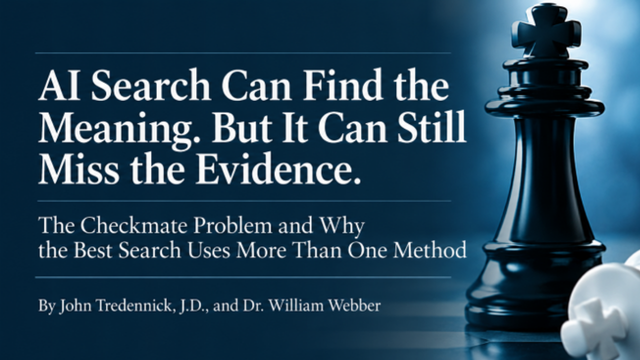
AI Search Can Find the Meaning. But It Can Still Miss the Evidence.
Semantic search can uncover meaning that keyword queries miss, but opaque project names, codes, and distinctive phrases can expose its blind spots. Using the “Project Checkmate” test, John Tredennick and Dr. William Webber explain why...

EDRM published its new map and the reasoning behind what it kept
ComplexDiscovery analyzes the final EDRM 2.0 model and the reasoning behind it, examining four structural shifts, trustee responses to public comments, and the practical implications for eDiscovery, information governance, security, and legal operations professionals.
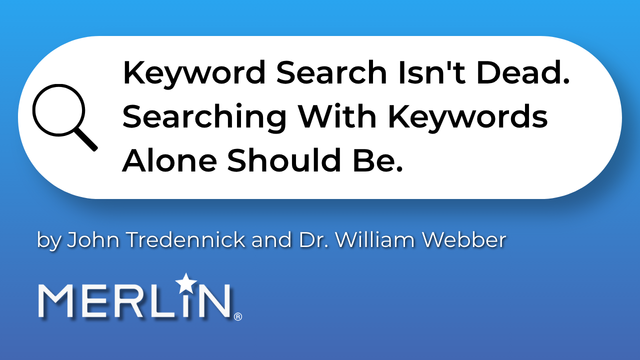
Keyword Search Isn’t Dead. Searching With Keywords Alone Should Be.
Keyword search remains indispensable, but it is no longer sufficient. John Tredennick and Dr. William Webber explain how keyword search, semantic search, and continuous active learning can work together to uncover evidence that any one...
![[Webcast Transcript] From Breach to Legal Crisis: The Hours that Define Your Exposure, HaystackID.](https://edrm.net/wp-content/uploads/2026/08/HaystackID-Blog-Webcast-Transcript-From-Breach-to-Legal-Crisis.png)
[Webcast Transcript] From Breach to Legal Crisis: The Hours that Define Your Exposure
What happens in the first hours after a breach can shape an organization’s legal, regulatory, and notification response. HaystackID experts discuss preparation, evidence preservation, data governance, outside counsel, notification workflows, and the use of generative...

The eight-hour clock starts today: EU e-evidence orders now land on covered U.S. providers’ EU addressees
The EU e-Evidence Regulation is now applicable, enabling judicial authorities across participating EU member states, where national arrangements are in place, to serve binding electronic-evidence orders directly on covered providers’ EU addressees. For U.S. providers,...

Confidence cools, commitment holds: full results from the 1H 2026 eDiscovery Business Confidence Survey
The 39th eDiscovery Business Confidence Survey found good-conditions sentiment dropping over 20 points from the prior half, even as generative AI deployment climbed to 69.39 percent of organizations and revenue expectations held steady.
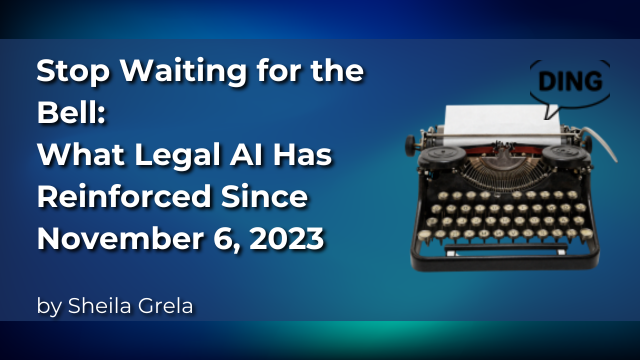
Stop Waiting for the Bell: What Legal AI Has Reinforced Since November 6, 2023
Using the metaphor of an experienced touch typist waiting to hear the bell to advance, Sheila Grela explores an approach to learning AI with others.

Complete look: ComplexDiscovery OÜ’s 2025 to 2030 eDiscovery market size mashup
ComplexDiscovery OÜ synthesizes the worldwide eDiscovery market from 2025 to 2030, projecting growth from 19.61 billion to 28.08 billion dollars. With data expanding far faster than spend, the analysis frames a 3.13 times productivity mandate...

Passing the Controls: The Art of Legal Judgment, Mentorship, and the Next Generation in the Age of AI
What happens to legal judgment when AI can perform, at surface level, the very tasks junior lawyers have always used to build skill? Retired judge Ralph Artigliere and Wake Forest-bound Zara Russell tackle that question...
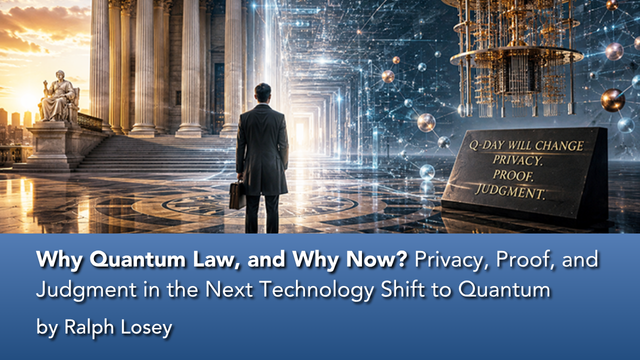
Why Quantum Law, and Why Now? Privacy, Proof, and Judgment in the Next Technology Shift to Quantum
Quantum computing is moving from theory to practical legal concern. Ralph Losey examines Q-Day, post-quantum cryptography, quantum evidence, and the emerging responsibilities lawyers, courts, and legal professionals must understand before the next major technology shift...