

[EDRM Editor’s Note: The opinions and positions are those of the author.]
Years ago, I taught a computer training class for professionals who were moving from typewriters to computers.
They were smart, experienced, and good at their jobs. They understood documents and knew how to produce quality work.
Still, many of them kept stopping and waiting for the same thing.
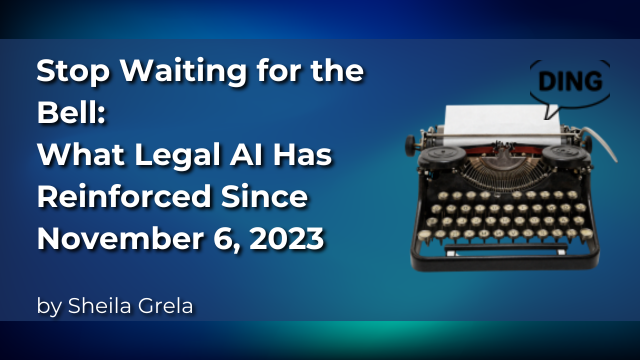
The bell.
On an IBM typewriter, the bell warned the typist that the margin was approaching and it was time to begin a new line. On a computer, the text moved automatically. Even so, many paused and waited for a sound that was never going to come.
The problem was not their ability to learn the technology. The problem was letting go of a habit that had worked for them for years.
Free virtual attendance for Masters AI New York is still available. Registration information can be found here: https://www.accelevents.com/e/masters-ai-x-technocat–new-york/page/ticketing#tickets
Sheila Grela.
Their skills were not holding them back. They simply needed time and practice to adjust to a new way of working.
Many of the secretaries felt uncertain and uncomfortable. They had spent years becoming very good at their work, and suddenly they were being asked to use a tool that felt unfamiliar.
What helped most was seeing that someone else had figured it out.
When one person understood how the new process worked, it gave others confidence to keep trying. They began asking more questions. They helped one another. Little by little, the room became less tense.
That experience stayed with me.
Sometimes people do not need a perfect explanation. They need reassurance that the new tool can be learned and that they do not have to learn it alone.
Eventually, they stopped listening for the bell and trusted the computer. They did not forget what they knew. They learned that an old habit did not always fit a new tool.
Looking back, I realized the lesson was never really about typewriters or computers.
It was about how professionals adapt when the tools around them change.
That lesson feels especially relevant as the legal profession learns to work with artificial intelligence.
What AI Has Reinforced Since November 6, 2023
On November 6, 2023, Law360 published an article1 examining generative AI and its possible effect on the paralegal profession. At the time, I said:
“AI will not be excusing paralegals from the process. Attorneys will not be able to say, ‘I don’t need a paralegal. I can use AI.’”
Since then, I have worked with AI regularly, collaborated with legal professionals across the country, and spent significant time examining how this technology is changing our work.
My conclusion has not changed
What has changed is my understanding of how useful AI can be, how carefully it must be used, and how much it asks us to learn.
AI can summarize documents, organize information, identify patterns, draft content, and accelerate tasks that once required hours of manual effort. Legal professionals should understand where those capabilities provide value and where they do not.
What AI cannot do is assume responsibility for the work.
AI may assist in creating work product, but it cannot exercise professional judgment or accept accountability for the result. Legal professionals must review outputs, verify facts and citations, protect confidential information, follow applicable requirements, and decide whether the final work is accurate and ready to use.
Learning to use AI is not simply a matter of learning a new application. It requires us to examine familiar workflows, evaluate outputs critically, protect confidential information, and recognize where experience and judgment must remain in control.
Responsible use must also comply with professional-conduct rules, court requirements, client obligations, organizational policies, and supervisory procedures. Those requirements may differ by jurisdiction, workplace, client, and matter.
The people who adapt best may not be those who know the most about AI today. They are often the people who remain curious, ask thoughtful questions, verify what they use, and continue learning.
How I Actually Use AI
One practical way I use AI is to review the tone and delivery of emails before I send them.
I may ask whether a message sounds sarcastic, passive-aggressive, overly blunt, or unclear. The goal is not to have AI write the message for me. The goal is to make sure the message communicates what I intend and will be received the way I intend.
That has been especially useful when a message involves a difficult issue or needs to be direct.
AI helps me pause and consider how my words might be interpreted by someone else. I still decide what to say, but the review helps me communicate more clearly and thoughtfully.
Sheila Grela.
AI helps me pause and consider how my words might be interpreted by someone else. I still decide what to say, but the review helps me communicate more clearly and thoughtfully.
I also use AI to review my own work product. After preparing a memorandum, chronology, timeline, spreadsheet, or case summary, I may ask AI to evaluate the work from a different perspective.
For example, I might ask:
- Is the information presented in a logical and understandable order?
- Are the key issues easy to identify?
- Are there gaps in the reasoning or facts that require additional support?
- Does the analysis address the question asked?
- Is the explanation concise, or does it provide more detail than necessary?
- Is the tone and level of detail appropriate for the intended audience?
One of the habits I am actively trying to break is providing more detail than is necessary. I enjoy sharing information, but too much detail can become a time sink and make communication less effective. Sometimes the better approach is to say what needs to be said and stop there.
For internal work product, I may ask AI to identify outstanding issues and create a preliminary to-do list of items that should be investigated, verified, or addressed before the project moves forward.
For client-facing memoranda, I may ask AI to generate a “please provide” list identifying information, documents, or facts that may be needed to strengthen the analysis or complete the record.
For client-facing memoranda, I may ask AI to generate a “please provide” list identifying information, documents, or facts that may be needed to strengthen the analysis or complete the record.
Sheila Grela.
I may also ask AI to identify statements that could be interpreted as personal opinion, unsupported conclusions, advocacy, legal advice, or other content that requires additional review or modification before the document is shared.
The goal is not to delegate professional judgment. It is to use AI as another review tool that can flag areas requiring closer attention.
Its observations are not always correct and should never be accepted without verification. The value lies in challenging my own work, testing assumptions, and seeing a document through a different lens before it is finalized. Sometimes the process confirms that the analysis is sound. Other times it reveals a question I had not considered.
That process reinforces something I have learned throughout my career: accuracy matters, but so do clarity, organization, completeness, and understanding how a document will be received by its intended audience.
When using AI, I rely only on authorized tools and follow applicable policies concerning confidential, privileged, personal, and client-identifying information.
Protected information should not be entered into an AI system unless the tool and intended use have been properly reviewed and authorized.
Not every tool is appropriate for every task. Responsible use requires understanding what a system is designed to do, what information it can safely handle, and what level of human review its output requires.
Curiosity is important, but so is caution. The two can and should exist together.
Throughout my career, I have learned that one of the most valuable things a paralegal brings to a legal team is not simply the ability to find information. It is the ability to understand what the information means.
- We identify gaps and recognize when a timeline does not make sense.
- We notice when an important witness’ statement is missing from the file.
- We understand that sometimes the most significant document is the one that should be there but is not.
AI can help us work with information.
Experienced legal professionals must still decide what matters, what is missing, and what requires a closer look.
What Is Your Hard Return?
The bell was the warning. The hard return was the response.
I introduced the concept of a hard return during my Masters AI presentation.
I use the term as a metaphor for the moment when the approach that helped us succeed in the past is no longer enough for the challenges ahead.
It does not mean our experience has lost value. It means we may need to apply that experience differently.
Every profession reaches that point eventually. The tools change, expectations evolve, and familiar methods become less effective than they once were. The professionals who adapt are rarely the ones who abandon what they know. They are the ones who build on it.
For many legal professionals, AI may be that hard return.
Whether we embrace it or avoid it, AI is already influencing the way legal work is being performed. The question is no longer whether change is happening. The question is how we choose to respond to it.
- Will we stay curious enough to practice, make mistakes, and keep learning?
- Will we apply the same judgment and professionalism that have always guided our work?
- Will we remain accountable for the results?
Those questions matter far more than how much anyone knows about AI today.
A Mindset for Moving Forward
Whenever people ask me how to prepare for AI, I find myself giving the same answer.
Start with the mindset, because the technology will continue to change.
The framework I use is simple:
- Stay curious and learn continually.
- Evaluate authorized tools safely and within established policies.
- Invest in judgment, communication, and other skills that outlast technological change.
- Adapt with confidence and help others learn.
None of those principles begins with technology. They begin with people.
Tools will continue to change. New applications will appear. Platforms will evolve. What remains valuable are the human skills that allow us to evaluate information, communicate effectively, solve problems, lead others, and exercise sound judgment.
A growth mindset helps us treat experience as a foundation for learning rather than a reason to resist change.
It also helps us recognize that confidence comes from practice.
Carrying the Masters AI Los Angeles Conversation to New York
My experience at Masters AI Los Angeles reinforced something I have seen throughout my career: people learn faster when they learn together.
The most valuable conversations focused on practical experience—the tools participants were testing, the risks they were evaluating, and the lessons they were learning. Like the professionals in my computer class, people gained confidence when they saw that others were working through the same uncertainty.
No one assumed they already knew enough. Technologists, attorneys, paralegals, consultants, and business leaders all recognized that AI is evolving too quickly for learning to stop.
That is what I hope to carry from Los Angeles to Masters AI New York: candid conversations that challenge assumptions and turn uncertainty into practical knowledge we can bring back to our teams.
Most important, these events remind us that learning does not have to happen in isolation.
Free virtual attendance for Masters AI New York is still available. Registration information can be found here: https://www.accelevents.com/e/masters-ai-x-technocat–new-york/page/ticketing#tickets
Moving Forward
Looking back, the most important question was never whether AI would replace paralegals. It was whether we would be willing to grow alongside the work itself.
The legal profession has adapted to computers, databases, electronic discovery, and other technologies that changed how legal services are delivered. Each shift required new skills, new habits, and a willingness to learn. AI is another such shift.
The same framework still applies: stay curious, use authorized tools responsibly, invest in durable human skills, and help others learn.
In my experience, AI has not diminished the value of legal professionals. It has highlighted the importance of qualities technology cannot replicate: judgment, discernment, adaptability, integrity, and accountability.
AI can help us work more efficiently, surface information more quickly, and approach tasks differently. It cannot take responsibility for the result.
Every legal professional will encounter a hard return at some point in their career. We cannot avoid those moments, but we can decide how we respond to them.
The professionals in that computer training class eventually stopped waiting for the bell because they realized they were capable of learning something new. Their experience did not become less valuable. It became the foundation on which they built new skills.
I believe the same is true for us.
AI will continue to evolve. New tools will emerge. New challenges will follow. Yet the qualities that define exceptional legal professionals—curiosity, judgment, adaptability, integrity, and accountability—will remain as important as ever.
The future does not belong to those who know everything. It belongs to those who remain willing to learn.
So when your hard return arrives, do not ask whether you are ready to know everything about what comes next.
Ask whether you are willing to keep growing.
If the answer is yes, you are already moving forward.
Note
- Law360, “How Generative AI Could Affect the Paralegal Profession,” November 6, 2023. https://www.law360.com/pulse/articles/1738467 determines whether it stands up when it matters. ↩︎
Assisted by GAI and LLM Technologies per EDRM’s GAI and LLM Policy.