
[EDRM Editor’s Note: EDRM is proud to publish Ralph Losey’s advocacy and analysis. Images in the article were created by Ralph Losey using AI. Originally published on EDRM.net.]
Most legal technology shifts do not announce themselves with trumpets. They slip into ordinary practice first. Email was once informal chatter, then became the core of discovery. Predictive coding was once treated as radical, then became accepted. Generative AI was once a toy for clever prompts, then became a sanctions risk, a productivity tool, and an ethics problem all at once.
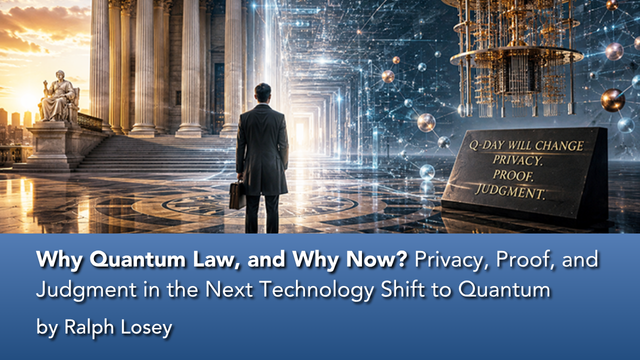
Quantum computing may follow the same pattern, but it could also arrive with a loud bang and deeper consequences. The timing is uncertain. Some forecasts are aggressive; others stretch out for many years. But when cryptographically relevant quantum computing arrives, the legal effects will be hard to ignore. It will affect how long secrets stay secret, how courts evaluate machine-generated proof, and how lawyers exercise judgment when powerful systems produce answers no ordinary computer can easily check. That is why quantum law deserves attention now, before the first crisis forces good lawyers to fumble, struggle, and learn in public.
Q-Day, Quantum Proof, and the Legal Terrain Ahead
This article is a clarion call and first outline of the terrain ahead. It is designed for everyone who deals with confidential data, evidence, or dispute resolution. Quantum computers law will arrive through inventions built by corporate, university, and government teams of engineers and scientists, increasingly assisted by powerful AI systems. Some forecast its arrival next year; others stretch it out for many years.
We may not know the date when the quantum computer future becomes practical, but we do know that it arrival could prove to be very disruptive. Some semi-quantum segments have already begun to seep into legal practice through vendors, simulations, and hybrid AI systems. Full quantum computing may arrive suddenly, especially if cryptographically relevant quantum computing makes old encryption vulnerable. The legal risk does not depend on guessing the exact date. It depends on whether lawyers understand the terrain before clients, courts, and vendors begin asking questions they are not prepared to answer.
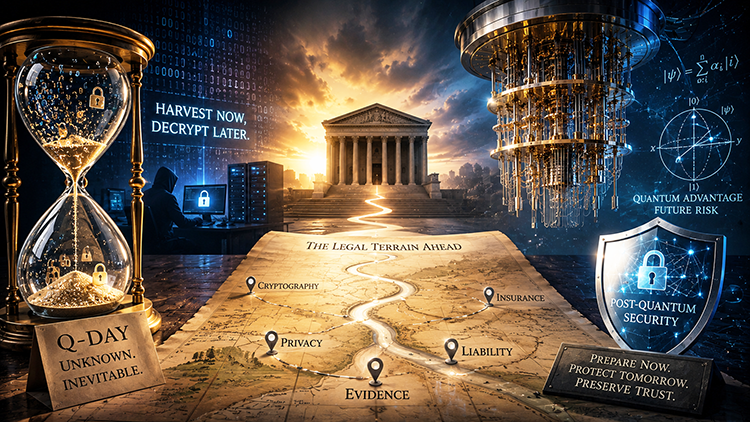
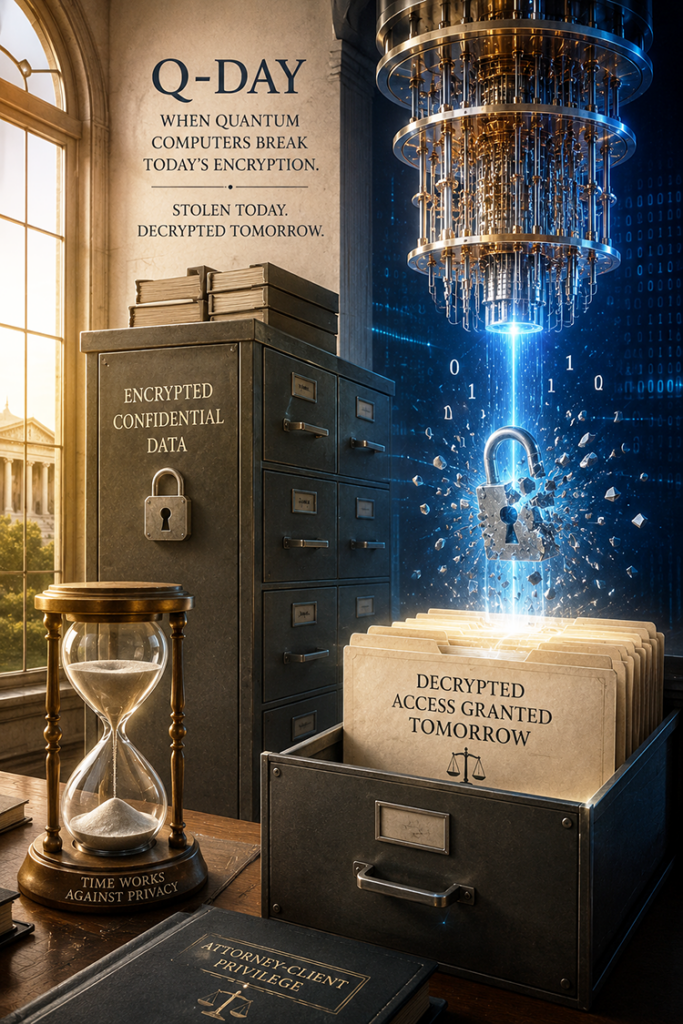
The best-known danger has a name: Q-Day. That is the day when a sufficiently powerful quantum computer is built that can break most of the public-key encryption now used to protect digital information. No one knows when Q-Day will arrive, but the danger begins before that day because encrypted data can be stolen now and stored for later. We know that is already happening. If the data is still valuable when quantum decryption becomes practical, today’s secure archive will become tomorrow’s open file cabinet. That is the “harvest now, decrypt later” problem, and it gives confidentiality an expiration-date problem lawyers cannot ignore. See NIST, What Is Post-Quantum Cryptography? and the companion paper, Post-Quantum Cryptography.
If the data is still valuable when quantum decryption becomes practical, today’s secure archive will become tomorrow’s open file cabinet.
Ralph Losey, CEO, Losey AI, LLC.
Q-Day is only part of the challenge. Quantum computing may also reshape how courts apply evidentiary standards and evaluate reliability, while creating new questions involving cryptography, privacy, liability, and insurance. See RAND, The Quantum Age and Its Impacts on the Civil Justice System (4/29/25).
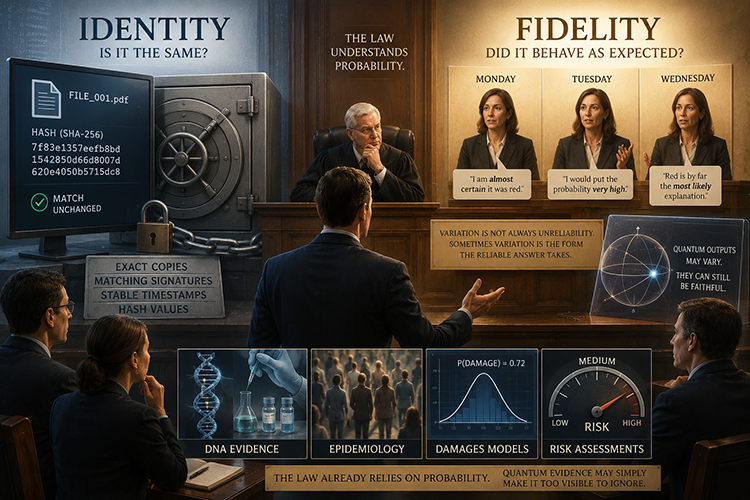
One of the most important evidentiary shifts may be from Identity to Fidelity. Lawyers are accustomed to machines that produce the same answer every time. That is identity. Quantum systems may force courts to ask a different question: whether the process behaves faithfully within known error limits. That is fidelity. The issue will not be whether every run produces the same output, but whether the pattern of outputs can be explained, tested, and trusted.
That shift will force lawyers to ask practical questions. What was the model asked to do? What assumptions went in? What error rate is known? What was excluded? Can another qualified team test the process well enough to trust it?
This article only traces the outline of how law can prepare now, before Q-Day, and later, when quantum-generated evidence begins appearing in disputes. A fuller map is needed, and I have been working hard on that, but the first step is seeing the terrain.
Quantum Was Already Here, Just Quietly
Many lawyers hear “quantum” and think of science fiction and multiverses. That reaction is understandable. Quantum mechanics is strange, and lawyers are trained to distrust strange things unless they come with affidavits, exhibits, and a billing code.
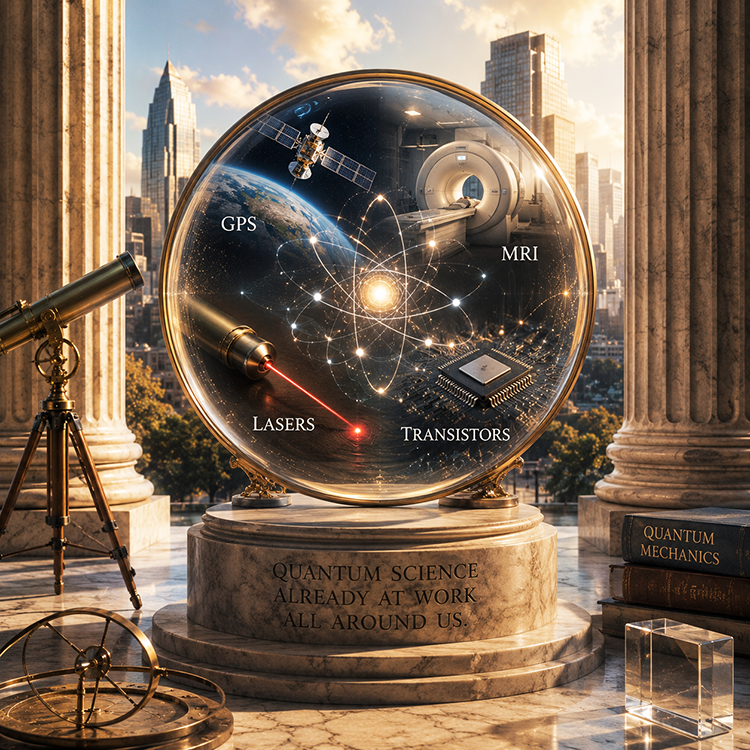
In fact, quantum technology is not new. NIST’s Andrew Wilson explains that GPS, MRI machines, and laser pointers all depend on quantum science. From GPS to Laser Pointers, Quantum Science Is All Around Us. NIST’s Corey Stambaugh makes the same point in still broader terms. A Quantum Leap Forward: How Tiny Particles Can Bring Us Exciting New Tech.
Quantum computing is different because it uses quantum behavior to process information itself. NIST’s Quantum Computing Explained. The article is a useful starting point for lawyers because it explains the basic difference between classical computer bits and quantum bits, Qubits. The legal point is not the math or entangled superpositions. The point is that a different way of processing information will create new and different legal problems.
Q-Day and the Old File Cabinet Problem
The most immediate legal problem is confidentiality. Imagine a law firm with an old litigation archive from a trade-secret case. The case settled years ago. The files are encrypted and stored in the cloud. The client has moved on. The lawyers have moved on. The archive sits quietly in a digital file cabinet, full of secrets everyone assumes are still safe.
Now ask how long those secrets must remain secret. Some secrets age out quickly. Others remain valuable long after the case is closed.
The legal danger begins before Q-Day because encrypted data can be stolen now and stored for later. The thief does not need to open the cabinet today. He only needs to steal it and wait. Q-Day is not just a future cybersecurity event. It is a present-day confidentiality problem for anyone holding secrets that must remain secret for years. See NIST, What Is Post-Quantum Cryptography? The unpleasant feature of this risk is that it may mature suddenly. A file that was unreadable yesterday may become readable tomorrow if the lock protecting it was built on vulnerable cryptography.
Q-Day is not just a future cybersecurity event. It is a present-day confidentiality problem for anyone holding secrets that must remain secret for years.
Ralph Losey, CEO, Losey AI, LLC.
Password protection is not encryption. A password controls access; encryption protects the contents. Q-Day is not a faster way to guess your great password. The risk pertains to the mathematics behind vulnerable public-key encryption. So, when a vendor responds to quantum-readiness questions by talking only about strong passwords, multi-factor authentication, or access controls, the vendor has not answered the real question. Ask what cryptography protects the data, who controls the keys, and whether there is a post-quantum migration plan.
NIST has already finalized its first three post-quantum cryptography standards to try to protect against this vulnerability: FIPS 203, FIPS 204, and FIPS 205. See NIST, Post-Quantum Cryptography FIPS Approved. See also Federal Register, Announcing Issuance of Federal Information Processing Standards FIPS 203, FIPS 204, and FIPS 205. For lawyers, the lesson is not to become cryptographers but to learn some of the basics, and to recognize that cryptographic migration has already moved from theory to standards.
The National Security Shadow of Q-Day
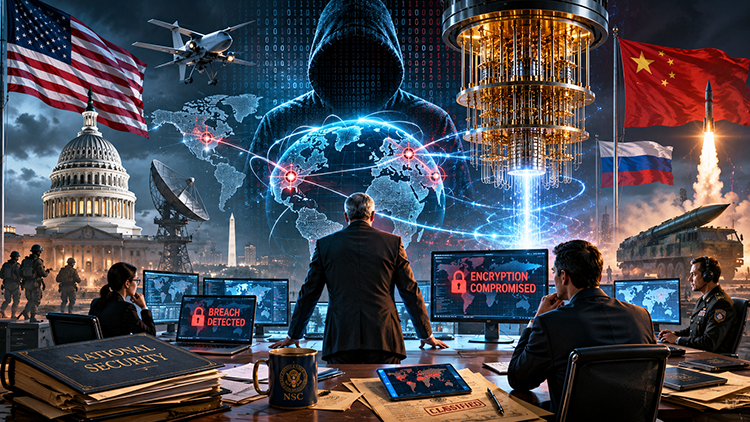
The deepest Q-Day risk is not merely that old legal files with client secrets become readable. That is bad enough. The larger danger is strategic. If the first cryptographically relevant quantum breakthrough is achieved secretly by a hostile government, the result could be more than a cybersecurity incident. It could be a shift in military, intelligence, diplomatic, and economic power.
A state actor that can read previously secure communications may not announce the achievement. It may watch, wait, and exploit. It may use old, intercepted traffic to identify sources, compromise negotiations, expose military plans, manipulate markets, pressure companies, or weaken alliances. The first signs may not look like a quantum breakthrough at all. They may look like inexplicable intelligence failures, severe infrastructure disruptions, mass persuasion and social manipulation, followed by financial collapse and social unrest.
That is the nightmare scenario. Not a quantum computer on stage at a press conference, but a quiet advantage used in secret by an unscrupulous power. The problem is not limited to adversaries. If any military-intelligence system reached Q-Day first, the pressure to use that advantage would be immense. History teaches that strategic breakthroughs become instruments of state power long before civilian institutions understand them.
History teaches that strategic breakthroughs become instruments of state power long before civilian institutions understand them.
Ralph Losey, CEO, Losey AI, LLC.
Do not think this will be like the mirage of Y2K. Although Q-Day has no known date, it is very real, may arrive in secret, and threatens power rather than malfunction.
Ben Buchanan and Andrew Imbrie’s important book, The New Fire: War, Peace, and Democracy in the Age of AI, is not a quantum book, but its warnings about advanced technology and state power apply here. Powerful computational tools can support science, medicine, and prosperity, but they can also intensify conflict, surveillance, and authoritarian control. The potential of quantum computing to vastly enhance mass surveillance and authoritarian control is especially worrisome. See my article, Escaping Orwell’s Memory Hole: Why Digital Truth Should Outlast Big Brother (March 2025), which may prove to be over optimistic.
That is also why the CISA, NSA, and NIST have all urged organizations, especially those supporting critical infrastructure, to begin quantum-readiness planning now. See CISA, NSA, and NIST, Quantum-Readiness: Migration to Post-Quantum Cryptography. The advice is not theatrical. It is a practical checklist we should all follow, now, to begin preparations: (1) identify long-lived sensitive data; (2) build migration plans; and (3) ask vendors what they are doing. Waiting for proof that Q-Day has arrived may mean waiting too long.
The best hope is that quantum breakthroughs occur in the open, with enough time for post-quantum defenses to be deployed across governments, courts, companies, and critical infrastructure. History offers little assurance that transformative strategic technologies will be introduced so politely.
A private company or university team might provide that warning if it reaches the threshold first and resists premature militarization. But even that hope is fragile. Once a technology can alter the balance of power, governments may smash through laboratory doors.
That is why quantum law is not just about future expert testimony or old encrypted archives. It is also about governance, secrecy, democracy, and stability in a world where computation is already a weapon of state power. Q-Day will make that weapon far more dangerous.
The Civil Justice System Is Already on Notice
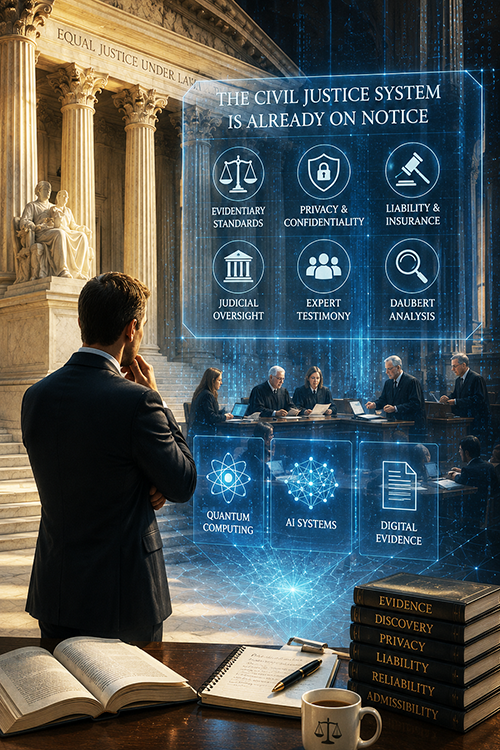
RAND has already examined the civil justice consequences of quantum computing, at least in a cursory way. Its 2025 report looks at what quantum computing may mean for courts, law firms, insurers, regulators, and related institutions. RAND, The Quantum Age and Its Impacts on the Civil Justice System. RAND is not selling magic crystals. It is telling the legal system to pay attention before the problems arrive fully formed.
The legal profession has been late before. It was late with email. It was late with e-discovery. It was late with cybersecurity. It is still catching up to generative AI. In Da Silva Moore v. Publicis Groupe, Judge Andrew Peck’s opinion became an early milestone in judicial acceptance of predictive coding in discovery. I served as lead technology counsel in that case, and the resistance to predictive coding was intense, to put it mildly.
Most lawyers in 2011-2012 treated machine learning in document review as dangerous speculation. Nearly all of the legal profession was in denial. If they heard the clarion calls of machine learning, they did not believe it. Cynics point out they had strong billable hour incentives not to. Today, fifteen years later, technology-assisted review is ordinary. Almost no one manually reviews a hundred thousand documents these days, much less a million.
Quantum law may follow that same pattern in some areas, but not all. Some quantum issues may arrive gradually through vendors, expert systems, and hybrid AI tools. Q-Day may not. If the first breakthrough occurs inside a military or intelligence program, the legal profession may receive no clear warning at all. We may instead see the consequences unfold in apoplectic scenarios that are hard to imagine without grounding in AI and quantum computer capabilities.
That is one reason we must skip the denial phase that happened with AI predictive coding in 2011. The stakes are much higher now. Common sense and professional ethics require it. ABA Model Rule 1.1, Comment 8 states that lawyers should keep abreast of changes in law and practice, including the benefits and risks of relevant technology. See ABA, Rule 1.1 Competence – Comment. The ABA made a similar move for generative AI in Formal Opinion 512. See ABA, Formal Opinion 512 on Generative Artificial Intelligence Tools.
Quantum computing will require the same kind of professional adjustment: familiar duties applied to new facts. That is not a call for panic. It is call for competent tracking of emerging technologies, especially in computing. Be prepared.
When Quantum Evidence Walks Into Court
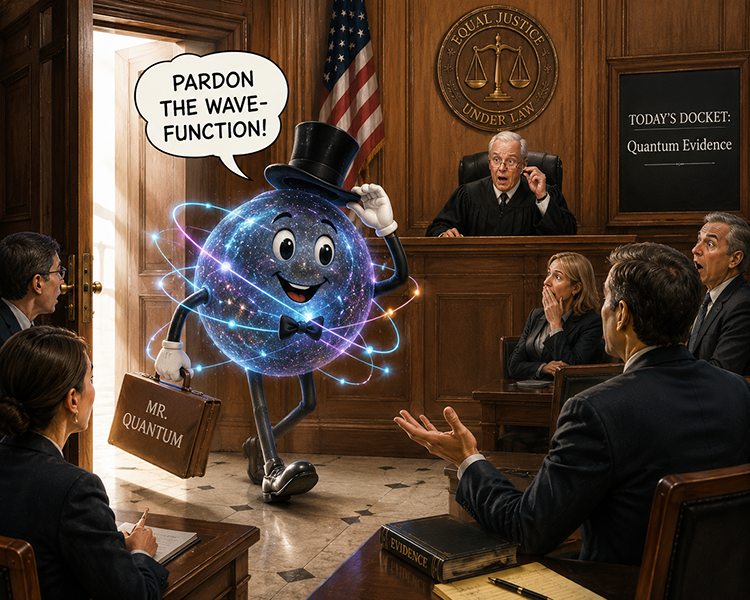
Encryption is the first practical problem. Evidence is the second. Strictly speaking, a quantum computer will not “testify” because witnesses are people, at least so far. But quantum systems may generate outputs that parties will want to use as proof. A manufacturer may use a simulation to test a material under stress. A pharmaceutical company may use a quantum method to model a molecule. A financial institution may use a hybrid quantum-classical process to test risk under market conditions.
Consider a product liability case involving a battery fire in an electric vehicle. The company’s emails show engineers debating heat risks. The testing logs are incomplete. One side says the risk was known and ignored. The other side says the accident resulted from misuse or unusual conditions. Then an expert offers a simulation of the battery chemistry under conditions close to the fire. The simulation does not produce one answer. It produces a pattern of outcomes.
That pattern may be powerful evidence, but it also creates practical courtroom questions. What inputs were used? Who selected them? What assumptions were built into the model? Were any runs excluded? Could another qualified team reproduce the distribution, even if not every individual result? How does the expert explain the error rate to a judge who has a docket full of ordinary human disputes waiting outside the door? This is just a rough outline of the new types of legal questions and analysis you will need for the future quantum.
Federal Rule of Evidence 702 should work fairly well for this kind of work, even if quantum evidence will stretch it. The rule requires expert testimony to rest on sufficient facts or data, reliable principles and methods, and reliable application to the case. See Federal Rule of Evidence 702. Rule 901 also matters because Rule 901(b)(9) addresses evidence about a process or system that produces a result. See Federal Rule of Evidence 901. Also see Daubert directs courts to consider factors such as testing, peer review, error rate, standards, and general acceptance. These factors will remain critical.
Identity Versus Fidelity
Lawyers like identity. We like exact copies, matching signatures, stable timestamps, and hash values that confirm a file has not changed. That instinct served us well in e-discovery. A hash value is a beautiful thing. It uses straightforward mathematical analysis to show whether the file is the same. The same values appear each time the hash analysis of the document is run.
Quantum systems often require a different instinct. The key question may not be whether the machine gives the identical output every time. The question may be whether it behaves with fidelity. Identity asks whether we got the same answer again. Fidelity asks whether the system behaved as expected, within known error limits.
A courtroom analogy helps. Suppose a careful witness is asked three times whether the traffic light was red. On Monday she says she is almost certain it was red. On Tuesday she says she would put the probability very high. On Wednesday she says red is by far the most likely explanation. A cross-examiner hears only contradiction. A better lawyer hears the same judgment expressed in different language.
Quantum outputs can work in a similar way. Variation is not always unreliability. Sometimes variation is the form the reliable answer takes. Law already understands this better than it admits. DNA evidence, sampling, epidemiology, damages models, and risk assessments all rely on probability. We go into this is detail in the course using both published cases and hypotheticals. Quantum evidence will make probability too visible to ignore. It will add a new dimension to the core legal concept of causation.
From Documents to Models
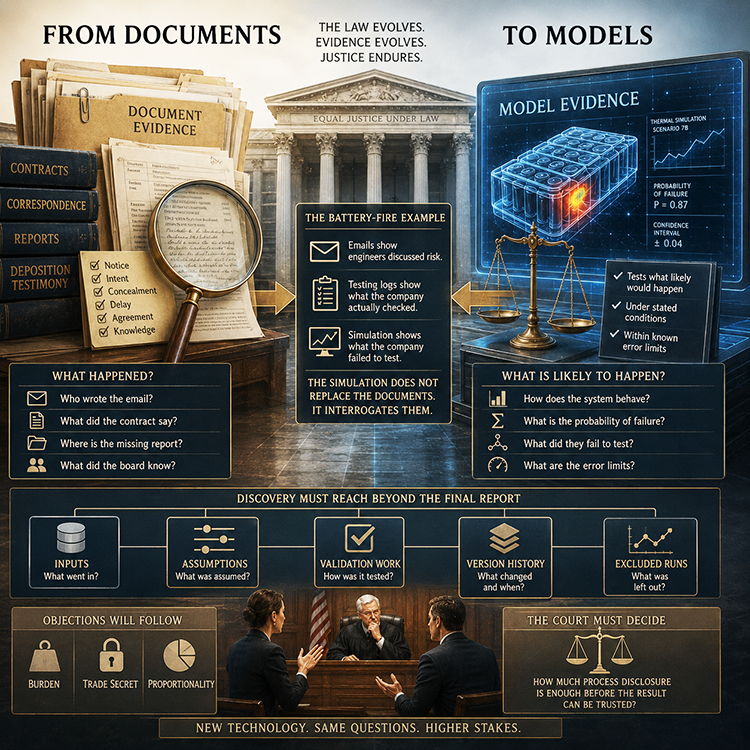
For most of legal history, lawyers have been document hunters. Who wrote the email? What did the contract say? Where is the missing report? What did the board know? That world is not disappearing. Documents still show notice, intent, concealment, delay, agreement, and knowledge.
But AI and quantum systems push law toward model evidence. A model does not merely record what happened. It tests what likely would happen under stated conditions. Return to the battery-fire example. The emails may show that engineers discussed risk. The testing logs may show what the company actually checked. The simulation may show what the company failed to test.
The simulation does not replace the documents. It interrogates them. That is the practical shift from document-centric law to model-centric law. A discovery request may need more than the final report. It may need the inputs, assumptions, validation work, version history, and excluded runs. The producing party will raise burden, trade secret, and proportionality objections. The court will have to decide how much process disclosure is enough.
This is familiar territory in new clothing. We fought similar battles over metadata, native files, search terms, sampling, and predictive coding protocols. Quantum evidence will bring another version of the same fight: how much of the machine’s process must be disclosed before the result can be trusted?
AI May Speed the Quantum Timeline
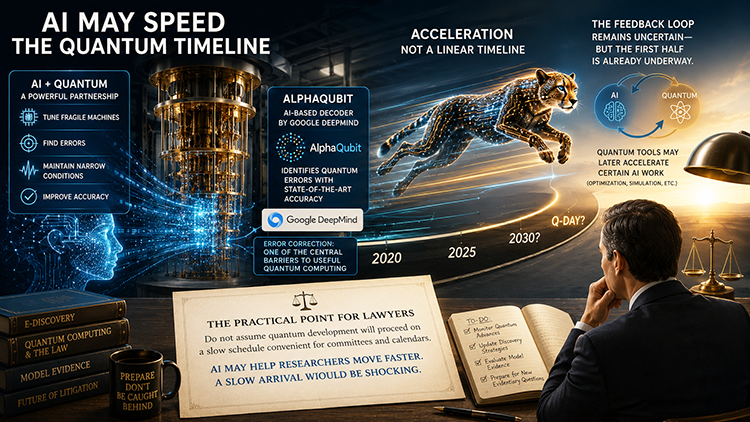
Lawyers are still adjusting to generative AI, but AI is already part of the quantum story. A 2025 Nature Communications review explains that AI is increasingly being used to help with quantum systems. In plain English, AI can help tune fragile machines, find errors, and keep quantum hardware closer to the narrow conditions required for useful work. See Artificial Intelligence for Quantum Computing, (Nature Communications, 12/02/25).
Google DeepMind’s AlphaQubit is one concrete example of AI-enhanced software. It identifies quantum-computing errors with greatly improved accuracy. Error correction is one of the central barriers to making quantum computers useful at scale. See AlphaQubit tackles one of quantum computing’s biggest challenges (11/20/24).
The practical point for lawyers is modest but important. Do not assume quantum development will proceed on a slow schedule convenient for law firm committees. AI may help researchers move faster. Quantum tools may later assist certain kinds of AI work, especially where optimization or simulation is the bottleneck. The feedback loop remains uncertain, but the first half of AI helping quantum is already underway. That matters because lawyers should not assume that quantum progress will move on a slow, linear timetable convenient for bar committees, vendor reviews, and CLE calendars. To me, a slow arrival would be shocking. I have seen an increased in the pace of change of technology my whole life. I see no reason this will not continue. The quantum floor is not a barrier; it is an opening.
Willow, Quantum Echoes, and the Word Lawyers Should Notice
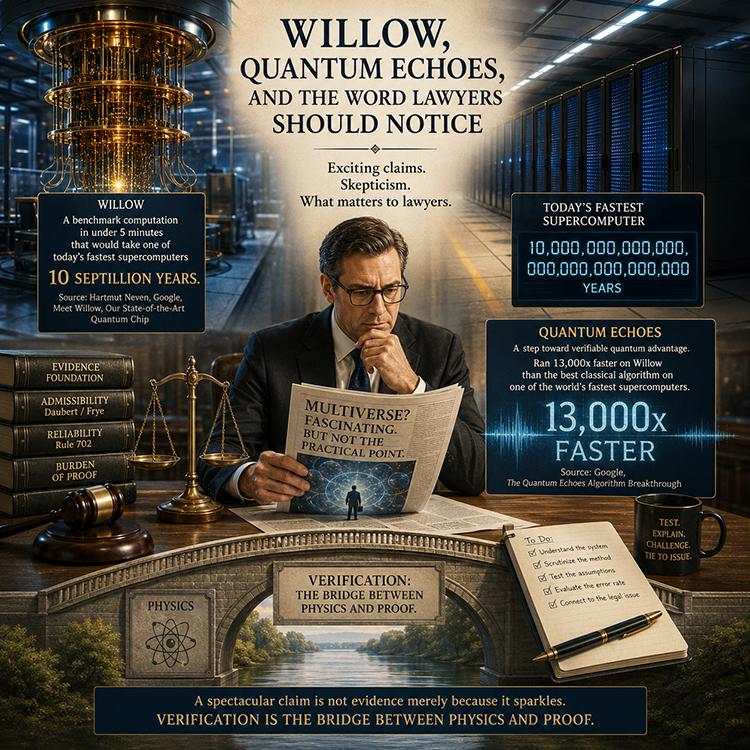
Google’s announcement in late 2024 of results achieved by its quantum computer, Willow, captured public attention. Willow performed a benchmark computation in under five minutes that would take our fastest AI supercomputers 10 septillion years. See Hartmut Neven, Google, Meet Willow, Our State-of-the-Art Quantum Chip. That claim naturally led to excitement, skepticism, and multiverse speculation. Quantum Leap: Google Claims Its New Quantum Computer Provides Evidence That We Live In A Multiverse (01/09/25, my all-time most read JD Supra article).
The multiverse is fascinating, but lawyers can leave it aside for practical purposes. The more important legal lesson comes from Google’s subsequent work on AI improved software, Quantum Echoes. In late 2025 Google described its new Quantum Echoes software as a step toward verifiable quantum advantage. The algorithm supposedly ran 13,000 times faster on Willow than the fastest supercomputers. See Google, The Quantum Echoes Algorithm Breakthrough (10/22/25).
The word that should matter most to lawyers is not “faster.” It is “verifiable.”
Ralph Losey, CEO, Losey AI, LLC.
The word that should matter most to lawyers is not “faster.” It is “verifiable.” A spectacular claim is not evidence merely because it sparkles. A courtroom claim must be tested, explained, challenged, and tied to the legal issue. Verification is the bridge between physics and proof.
What Lawyers Should Do Now
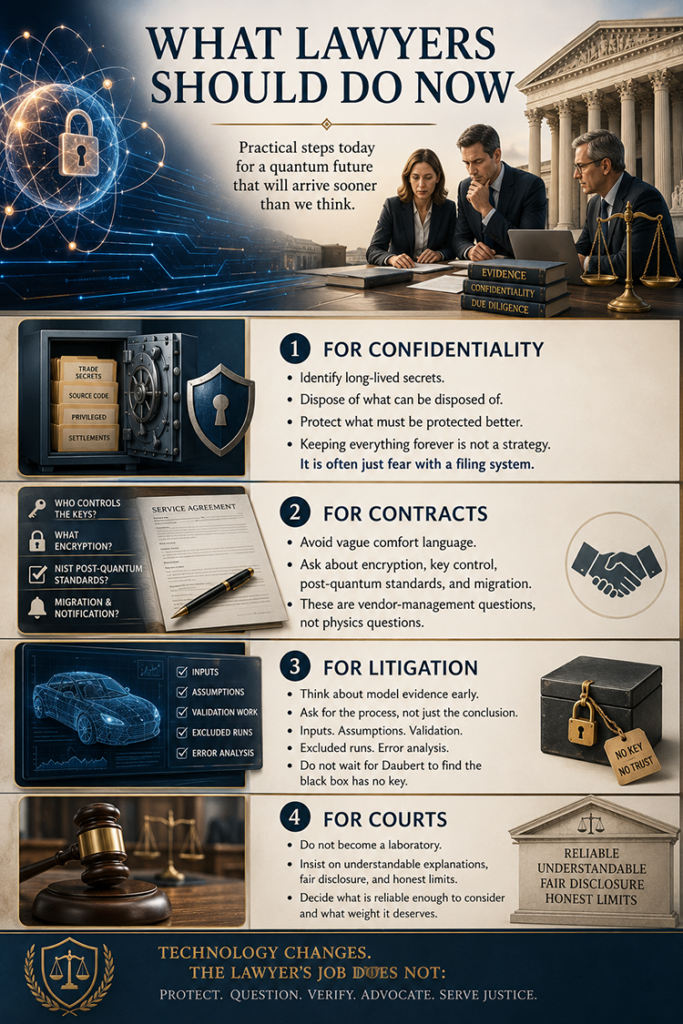
The first step is to stop treating quantum as trivia. You do not need to understand the math to recognize where it may matter. If a client has long-lived secrets, ask whether quantum risk belongs in the confidentiality analysis. If a vendor holds sensitive data, ask about cryptographic migration. If an expert relies on a simulation, ask for process evidence, not just conclusions.
For contracts, avoid vague comfort language. A clause promising “commercially reasonable security” may not tell you enough. Ask who controls the keys, what encryption is used, whether the vendor tracks NIST post-quantum standards, and how the vendor will notify customers when migration affects stored data. These are not physics questions. They are vendor-management questions. The time to learn this is now.
For litigation, start thinking about model evidence. When an expert relies on a simulation, ask for inputs, assumptions, validation work, excluded runs, and error analysis. Do not wait until the Daubert hearing to discover that the “black box” is really a locked box and nobody brought the key.
For courts, the task is not to become a laboratory. It is to insist on understandable explanations, fair disclosure, and honest limits. The judge’s job remains what it has always been: decide what is reliable enough to consider and what weight it deserves.
Learn the Terrain Before the Emergency
Quantum computing will not eliminate legal judgment. It will make judgment more important. Some quantum issues may arrive quietly, hidden inside vendor tools, expert simulations, cybersecurity updates, and hybrid AI systems. Others may not arrive quietly at all. If Q-Day comes through a breakthrough in fault-tolerant quantum computing, the legal profession may not get a polite warning, a fixed deadline, or a long runway. It may come instead as a very rude awakening. Will you be prepared to answer the client calls?
Quantum computing will not eliminate legal judgment. It will make judgment more important.
Ralph Losey, CEO, Losey AI, LLC.
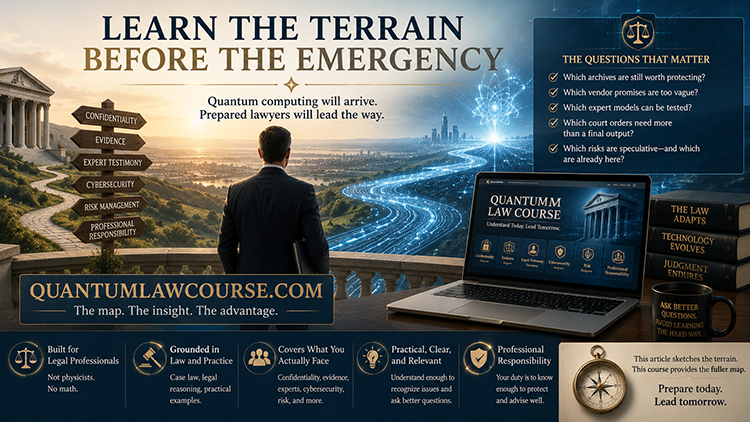
Lawyers do not need to predict the exact date. They need to understand the questions that date will create, what the contours of the emergencies will be. Which old archives are worth protecting? Which vendor promises are too vague? Which expert models can be tested? Which court orders should require more than a final output? Which risks are speculative, and which are already present because data can be harvested now and decrypted later?
Those are not physics questions. They are legal judgment questions. The lawyer’s task is not to master the machinery, but to know enough to question the machinery, the vendor, the expert, and sometimes the client’s own assumptions. That is familiar work. The tools are new, but the professional responsibility is not.
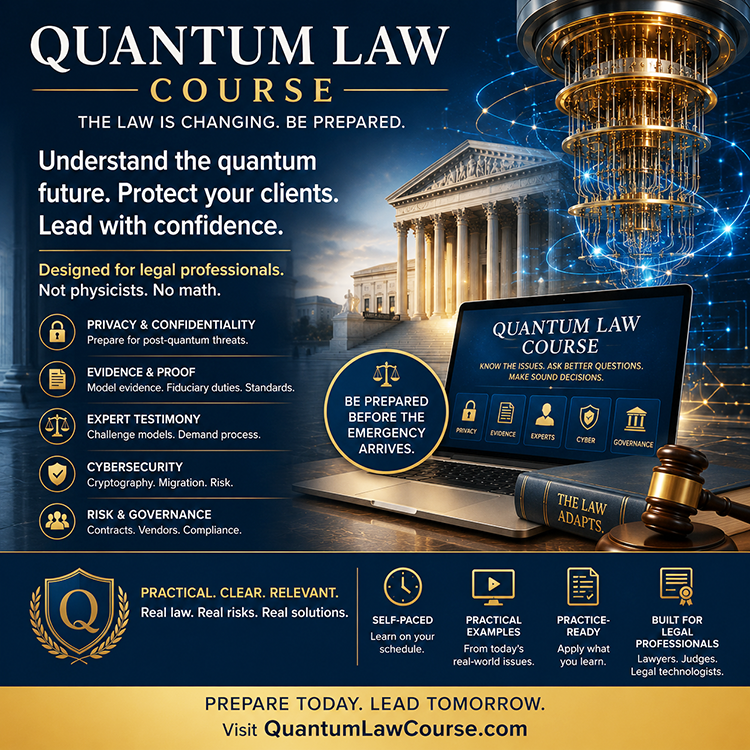
That is why I created the online QuantumLawCourse.com.
The course is designed for legal professionals, not physicists. No math. Instead, it uses case law, legal reasoning, practical examples, and the kinds of concerns lawyers, legal tech professionals, and judges face every day. It focuses on confidentiality, evidence, expert testimony, cybersecurity, risk, and professional responsibility.
The goal is not to make you a quantum expert. It is to help you become an informed legal professional who understands enough to recognize the issues, ask better questions, and avoid learning the hard way when quantum law arrives in your own practice. This article only sketches the terrain. The course provides a full map.
Conclusion
The law has always had to judge under uncertainty. Quantum computing does not change that responsibility. It makes the uncertainty harder to ignore. Machines may calculate. Experts may explain. AI may help interpret. Vendors may package the result in polished dashboards. But courts, lawyers, regulators, and clients will still need reasons, evidence, standards, accountability, and courage.
Privacy, proof, and judgment are not abstract concerns. They are the daily work of the legal profession. Quantum computing may affect all three, sometimes gradually and perhaps someday, quite suddenly. Waiting until the emergency arrives is the surest way to fumble, struggle, and learn in public.
Consider taking the Quantum Law Course now, while the field is still emerging and there is time to prepare. The best time to learn a new legal technology is before it appears in your next emergency motion, vendor presentation, expert challenge, or board-level crisis.
Quantum law is coming. Lawyers who understand the terrain early will be better prepared to protect clients, question experts, contest false claims, and help courts make sound decisions.
Ralph Losey Copyright 2026. All Rights Reserved.
Assisted by GAI and LLM Technologies per EDRM’s GAI and LLM Policy.