

[EDRM Editor’s Note: EDRM is proud to publish the advocacy and analysis of the Hon. Ralph Artigliere (ret.). The opinions and positions expressed are their own. The author gratefully acknowledges the insights and suggestions of Professor William F. Hamilton, which helped shape this work.]
As a trial lawyer, I had a problem with delegation. I realized then that I took more responsibility for early case assessment, building my case, discovery details, exhibit content, and presentation strategy than most of my peers doing similar work. Perhaps to a fault, I was confident in my ability to assess and present my case and was not especially good at handing off tasks that required judgment.
Of course, I learned constantly from associates, partners, clients, experts, judges, and even opponents. Good lawyers do. But when it came to working my case, handling my witness, presenting my issue, or standing behind a filing or exhibit, I needed to believe in what I was doing and be able to own it completely. That meant taking responsibility for the work, not merely supervising its completion. When I became a judge, that instinct fit my role as decision-maker. Right or wrong, I was not afraid to make the call, and I owned the decisions I made.
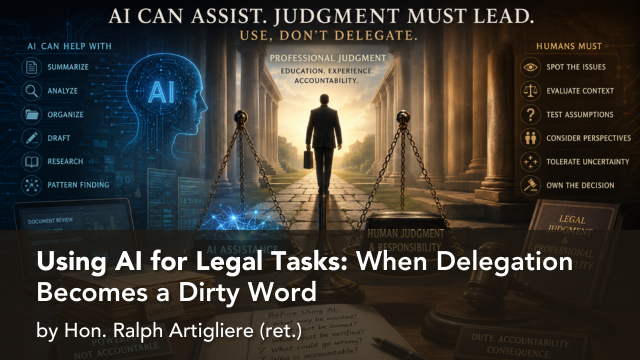
That background explains why working with generative AI tools both attracts me and makes me cautious. AI can do some things faster than I can. It can summarize, compare, organize, draft, reframe, translate, and test ideas at a speed that no lawyer or judge should ignore. In eDiscovery, it can help make sense of large collections, identify patterns, accelerate early case assessment, suggest lines of inquiry, and support better preparation for Rule 26(f) conferences and proportionality discussions. In drafting and analysis, it can help produce a stronger first pass, a better checklist, or a useful critique of an argument. But impressive power and confident expression can be deceptive and lead to overreliance, especially when AI is prone to mistakes even with careful and well-conceived prompts.
Human Responsibility Using AI Assistance
I have some enduring personal rules for use of AI: know what the tool can do, verify before you rely, and never surrender the judgment that makes legal work professional. Applying judgment to a legal issue remains a human professional act. AI does not take an oath. It does not owe duties to a client, court, opposing party, or legal system. It does not bear reputational, ethical, disciplinary, or moral responsibility. It can help a lawyer or judge make a better decision, but it cannot and should not make the decision for us.
Judge Scott Schlegel captured the point well in a recent post, The Anchor Leg. His essential message is that AI may assist the work, but “responsibility does not attach to a workflow.”1 Responsibility in the legal context exclusively lies with a person. The tool may help with the work around the duty, but it should not complete tasks requiring human judgment.
Frameworks and guidelines for judicial use of AI, including Judge Schlegel’s Framework for Judicial AI Use2 and The Sedona Conference’s judicial AI guidance,3 focus on judicial responsibility, ownership of outcome, verification, and avoiding overreliance. AI tools may properly assist with many tasks, but authority and responsibility remain with the judge. The Sedona Conference’s Primer on Artificial Intelligence and the Practice of Law4 extends the same core principles to legal practice more broadly: AI can support legal work, but professional responsibility, verification, confidentiality, and judgment remain human obligations. Lawyers have similar duties and should take heed in their use of AI and in their supervision of others who use it.
The distinction between use and over-delegation is becoming more important, not less. The current discussion in legal technology has moved beyond whether lawyers may use AI. They may, and in many circumstances they should. The question is whether they are using it in a way that preserves competence, confidentiality, candor, supervision, and independent judgment. ABA Formal Opinion 5125 identifies the familiar duties that apply when lawyers use generative AI, including competence, confidentiality, communication, supervision, and reasonable fees. The Florida Bar’s Ethics Opinion 24-16 similarly provides that lawyers may use generative AI, but they remain responsible for work product and professional judgment and must develop policies and practices to verify that AI use is consistent with ethical obligations.
That is the line between assistance and over-delegation.
Assistance versus Over-Delegation
Over-delegation is not simply using AI. It is allowing AI output to substitute for professional judgment before the lawyer or judge has done the work necessary to understand, test, and own the result. It can occur when a lawyer accepts a research answer because it sounds plausible, adopts a summary without checking the underlying record, relies on an AI-generated chronology without verifying source documents, or signs a pleading containing propositions the lawyer has not independently evaluated. It can also occur in more subtle ways, when AI frames the issues so persuasively that the human reviewer stops asking whether a different framing is better supported by the record, the law, or the client’s objectives.
The deeper risk is not simply that AI will make mistakes. Assuming proper verification is exercised, mistakes can often be found and corrected. The more serious problem is that AI compresses the path from raw information to apparent understanding. It can take a large set of documents, deposition excerpts, pleadings, emails, or research materials and quickly return a clean summary, a chronology, a list of issues, or a proposed narrative. That can be useful. But the polished structure can also create the illusion that the work of understanding has already been done. It has not. Cognitive psychologists call this automation bias: the well-documented tendency to over-rely on and under-scrutinize machine-generated recommendations.7 AI has processed and organized information. It has not exercised legal judgment.
That distinction is worth pausing on, because judgment in legal workflow is harder than it sounds. Lawyers who believe they are exercising judgment when they are following a rule, applying a standard, or reaching the conclusion that seems most defensible on the surface are only doing the first step. That is calculation. Genuine legal judgment is more demanding. It requires stepping back from the most plausible answer, imagining how the problem looks from perspectives other than your own, tolerating the discomfort of uncertainty long enough to test whether your first conclusion survives scrutiny, and ultimately owning a decision that may be wrong and that others will evaluate. It requires what experienced judges and trial lawyers learn the hard way: that the weight of a decision clarifies thinking in ways that delegation, calculation, and even verification cannot replicate. It is a function of specialized education, training, experience, and accountability. That combination is why lawyers and judges have special value in the world, and why that value is diminished when judgment is treated as a task that can be delegated away. AI cannot bear that weight, not because it lacks processing power, but because it has no stake in the outcome, no exposure to consequence, and no obligation to live with the result. That asymmetry is not a technical limitation. It is the professional distinction that the entire framework of legal responsibility rests on.
Legal judgment is irreducible. It is not a final proofreading function or something the lawyer or judge can safely apply only after the AI has generated a complete answer. Judgment must be exercised during the work: in choosing the task, selecting the materials, framing the prompt, testing the output, asking what is missing, comparing the result against the record, and deciding whether the product is reliable enough to use. All of that is done against the backdrop of knowing the case, understanding the client’s objectives, and applying the specialized expertise that no prompt can supply. The danger of over-delegation is that the human professional becomes a reviewer of AI conclusions generated from generalized patterns rather than the specialist actively directing, questioning, and owning the analysis.
This is especially important in litigation and eDiscovery because AI’s most valuable contribution is often compression, not cognition.8 It can shorten the time between data and structure, between document volume and apparent themes, between testimony and a usable outline, and between a record and a proposed strategy. That compression can help lawyers reach the judgment-intensive parts of the work sooner. But it can also make untested assumptions look mature, provisional patterns look settled, and fluent summaries look more reliable than they are. The question is not merely whether the output contains errors. The question is whether the lawyer understands how the output was generated, what it omits, what it assumes, and whether it should influence the next professional decision.
Verification after the fact is necessary, but it is not enough: Responsible AI use requires judgment in real-time, at the point of use.
Hon. Ralph Artigliere (ret.).
The same principle applies to safeguards. Verification after the fact is necessary, but it is not enough. Responsible AI use requires judgment in real-time, at the point of use. The better model is not “let the tool work, then check it later.” The better model is to build workflows that keep the lawyer or judge engaged throughout the process. That means using AI to surface options, patterns, inconsistencies, and alternatives while preserving human responsibility for significance, reliability, proportionality, privilege, strategy, and final decision-making. The goal is not to avoid delegation altogether. The goal is to avoid delegating the part of the work that gives legal work its professional character.
Those developments point to the next generation of problems. The risk is not limited to fake cases. The deeper risk is that AI-generated work will move through legal workflows with insufficient human friction. In litigation, that could affect preservation decisions, collection scope, privilege calls, responsiveness determinations, deposition outlines, expert issue spotting, settlement analysis, and proposed orders. Errors in those tasks can inadvertently carry over to mediations, arbitrations, settlement discussions, and court filings. In eDiscovery, it could affect the way lawyers characterize data sources, negotiate search and review protocols, explain technology-assisted review, evaluate proportionality, or certify the completeness of a production. In judicial work, it could affect research, drafting, summarization of party submissions, and review of proposed orders.
Rising Stakes Even as AI Tools Improve
Agentic AI will raise the stakes. Traditional generative AI responds to prompts. Agentic AI can plan and execute multi-step tasks with less continuous human direction. That shift from generating text to taking action changes the risk profile. A mistaken agentic workflow could send the wrong file, disclose privileged information, alter a litigation hold process, miscalendar a filing deadline, or propagate an erroneous legal conclusion across multiple work products. The difference is scale and propagation: an erroneous AI-generated summary may mislead one draft, but an agentic workflow connected to document management, email, calendaring, eDiscovery tasks, or filing systems may repeat the error across tasks before a lawyer sees the full consequence. Agentic AI adds a distinct layer of risk because it acts. It does not merely assist with thinking or writing. That is why real-time judgment, rather than after-the-fact review, must be built into the way agentic tools are supervised in legal workflows. Those risks increase when the workflow is not transparent enough to audit or explain. When agentic tools contribute to a litigation decision, courts may later ask how the result was produced, who made which call, and what the human lawyer reviewed before relying on it.
The challenge that legal teams face is that faster execution must be balanced against governance, trust, and human oversight. Generative AI is a risk-management problem requiring governance, measurement, and lifecycle controls, not merely individual user caution. Supervision and verification are necessary burdens, and the workflows that best accommodate real-time human governance of AI during its use rather than verification after the fact will not only be the most efficient, they will also be the most effective at avoiding mistakes.
The Disciplined Path Forward
For lawyers and judges, the answer is not to reject AI. That would be unrealistic and, in many settings, irresponsible. A lawyer who refuses to understand AI may soon be as poorly positioned as the lawyer who refused to understand email, metadata, search, or technology-assisted review. The better answer is disciplined use: know the tool, know the task, know the risk, and know where the human professional must step back in.
Before using AI for a legal task, decide what may be assisted and what must be owned.
Hon. Ralph Artigliere (ret.).
For legal professionals, the practical test is clear: Before using AI for a legal task, decide what may be assisted and what must be owned. AI may assist with summarizing a deposition, but the lawyer must decide what testimony matters. AI may help compare documents, but the lawyer must assess significance, context, and privilege. AI may suggest arguments, but the lawyer must determine whether they are legally sound, factually supported, ethically appropriate, and strategically wise. AI may help a judge organize competing submissions, but the judge must independently determine the facts, apply the law, and explain the ruling.
That framework extends directly to eDiscovery. AI use in litigation may create its own ESI, which may be discoverable, protected, or outside the proper scope of discovery depending on the circumstances. Prompts, outputs, logs, review notes, and workflow records may be relevant in some cases, privileged or protected in others, and the subject of overbroad or disproportionate discovery requests in still others. The lesson is not to preserve everything reflexively, but to recognize that AI-assisted legal work must be governed like other litigation information: with attention to relevance, proportionality, privilege, confidentiality, and defensibility.
The obligation to exercise human judgment does not end when AI is used to perform discovery tasks. AI may help identify relevant documents, test search terms, cluster communications, summarize custodial interviews, support TAR validation, analyze privilege issues, assess proportionality, or prepare for a Rule 26(f) conference. But counsel must still understand the client’s systems, preservation obligations, proportionality factors, sources of ESI, privilege risks, and the defensibility of the process. Delegating mechanical assistance is one thing. Delegating professional judgment and governance over discovery obligations is another.
That is why policies alone are not enough. Nor are standing orders, local rules, or certifications enough by themselves. A policy or certification requirement can tell lawyers what they must do, but it does not ensure they will do it in the moment of use, when pressure, deadlines, and polished AI output make speed more tempting than verification. The profession needs workflows and embedded reminders in tools9 that require judgment while the work is being performed: verification before reliance, disclosure before use when required, escalation before high-risk tasks, and documentation when AI materially affects legal analysis or litigation decisions. A workable audit trail is part of that discipline, not for bureaucracy’s sake, but to show what was done, what was checked, and why the human professional remained accountable. The goal is to make responsible behavior easier to execute when AI makes it tempting to move too quickly.
Clients are part of this governance question. They may reasonably ask whether AI can reduce cost or improve efficiency, but they are also entitled to confidentiality, competence, candor, and human accountability. Responsible AI use therefore includes not only deciding whether AI can help, but whether the client should be informed, whether the task is appropriate for the tool, and whether the resulting fee and work product remain reasonable.
Applying a dose of healthy realism and professional caution, the future issues are plain and compelling. Courts will increasingly confront AI-generated proposed orders, AI-assisted expert work, AI-created demonstratives, synthetic or altered evidence, automated privilege review, AI-generated deposition preparation, and agentic tools connected to document management, filing, and client communication systems. Lawyers will need to explain not only what tool was used, but what the tool did, what data it accessed, what human review occurred, and why the resulting process was reasonable. Judges will need to distinguish between appropriate AI assistance and improper delegation of judicial authority. Clients will ask why AI was not used to reduce cost, while courts and disciplinary authorities will ask whether it was used safely.
The profession is not standing still. Sedona’s continuing AI work, including its newly formed Working Group 13 on AI and the Law, reflects a broader movement from fascination with tools toward governance, defensibility, and judgment. Across the bench, bar, academy, and legal technology community, the same balance is emerging: competence now includes knowing how to use AI where it improves legal work; judgment means knowing where AI assistance ends and professional responsibility begins.
CONCLUSION
Delegation is not a dirty word when the delegating lawyer or judge remains fully engaged, understands the work, verifies the output, and owns the result. It becomes a dirty word when the human professional allows AI to supply not just assistance, but authority. The emerging rule is straightforward and demanding: use the tool where it helps, verify the work where it matters, and never delegate the judgment that gives legal work its professional character.
Notes
- Judge Scott Schlegel, The Anchor Leg, [sch]Legal Tech (May 6, 2026), available at https://judgeschlegel.com/blog/the-anchor-leg. ↩︎
- Judge Scott Schlegel, AI in Chambers: A Framework for Judicial AI Use Using Generative AI for Iterative Legal Drafting (Version 1.1 — September 2025), available at https://static1.squarespace.com/static/63c35a0b6817d035ea368c19/t/68c87476f545721848a413d1/1757967478473/AI_in_Chambers_v1_1_Judge+Schlegel.pdf. ↩︎
- Hon. Herbert B. Dixon et al., Navigating AI in the Judiciary: New Guidelines for Judges and Their Chambers, 26 Sedona Conf. J. 1 (2025). ↩︎
- The Sedona Conference, The Sedona Canada Primer on Artificial Intelligence and the Practice of Law, 26 SEDONA CONF. J. 99 (2025). ↩︎
- ABA Comm. on Ethics & Prof’l Responsibility, Formal Op. 512 (July 29, 2024). ↩︎
- Fla. Bar Ethics Op. 24-1 (Jan. 19, 2024). ↩︎
- See K. Goddard et al., Automation Bias: A Systematic Review of Frequency, Effect Mediators, and Mitigators, 19 J. Am. Med. Inform. Ass’n 121, 121–27 (2012) (describing automation bias as the tendency to over‑rely on automated decision support and under‑exercise independent judgment); R. Artigliere, From Training to Execution: Embedded Safeguards for Responsible AI Use in Legal Practice, EDRM/JD Supra (Apr. 30, 2026), available at https://www.jdsupra.com/legalnews/from-training-to-execution-embedded-3224099/. ↩︎
- See R. Artigliere and W. F. Hamilton, From Competence to Judgment: How AI Compresses Litigation Work and Why That Makes Judgment More Important, EDRM/JD Supra (Apr. 14, 2026), available at https://www.jdsupra.com/legalnews/from-competence-to-judgment-how-ai-4386570/. ↩︎
- See R. Artigliere, From Training to Execution: Embedded Safeguards for Responsible AI Use in Legal Practice, EDRM/JD Supra (Apr. 30, 2026), available at https://www.jdsupra.com/legalnews/from-training-to-execution-embedded-3224099/. ↩︎
May 12, 2026 © 2026 Ralph Artigliere. ALL RIGHTS RESERVED (Published with permission.)
Assisted by GAI and LLM Technologies per EDRM’s GAI and LLM Policy.