

The “Nextpoint eDiscovery Landscape” survey sheds light on the unique challenges facing attorneys vs. paralegals in modern litigation.

[EDRM Editor’s Note: This article was first published here, and EDRM is grateful to our Trusted Partner Nextpoint, for permission to republish.]
Practicing law and running ediscovery has never been more complicated. From the proliferation of new data types and sources to the implications of AI to debates on hyperlinked files and emojis, technology is rapidly changing the way lawyers operate at all levels.
The “Nextpoint eDiscovery Landscape” survey was designed to get to the heart of what’s moving the industry forward (or holding it back). It focused on learning and measuring the problems, priorities, and predictions from all levels of law firms and corporate legal teams.
The “Nextpoint eDiscovery Landscape” survey was designed to get to the heart of what’s moving the industry forward (or holding it back).
Elizabeth Guthrie, Content Manager, Nextpoint.
We learned so much from our respondents — not only from the answers themselves, but in the ways their answers varied across industries and job types. Nowhere were the differences more acute than in the question addressing respondents’ biggest challenges.
How We Did It
Our survey starts by diving into the source of an individual respondent’s perspective — what is their working environment and the role they play in it? Here we found out that around 70% of respondents worked at a law or legal services firm, followed by about 12% in corporate and an even mix of government, software, consultancy, and college and university. We also found our respondents worked at a variety of firm or company sizes (see below for details).

After categorizing respondents, the largest portion of our survey focused on challenges.
We asked respondents to share their three biggest professional challenges as individuals, as well as the three largest challenges their firm faces going into 2026.
What We Learned
The survey showed one key area of agreement across job levels, firm types, and firm sizes. The primary challenge for firms practicing ediscovery is in “Document management, review, and reduction.” When you consider the quantity and variety of data legal professionals must work with in ediscovery, it’s no surprise that this is the biggest challenge. Combing through several gigabytes of data — or even multiple terabytes — is a tall order, even with all of the time and resources in the world.
Our very own eLaw evangelist and ediscovery expert, Brett Burney, shared his perspective on the document management challenge.
“Reducing the numbers of documents to review and produce has always been a significant challenge in ediscovery, but over the last couple of decades, it’s become even more unruly due to the proliferation of electronically stored information (ESI) (email, text messages, social media, unlimited data storage, etc.). Data volumes aren’t getting smaller, so it’s even more critical today to utilize a document review tool that is specifically designed to help legal teams sift through mountains of files.”
Beyond document management, there’s less agreement on what constitutes a firm’s largest challenge, especially as reported by attorneys versus paralegals and other legal support personnel.
For example, attorneys seem to find “storage and tagging” a much more challenging prospect than paralegals, with 45% of attorneys listing it in their top three challenges, compared with only 19% of paralegals.
“Data collection” was similarly reported by more attorneys (45%) as a top challenge than paralegals (29%).
“Confusing or challenging technology” was one challenge that more paralegals (29%) reported than attorneys (9%). Here’s what Brett had to say:
“Being a legal professional today requires a level of comfort and competency with technology (although you don’t need to be an expert!). It’s important for lawyers to acknowledge that technology is integral to the job. This is especially true in litigation where you need to effortlessly tag and review documents, or explain to your clients how to properly preserve and collect potentially relevant ESI from their information systems. Again, you don’t need to be an expert, but legal professionals must be able to confidently navigate technology internally at their firm as well as externally with their clients and opposing counsel… or find someone that can help them through the challenges.”
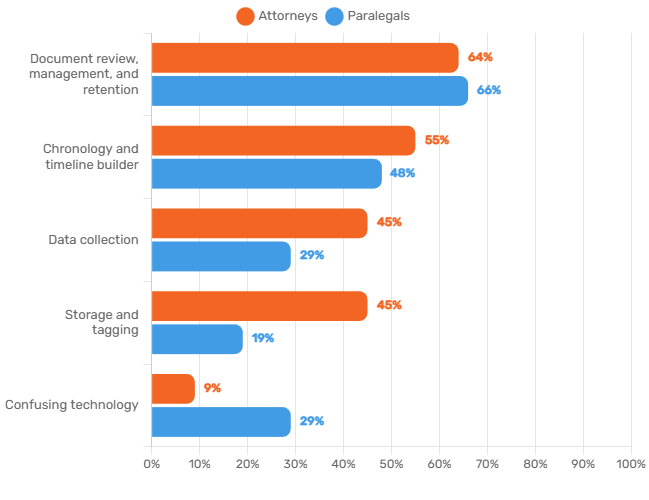
While there was little consensus on the top challenges facing firms as a whole, respondents were more aligned when noting their biggest hurdles as individuals. The top responses overall were:

There’s One Thing We Can All Agree On
One question garnered responses that left little room for debate. We asked, “What trend do you expect to have the biggest impact on ediscovery practice in the next year?” It should be no surprise that 91% of respondents answered “AI and LLMs.”
AI is transforming the legal landscape, but rapid changes and technical complexities can leave legal professionals feeling overwhelmed in the world of AI. Our new book AI for the Rest of Us, written in partnership with Tom O’Connor, provides an essential foundation for anyone navigating AI in the legal field, with graphics, checklists, and practical tips for adopting AI in your practice. Learn more and buy your copy.
Read the original article here.
Assisted by GAI and LLM Technologies per EDRM’s GAI and LLM Policy.