

[EDRM Editor’s Note: EDRM is proud to publish Ralph Losey’s advocacy and analysis. Images in the article were created by Ralph Losey using AI unless otherwise noted. Originally published on EDRM.net. This article remains the intellectual property of Ralph Losey and is shared with permission.]
How a thought experiment about measurement became a technology lawyers need to understand
Quantum Law is already beginning to arrive. One part of it is practical and immediate: encrypted client files, trade secrets, privileged communications, and other information that may need to remain secret for decades while governments and businesses begin migrating toward post-quantum cryptography.
Another part is forming behind it. Quantum computers increasingly operate as components of larger systems that include classical supercomputers, conventional software, cloud platforms, and, increasingly, artificial intelligence. When those systems begin producing simulations or other conclusions that clients, experts, and courts are asked to trust, familiar legal questions about discovery, preservation, authentication, expert testimony, and responsibility will arrive in unfamiliar technical clothing.
Part Two of this article will take up those legal problems directly. But first we need to understand what is different about the technology.
For that, there may be no better guide than the most famous cat in science.
Introduction: The Cat Everyone Knows
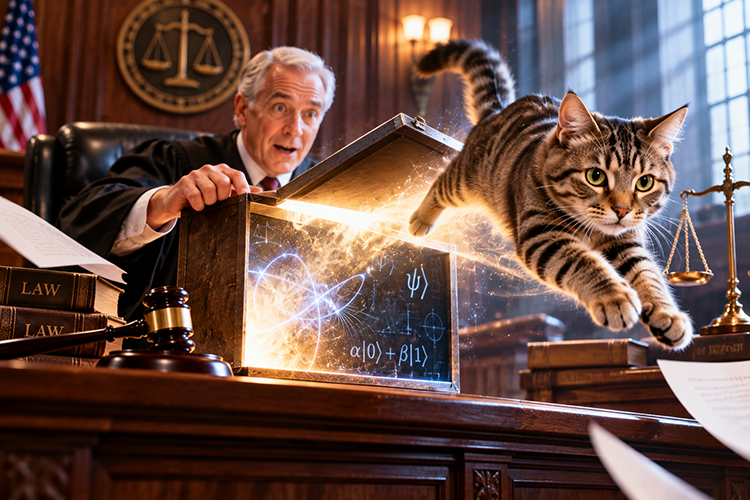
Almost everyone has heard the popular version of Schrödinger’s Cat. A cat is sealed inside a box and, according to quantum mechanics, remains both alive and dead until somebody opens the box and looks.
It is one of the most recognizable images in physics. Along with Einstein’s E=mc², the Cat may be one of the few physics ideas familiar to most lawyers, their clients, and even their pre-teen children.
It is also badly misunderstood.
Erwin Schrödinger did not invent the Cat to celebrate quantum weirdness. He was not proposing an experiment involving an unfortunate animal. Nor was he arguing that human eyesight performs some kind of magic by creating reality.
The Cat was an objection.
Schrödinger devised the thought experiment in 1935 as part of a profound dispute over what quantum mechanics actually meant. The mathematical theory, which was in large part invented by Schrödinger, worked extraordinarily well. Its predictions repeatedly agreed with experiments. Yet Schrödinger, Einstein, and other founders of quantum physics disagreed sharply about what the mathematics was telling them about physical reality.
That distinction is crucial to this story. Einstein and Schrödinger did not reject the experimental evidence. They did not claim that quantum mechanics failed to make astonishingly accurate predictions.
They questioned what the evidence meant.
Before opening Schrödinger’s box and examining his argument in detail, we therefore need to see the evidence that made the argument necessary. First, we have to understand the world quantum mechanics disrupted and the experiment that made its strangeness impossible to dismiss.
For now, leave the Cat in the box.
From Clockwork to Probability
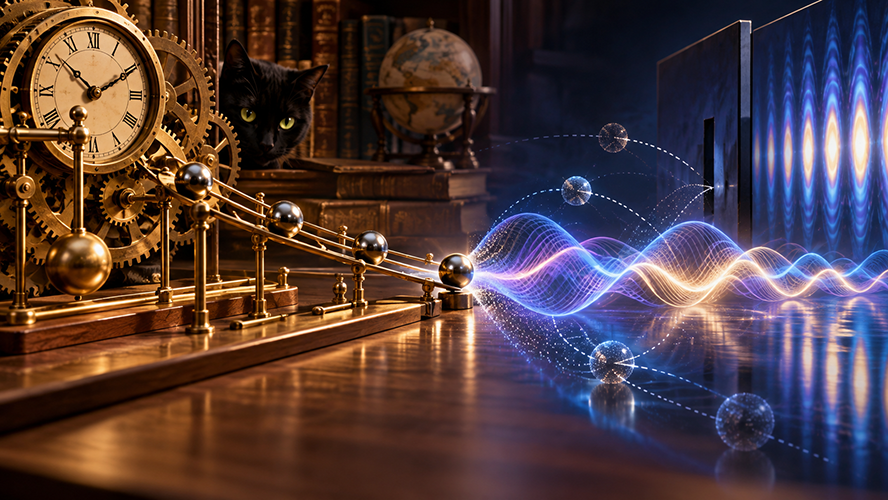
Classical physics described a universe that was comparatively easy to picture. Objects had locations. They moved along paths. Causes produced effects. Given enough information about a billiard ball, the table, and the force of the strike, its future movement could in principle be calculated.
This picture was enormously successful. It remains successful today for countless ordinary purposes. Nobody needs quantum mechanics to explain a bad shot at the pool table.
Law did not derive causation from Newtonian physics, and quantum theory does not repeal but-for causation, proximate cause, intent, reliance, responsibility, or chain of custody. Still, law developed in the same intellectual atmosphere. Lawyers reconstruct timelines, trace events, separate relevant from irrelevant causes, and ask what would have happened if one part of the story were removed.
The familiar assumption is that there is one determinate sequence behind the evidence. The investigator’s problem is to uncover it.
Beginning around 1900, physicists encountered experiments that did not fit comfortably within that picture.
Max Planck found that explaining radiation from hot objects required energy to be treated in definite portions related to frequency. Einstein pushed the idea further in 1905 by proposing that light itself could behave as discrete packets of energy, later called photons. Niels Bohr used quantized energy levels to help explain why atoms emit particular colors rather than every possible color. Louis de Broglie then proposed that matter, including electrons, could display wave behavior.
Schrödinger transformed that wave idea into a powerful mathematical theory. Then Max Born supplied an interpretation that changed the argument profoundly. The wave function did not generally tell us the exact result of the next observation. Its magnitude squared gave probabilities for possible outcomes.
Quantum mechanics could therefore predict a statistical pattern with remarkable precision while leaving the next individual result uncertain. Born eventually received the 1954 Nobel Prize, in part for his statistical interpretation of the wave function.
The universe had not stopped obeying laws. But those laws no longer looked like a hidden schedule in which every individual result merely waited to be uncovered.
That distinction matters to lawyers.
Ordinary courtroom uncertainty usually arises because records are missing, memories conflict, witnesses lie, or relevant information cannot be recovered. Philosophers call this epistemic uncertainty, uncertainty caused by what we do not know.
Quantum probability introduces a different possibility. Under standard readings of quantum mechanics, the theory itself gives probabilities for outcomes. There is no certainty in individual results, only in overall patterns. The uncertainty is not a temporary gap in evidence. It is inherent to the small world of quantum that underlies everything.
Lawyers should not confuse the two. A missing email is not a superposition. A disputed recollection is not quantum indeterminacy. But the deeper lesson is still important. Reliable knowledge does not always require predicting the next individual event. Sometimes the strongest available knowledge is a well-tested probability distribution.
That will matter later when quantum-generated evidence reaches litigation.
To understand the uncertainty of quantum-related proof, however, we first need to understand the experimental evidence. Einstein, Schrödinger, Bohr, and the other founders could accept the extraordinary success of quantum experiments and still disagree profoundly about what those experiments meant.
Litigators understand this immediately. Two sides may agree that the document is authentic, that the test produced a particular result, or that an event occurred exactly as recorded. The dispute may instead concern the inference that should be drawn from that evidence.
That was increasingly the dispute in quantum physics.
The Real Experiment Behind the Fictitious Cat
Richard Feynman called the two-slit experiment the heart of quantum mechanics and wrote that, in a sense, it contains the central mystery. You do not need advanced mathematics to see why. See The Feynman Lectures on Physics, Vol. III, Chapter 1.
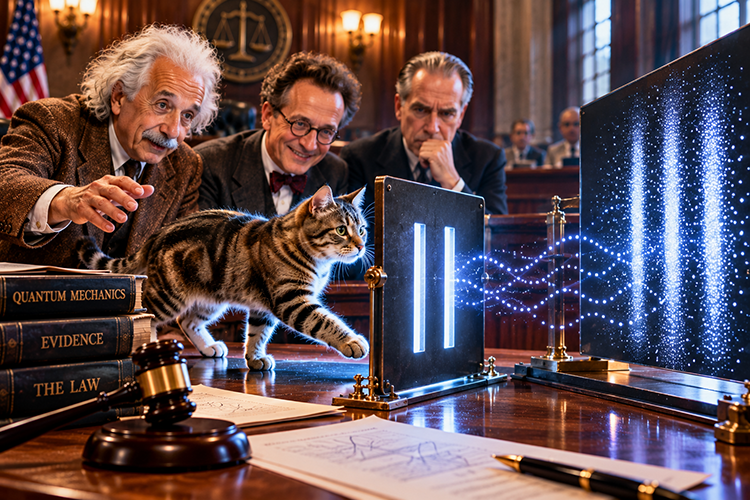
Begin with something ordinary. Imagine firing small pellets toward a barrier containing two openings. Every pellet that gets through passes through one opening or the other. On a screen beyond the barrier, the impacts form two broad groups.
Now replace the pellets with waves. Waves spread through both openings and overlap. Where crest meets crest, the waves reinforce each other. Where crest meets trough, they partially or completely cancel. Instead of two simple groups, the screen shows an interference pattern, alternating regions of greater and lesser intensity.
So far, nothing strange. Pellets behave like particles. Waves behave like waves.
Now fire electrons at the openings.
Each electron arrives at the detector as one localized event, one dot at one place. We do not find half an electron on one side of the screen and its other half somewhere else.
Yet as many electrons arrive, something extraordinary happens. The individual dots gradually build the same kind of interference pattern associated with waves.
Send the electrons one at a time and the pattern still develops. One electron arrives. Then another. Then another. There is no crowd of electrons traveling together and jostling one another through the apparatus.
Nevertheless, the accumulated pattern displays wave interference.
Feynman emphasized precisely this puzzle. The electrons arrive as individual “lumps,” but the probabilities governing where those individual events occur follow an interference pattern.
The obvious question is irresistible:
Which slit did each electron go through?
So we add equipment capable of finding out.
Now the experiment changes. When the apparatus reliably records which route the electron used, the interference pattern is lost. Feynman’s discussion of the two-slit experiment shows the same essential result: once the alternatives become physically distinguishable, they no longer combine into the same interference pattern. See The Feynman Lectures, “Watching the Electrons.”
This is often summarized by saying that “observation changes reality.” That slogan creates almost as many problems as it solves.
No conscious human observer is required. A detector can interact with the electron, leave a record, and change the experimental situation while every physicist involved is out to lunch. The point is not that somebody looks. The measuring apparatus is part of the physical experiment as shown below.
Still have trouble visualizing this? See the video I generated with more details and images. It is part of my YouTube Quantum Channel, which includes some of my favorite quantum videos by others.
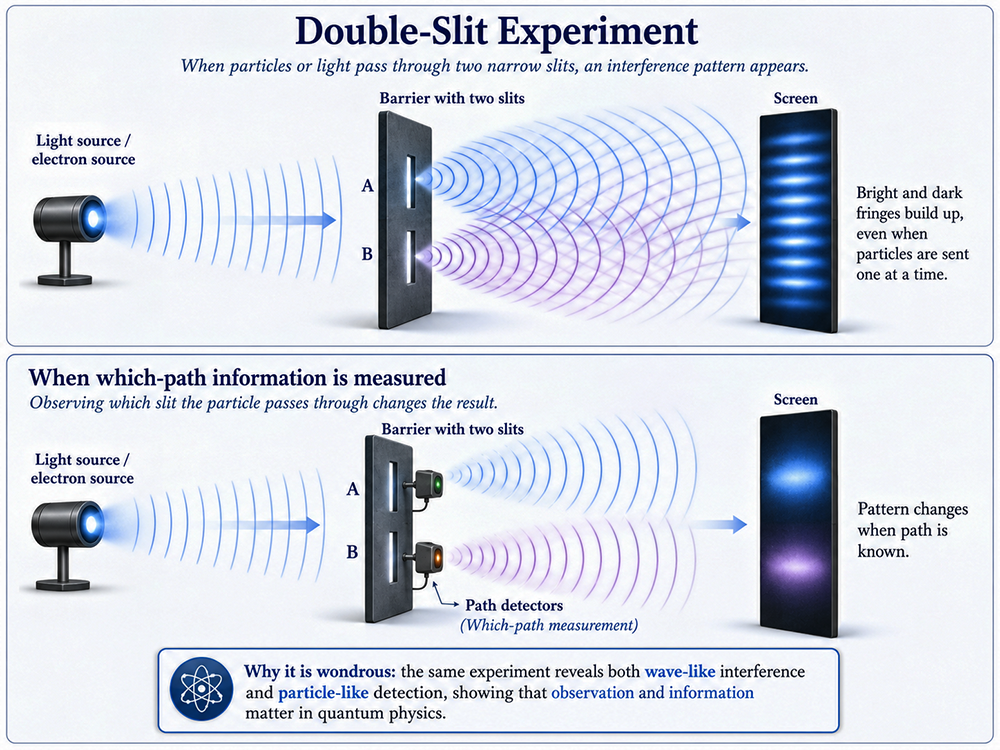
When alternatives remain indistinguishable, quantum theory assigns probability amplitudes to them. Those amplitudes can reinforce and cancel, creating interference. When the experimental arrangement makes the alternatives distinguishable, the amplitudes no longer contribute to the observed statistics in the same way.
Niels Bohr regarded this dependence on the experimental arrangement as fundamental. His principle of complementarity held that experimental arrangements that reveal one aspect of a quantum phenomenon may exclude another, while both may be necessary for a full account of the phenomena. See Bohr, The Quantum Postulate and the Recent Development of Atomic Theory (Nature 121, 580–590 (1928)).
Einstein was deeply uncomfortable with where this seemed to lead.
Again, the disagreement was not over whether the experiment worked. Einstein did not dispute that quantum equations predicted experiments remarkably well. He questioned whether the probabilities and measurement rules supplied by quantum mechanics could really be the final and complete description of physical reality.
That difference is easy for lawyers to recognize.
The evidence was not necessarily in dispute. Its meaning was.
A simple comparison helps explain why the problem went deeper than ordinary ignorance. Suppose I place a coin on a table and cover it with my hand. You do not know whether it landed heads or tails. But ordinarily we assume the coin has already landed one way or the other. Your ignorance does not cause heads and tails to interfere with each other.
Quantum alternatives can interfere.
That is why superposition cannot simply mean, “We do not know yet.” Whatever quantum mechanics ultimately tells us about reality, the alternatives represented in the theory can have observable physical consequences.
Before measurement, the theory may contain several possible outcomes whose amplitudes can interfere. After measurement, the apparatus contains one definite record.
One electron produces one dot.
One detector records one result.
The theory gives possibilities and probabilities. The apparatus gives us a fact.
How does the first become the second?
That is the measurement problem.
By 1935, Einstein was ready to put his objection into formal terms.
The Dice, EPR, and the Cat
Einstein accepted the experimental success of quantum mechanics. His objection was not that the theory failed.
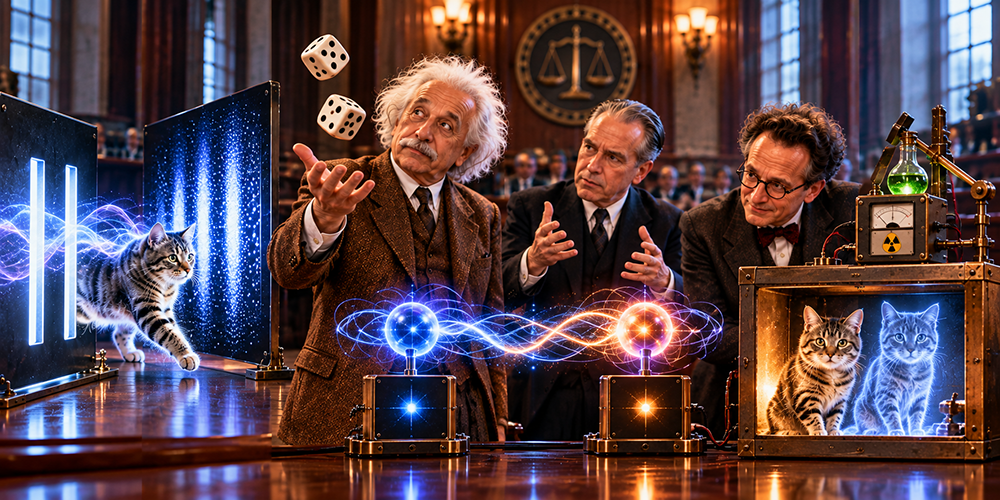
He thought it could not be the final word if irreducible chance was built into its account of reality. His position is remembered through the famous line, “God does not play dice with the universe.”
The remark was not merely a joke about probability. Einstein was pressing a serious distinction between a theory that predicts observations and a theory that completely describes the physical world.
In 1935, Albert Einstein, Boris Podolsky, and Nathan Rosen placed that objection into formal published form in Can Quantum-Mechanical Description of Physical Reality Be Considered Complete?, usually called the EPR paper.
Their summary principle was direct: “In a complete theory there is an element corresponding to each element of reality.”
The word “element” is abstract, but the argument was concrete. Einstein and his co-authors considered two systems that had interacted and become correlated before separating. Under carefully chosen conditions, measuring one could permit a certain prediction about the other. If a physical quantity could be predicted with certainty without disturbing the distant system, EPR argued, then something in physical reality should correspond to that quantity.
Yet the quantum wave function did not assign simultaneous definite values in the way their criterion appeared to require.
Their conclusion was not that quantum mechanics failed experimentally. It was that the wave-function description was incomplete.
Bohr replied later that year in his own paper, also titled Can Quantum-Mechanical Description of Physical Reality be Considered Complete? He said the EPR criterion of physical reality contained “an essential ambiguity.” As a lawyer, I have to add that Bohr choosing the exact same title for his paper is another essential ambiguity. Can you imagine using the same title for your opposing brief as the moving party?
For Bohr, the experimental conditions were not detachable scenery. The arrangement used to establish one physical quantity could not simply be combined with a different, incompatible arrangement and treated as though both revealed a set of classical properties existing independently of how they were measured.
Bohr was not claiming that human wishes create reality. His argument was that a quantum description cannot always be separated from the physical conditions that make the description meaningful.
Schrödinger entered the same debate from yet another direction. Erwin Schrödinger, Die Gegenwärtige Situation in der Quantenmechanik (The Present Situation in Quantum Mechanics) (3-part paper 1935), trans. John D. Trimmer, Proceedings of the American Philosophical Society 124, 323–338 (1980). In his essays, Schrödinger supported the EPR paper and, in the process, coined a new word: entanglement.
But he did something else too. He created a cat.
Schrödinger used a form of argument familiar to lawyers: reductio ad absurdum. Carry an idea to its logical conclusion. If the conclusion becomes absurd, something in the reasoning or one of its assumptions is wrong.
His Cat took a puzzle from the invisible world of atoms and expanded it until the puzzle occupied an ordinary box.
Inside the box was radioactive material, a radiation detector, a mechanical mechanism, a flask of poison, and a cat. If an atom decayed, the detector would activate the mechanism, the flask would break, and the cat would die. If no decay occurred, nothing would happen and the cat would live.
There was nothing mysterious about either causal chain.
The strange part came from the quantum description of the radioactive event.
If the microscopic system could be represented as a superposition of decay and no decay, and if that quantum description simply continued through everything physically connected to it, then the alternatives seemed to spread into the detector, the mechanism, and finally the cat:

decay → detector fires → poison released → cat dead
or
no decay → detector silent → poison contained → cat alive.
Schrödinger did not believe ordinary cats should be understood as grotesque mixtures of life and death. He constructed that apparently absurd result to make a microscopic problem impossible to ignore.
His real question was the one we have now reached through the double-slit experiment:
How do the several possibilities represented in a quantum state become the one definite result recorded by a measuring apparatus?
Schrödinger developed the Cat in the aftermath of Einstein, Podolsky, and Rosen’s challenge to Niels Bohr on whether Bohr’s quantum-mechanical description of reality was complete. Id. Here is the best-known paragraph in Schrödinger’s own words:
One can even set up quite ridiculous cases. A cat is penned up in a steel chamber, along with the following diabolical device (which must be secured against direct interference by the cat): in a Geiger counter there is a tiny bit of radioactive substance, so small, that perhaps in the course of an hour one of the atoms decays, but also, with equal probability, perhaps none; if it happens, the counter tube discharges and through a relay releases a hammer which shatters a small flask of hydrocyanic acid. If one has left this entire system to itself for an hour, one would say that the cat still lives if meanwhile no atom has decayed. The first atomic decay would have poisoned it. The ψ-function of the entire system would express this by having in it the living and dead cat (pardon the expression) mixed or smeared out in equal parts.
Einstein replied to Schrödinger after learning of the Cat thought experiment in their correspondence:
Your cat shows that we are in complete agreement concerning our assessment of the character of the current theory. A ψ-function that contains the living as well as the dead cat just cannot be taken as a description of a real state of affairs.
See David Kaiser, How Einstein and Schrödinger Conspired to Kill a Cat (Nautilus, 10/07/16) (citing letter of Albert Einstein to Erwin Schrödinger (Sept. 4, 1935)).
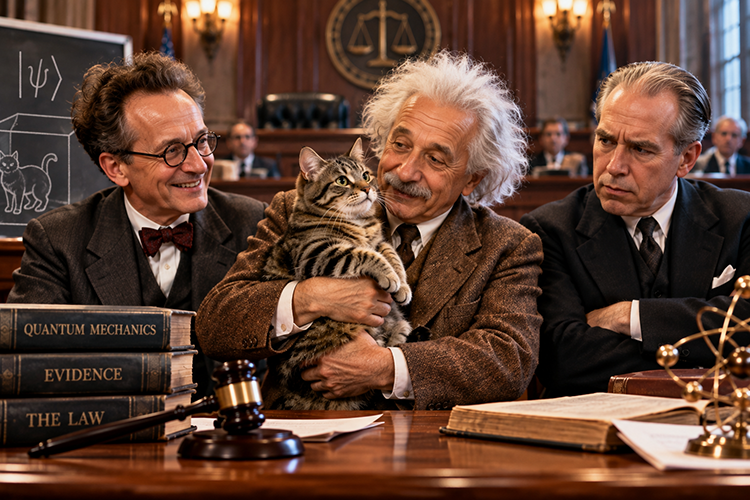
The Cat is also a surprisingly useful place for lawyers to pause. Look at the chain inside the box. There is a process, a physical interaction, a detector, a record, a later human observer, and finally an interpretation of what happened.
That is not yet a legal case.
But it is beginning to look like evidence.
Schrödinger’s point was not that an ordinary animal waits for a human being to decide whether it lives or dies. The Cat exposed the difficulty of carrying a quantum description, which works so well for microscopic systems, without qualification into the macroscopic world of detectors, apparatus, records, and definite events.
Einstein saw that as evidence that the wave function could not be a complete description of reality.
Bohr saw the problem differently.
And physics spent the next ninety years arguing about what the evidence meant.
Schrödinger gave the mystery at the heart of the argument a name: ENTANGLEMENT. Little did he know that the phenomenon he named would become the key to making the argument testable nearly thirty years later.
Entanglement describes a quantum relationship in which two particles, or other quantum systems, become connected strongly enough that quantum mechanics describes them with a shared state. The particles may later move far apart, but measurements performed on many similarly prepared pairs reveal correlations between their results. Those correlations are the important part. They are stronger and stranger than we would expect if the particles were simply two independent objects carrying ordinary properties of their own. The Royal Swedish Academy gives a useful nontechnical explanation in its 2022 Nobel Prize background, How Entanglement Has Become a Powerful Tool.
Einstein hoped there might still be a deeper explanation. Perhaps the apparently random results were only random because quantum mechanics did not describe everything. The example of this that he hypothesized was that each entangled particle might carry hidden information established when the pair was created, something like sealed instructions telling it how to respond when measured. That would preserve much of Einstein’s preferred picture of a world in which physical properties existed independently and distant events did not somehow reach across space instantaneously.
For almost thirty years, however, the dispute remained largely one of interpretation. Quantum mechanics predicted the strange correlations. Einstein and those sympathetic to his position could still hope that some deeper, local explanation might reproduce them.
Then John Bell found a way to turn the hope based on hidden variables into a mathematical test.
In 1964, Bell showed that a broad class of theories based on local hidden variables placed limits on how strongly the results of measurements on separated particles could be correlated. Quantum mechanics predicted correlations that could exceed those limits. In other words, Einstein’s preferred kind of explanation and quantum mechanics could not both give the same answers in every properly designed experiment. See John S. Bell, On the Einstein Podolsky Rosen Paradox, Physics 1, 195–200 (1964). The linked copy is the complete paper hosted by CERN (Conseil Européen pour la Recherche Nucléaire), which is a cool (near absolute zero) place to go: CERN Document Server.
That changed the character of the argument. Physicists no longer had to debate only what quantum mechanics might mean. Bell had identified a situation in which competing explanations could produce measurably different statistical results.
The experiments followed.
In 1972, Stuart Freedman and John Clauser measured correlations between pairs of photons and obtained results that violated the restrictions imposed by the local hidden-variable theories they were testing, thus supporting Bohr. See Stuart J. Freedman & John F. Clauser, Experimental Test of Local Hidden-Variable Theories, Physical Review Letters 28, 938 (1972).
Alain Aspect and his colleagues later developed more demanding experiments. In a particularly famous 1982 test, the measurement settings were changed while the photons were already in flight. Their results again agreed with John Bell and standard quantum mechanics interpretations. See Alain Aspect, Jean Dalibard & Gérard Roger, Experimental Test of Bell’s Inequalities Using Time-Varying Analyzers, Physical Review Letters 49, 1804 (1982).
Still more sophisticated Bell experiments followed, including the work of Anton Zeilinger and many others. In 2022, the Nobel Prize in Physics was awarded to Alain Aspect, John Clauser, and Anton Zeilinger “for experiments with entangled photons, establishing the violation of Bell inequalities and pioneering quantum information science.” The Nobel Committee’s 2022 Physics Prize scientific and popular background provides a readable history of that progression.
What did those experiments prove?
They did not prove that Bohr’s Copenhagen interpretation was the one true description of reality. Bell’s result was narrower and, in some ways, more interesting. The experiments ruled against broad classes of local hidden-variable explanations of the kind Einstein hoped might restore the older classical picture. They did not choose among every remaining interpretation of quantum mechanics.
That distinction matters.
Bell did not settle the metaphysics. He eliminated important possible explanations.
Entanglement also does not give us an instantaneous telegraph. The individual result observed at either location remains unpredictable, so an experimenter cannot choose a result at one end and thereby encode a message for someone at the other. The correlations become useful only when the separate measurement records are compared through ordinary communication. NIST explains this limitation directly in its cleverly titled article, Quantum and Dance: It Takes 2 to Entangle (NIST, 04/14/25) by Krister Shalm.
The larger historical point is more important for our story. The strange features of quantum mechanics did not disappear as experiments became more precise. Better experiments made some classical explanations increasingly difficult to maintain.
For much of the twentieth century, Bohr’s approach, together with the cluster of aligned views that came to be called the Copenhagen interpretation, became the orthodox or default way quantum mechanics was taught and used. Historians now emphasize that “Copenhagen” was never one perfectly uniform doctrine and that Bohr and Heisenberg themselves differed on important points. But the practical Copenhagen attitude clearly dominated much of twentieth-century physics. The Stanford Encyclopedia of Philosophy’s history of the Copenhagen interpretation describes both its former dominance and the later growth of competing approaches.
That dominance has eroded. Serious physicists and philosophers now openly develop and debate alternative interpretations, including Bohmian approaches, objective-collapse theories, relational approaches, and the Everett or Many-Worlds family of interpretations, popularly described as involving parallel worlds. We do not need to examine those alternatives here. Nor does a lawyer need to choose among them to understand quantum computing.
The point is simply that the foundational dispute continues. Quantum mechanics remains one of the most successful predictive theories ever devised. The experimental evidence supporting its predictions is overwhelming. Yet physicists still disagree about what the mathematical description tells us about the underlying nature of reality. Stanford Encyclopedia of Philosophy.
For lawyers, that distinction should feel familiar.
Parties can agree on an experiment, a document, a measurement, or a test result and still disagree profoundly about the inference that should be drawn from it.
The evidence can be extraordinarily strong while its ultimate meaning remains contested.
Bell narrowed the field.
He did not close the case.
Why Do We Never See a Half-Alive Cat?
That brings us back to Schrödinger.
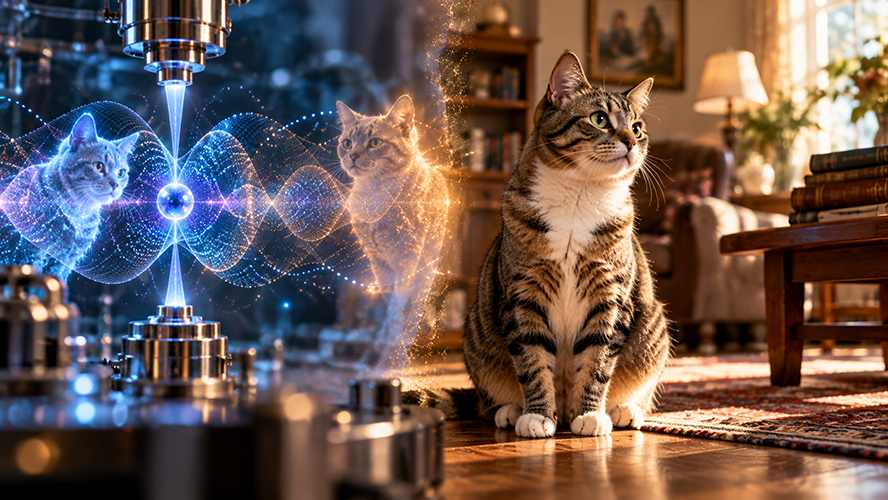
If microscopic quantum systems really can occupy superpositions and become entangled, why do ordinary cats, tables, judges, and court files always appear to us in definite states?
One important part of the answer is decoherence.
A microscopic quantum system can be carefully isolated. A cat cannot. Large physical objects constantly interact with their surroundings. Light strikes them. Air molecules collide with them. Heat moves through them. Their countless internal components interact with one another. Those environmental interactions rapidly disperse the delicate phase relationships that permit different quantum alternatives to interfere.
That is why physicists create what they call “Schrödinger cat states” with carefully controlled atoms, photons, superconducting circuits, and other small systems rather than with actual cats.
In a famous 1996 experiment, researchers at NIST prepared a single trapped ion in a superposition of two spatially separated states and then demonstrated its quantum character through interference. See Christopher Monroe, David M. Meekhof, Brian E. King & David J. Wineland, A “Schrödinger Cat” Superposition State of an Atom, Science 272, 1131–1136 (1996).
Decoherence therefore explains a great deal about why quantum interference becomes effectively unavailable for ordinary macroscopic objects. It helps explain how the familiar classical-looking world emerges from systems that are quantum underneath.
But it does not, by itself, end the measurement problem.
Textbooks often introduce a rule called collapse. Before measurement, the quantum state contains amplitudes associated with possible outcomes. After a definite outcome has been recorded through measurement, subsequent calculations proceed using the state associated with that result.
The mathematics works extraordinarily well. The word “collapse,” however, does not tell us what physically happened.
Did a genuine physical collapse occur? Did the quantum state merely update because new information became available? Does interaction with the environment explain the appearance of a definite classical result? Do all alternatives continue in different branches of a larger quantum reality? Or was Einstein right that the wave function never gave us a complete description in the first place? There may be more to quantum fields than meets the eye.
Different interpretations still give different answers.
Decoherence has become an essential part of the modern understanding of the quantum-to-classical transition, but its relationship to the measurement problem and to competing interpretations remains contested. A particularly useful open review is Maximilian Schlosshauer, Decoherence, the Measurement Problem, and Interpretations of Quantum Mechanics, Reviews of Modern Physics 76, 1267 (2005).
Schrödinger’s Cat therefore did not resolve the argument he entered in 1935. It did something almost as important.
It made the problem impossible to hide.
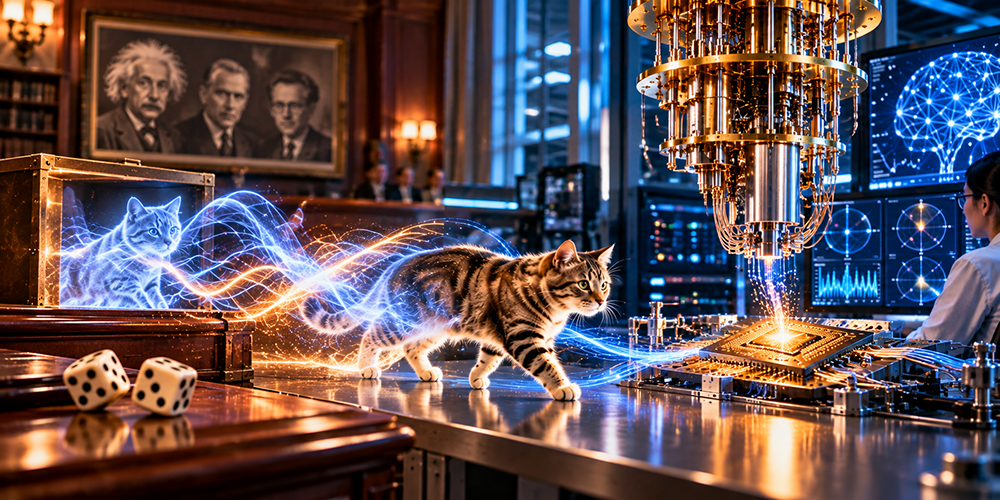
From Mystery to Machine
Schrödinger’s Cat did not settle the foundations of quantum mechanics. Physicists eventually did something almost as remarkable.
They learned to control some of the quantum effects that had made the Cat so disturbing.
Quantum physics had already become technology long before anyone built a quantum computer. Semiconductors, lasers, LEDs, atomic clocks, and many other parts of modern life depend on quantum mechanics. NIST gives a useful overview in Where Is Quantum in Your Everyday Life?
Quantum computing takes another step. Instead of relying on quantum physics merely to make a transistor, laser, or sensor work, engineers deliberately manipulate superposition, interference, entanglement, and measurement in order to process information.
The basic idea is easier to state than to accomplish.
A group of quantum bits, or qubits, can be prepared in a quantum state containing amplitudes associated with different possible configurations. Quantum operations change those amplitudes. Interference can suppress some possibilities and strengthen others. Entanglement permits qubits to participate in joint states that cannot be represented simply as independent classical switches.
This is why the popular claim that a quantum computer merely “tries every possible answer at once” is misleading.
A quantum computer cannot look inside a superposition, inspect every represented possibility, and simply select the right one. The algorithm must manipulate the amplitudes so that measurement has a useful probability of revealing information about the problem. NIST explains this point in Quantum Computing Explained.
Measurement therefore remains unavoidable.
At some point the quantum state has to produce ordinary information that a classical computer, scientist, engineer, lawyer, or judge can actually use.
The old philosophical problem has not vanished. It has become part of an engineering system.
And that system is increasingly hybrid: quantum Qubit computers working with AI-enhanced Bit computers.
Quantum processors are unlikely to replace ordinary computers in the way laptops replaced typewriters. A more realistic architecture combines quantum processors with CPUs, GPUs, networks, storage, conventional software, and high-performance AI-enhanced computing.
In February 2026, IBM reported that its Heron quantum processor and Japan’s Fugaku supercomputer had been operated together in a closed-loop quantum-chemistry workflow in which information moved repeatedly between the quantum and classical machines. See Rafi Letzter, IBM Quantum Computing Blog, RIKEN and IBM Demonstrate Quantum-Centric Supercomputing at Enormous Scale (Feb. 18, 2026), and RIKEN, Quantum Computer and Supercomputer Powers Combine (Jan. 6, 2026).
IBM has also published a reference architecture in which quantum processors operate beside CPUs, GPUs, high-speed networks, and shared storage. It is IBM’s proposed architecture, not an industry-wide standard, but it illustrates an important point. See IBM, IBM Releases a New Blueprint for Quantum-Centric Supercomputing.
The useful quantum computer is increasingly being conceived not as an isolated box, but as one component of a larger computational system.
Artificial intelligence is entering that system too.
In research published in Nature in July 2026, scientists from Google Quantum AI used reinforcement learning to help control quantum error correction on the Willow superconducting processor. The AI system used information from quantum error detection as feedback and adjusted more than a thousand control parameters while the system operated. Under deliberately introduced drift, the researchers reported improved stability. See Volodymyr Sivak and colleagues, Reinforcement Learning Control of Quantum Error Correction, Nature 655, 879-884 (07/08/2026).
That is an important present-day connection between AI and quantum computing.
The AI was not simply handed a quantum answer after the computation ended and asked to summarize it. It participated in the operation of the machine itself, using error information generated by the quantum system to help keep that system stable.
We should not leap from that result to the claim that quantum computers are about to transform the large generative-AI systems lawyers use today. That has not been established. Current quantum computers remain fragile and error-prone, and many proposed applications remain research goals.
“Quantum AI” is already becoming a marketing phrase. Lawyers should treat broad claims with the same skepticism they should bring to any unfamiliar technology. Ask what was actually demonstrated.
For law, the significant development is not that quantum computing will replace classical computing, or that quantum computing will somehow swallow AI. It is that the systems lawyers encounter may combine all of them.
Imagine the chain. A classical computer prepares the data. AI software helps choose or adjust parameters. A quantum processor performs part of the calculation. Classical software decodes and stores the measurement results. Another model helps interpret them. A human expert eventually presents a conclusion to a client, regulator, or court.
At that point, the legally important object may no longer be any single machine.
It may be the entire decision-producing system.

Where the Cat Goes Next
That is where Part One ends and Quantum Law begins to look much more familiar to practicing lawyers.
The Cat started as a challenge to the relationship between quantum possibilities and one definite recorded result. The double-slit experiment showed why quantum alternatives cannot simply be treated as undiscovered classical facts. Einstein’s dice raised the question of whether probability could really be fundamental. The EPR paper sharpened his claim that the quantum description might be incomplete. Schrödinger then pushed that objection into the everyday world with the Cat. Bell later turned an important part of the dispute into experimental science.
What remained was something lawyers understand very well: powerful evidence did not eliminate disagreement over what the evidence meant.
Engineers then transformed superposition, interference, entanglement, measurement, and error correction into tools for computation.
Now add classical computers, AI, cloud infrastructure, vendors, software versions, calibration records, human experts, and legal decision-makers.
The strange box has become a system.
In Part Two, we will follow that system into the legal world. The first problem is already present: harvest-now-decrypt-later attacks and the migration to post-quantum cryptography place long-lived confidential information at risk before Q-Day itself arrives. The second problem will emerge as quantum-generated outputs become evidence: what must be discovered, preserved, authenticated, validated, and explained when no conventional computer can simply reproduce the final calculation?
That is where the Cat meets Identity versus Fidelity, Rule 702, system discovery, AI-quantum control loops, and the responsibility of human judgment.
The Cat is not yet on the witness stand.
But it is headed there.

For educational use only. Not legal advice.
Ralph Losey Copyright 2026. All Rights Reserved.
Assisted by GAI and LLM Technologies per EDRM’s GAI and LLM Policy.