
Why quantum computers will force lawyers to test distributions, not just documents.
[EDRM Editor’s Note: EDRM is proud to publish Ralph Losey’s advocacy and analysis. Images in the article were created by Ralph Losey using AI. Originally published on EDRM.net.]
A lawyer receives a technical report in discovery. The report was generated with help from a quantum or quantum-assisted system. The result matters. It may affect liability, damages, cybersecurity, privilege, or the authenticity of a disputed record. So the lawyer asks the familiar question: “Can you run it again and get the same answer?” The expert answers: “Not exactly. But the distribution is reliable.”
That is when the room gets quiet.
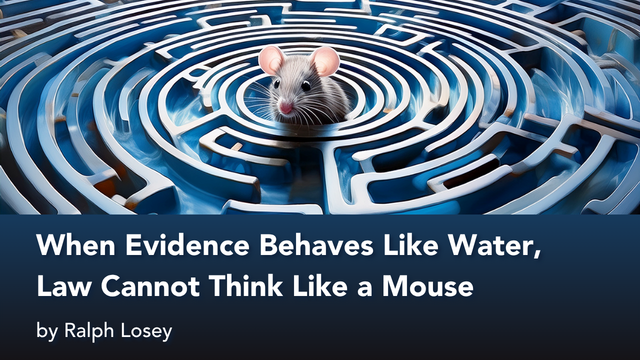
Lawyers are trained to follow trails. We preserve documents, verify hash values, examine metadata, reconstruct timelines, and ask witnesses who knew what, when they knew it, and what they did next. That is mouse thinking: one path through the maze, step by step, leaving a trail that can be followed.
Quantum-generated evidence will not always behave that way. It may behave more like water poured into the same maze — spreading through possibilities, shaped by interference, and understood through patterns rather than identical repetition.
When evidence behaves like water, law cannot think only like a mouse.
In the first article in this series, Quantum Law, and Why Now?, I presented evidence and argument that quantum law is not science fiction. It is already beginning to press on familiar legal duties: protect secrets, test proof, question machines, and preserve human judgment.
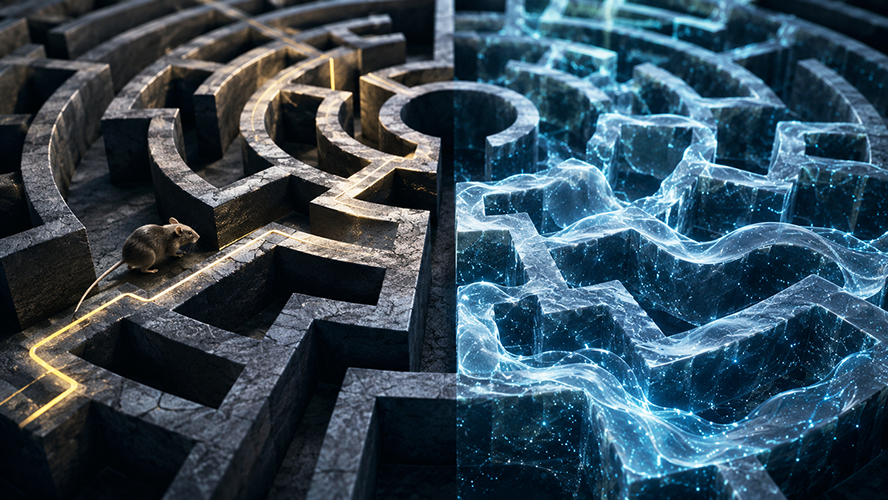
That article was the map. This one is the maze. More precisely, it is about a mouse, water, and a maze — a simple image that my AIs and I came up with to explain how quantum mechanics and quantum computing work. The image is not meant to turn lawyers into physicists. It is meant to give lawyers, judges, and e-discovery professionals a working intuition for the new kind of evidence that will be created by quantum computers and the new kind of legal analysis required to use it in a just manner.
The Mouse and the Water
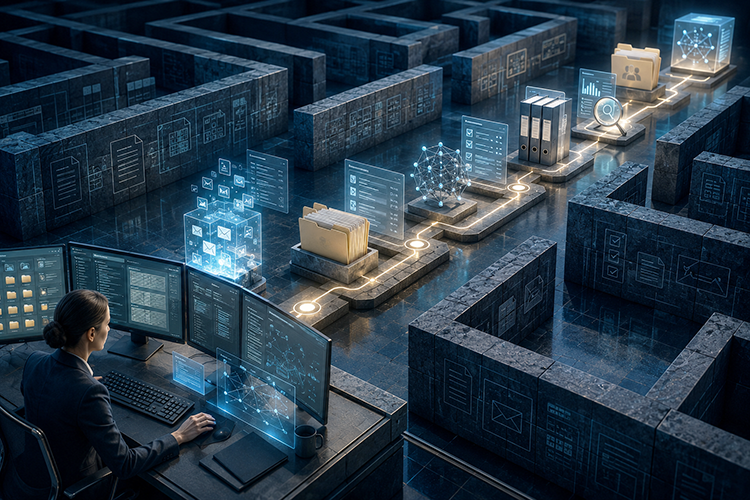
For decades, classical computer systems have behaved like mice whose speed kept increasing under Moore’s Law. Put a mouse in a maze and it runs down one corridor, hits a wall, backs up, and tries another. The mouse may run faster every year, but the logic remains the same: one path at a time, one step after another. That is also the kind of thinking lawyers are trained to follow. We hunt for the document, verify the hash value, follow the chain of custody, and reconstruct events by chronology.
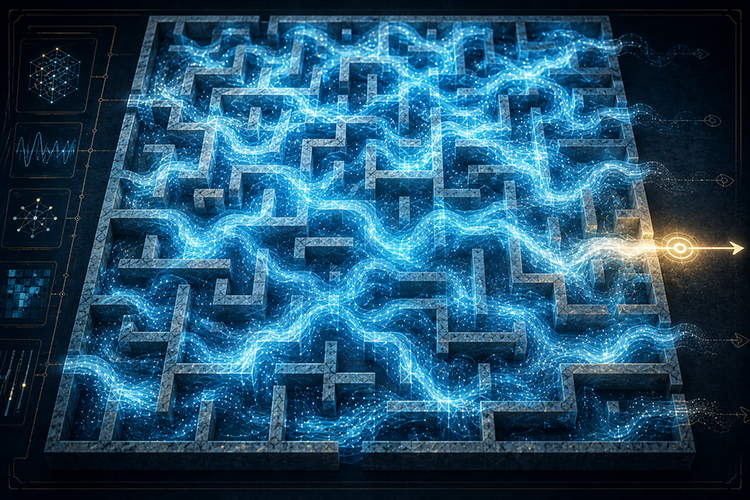
Quantum-generated evidence behaves less like that mouse and more like water poured into the same maze. Water does not choose a single corridor. It spreads as a wave through many possible pathways, shaped by the structure of the maze and by the interference patterns created along the way. It does not leave a neat, single-file trail of steps. It reveals a broader pattern.
This is not a physics lecture. It is a warning about the future of legal judgment. When evidence begins to behave like water, lawyers cannot afford to think only like mice. We will still need the mouse. But we will also need the water. Not one or the other. Both.
When evidence begins to behave like water, lawyers cannot afford to think only like mice. We will still need the mouse. But we will also need the water. Not one or the other. Both.
Ralph Losey, CEO, Losey AI, LLC.
The Mouse: Classical Search and Classical Legal Intuition
To be clear, the mouse in this metaphor is not the lawyer, it is the classical computer. One that stores information in binary form, on or off. That is also the world lawyers understand. Law is based upon the idea of proximate causation. Proof is based on sequence and timelines, who knew what, when they knew it, and what they did next. It is based on authenticated documents, on hash values, metadata. Discovery is based on validated search and review methods.
E-discovery trained us well for our current world, which was once but a dream. Email became evidence. Metadata became evidence. Mobile messages became evidence. Cloud systems became evidence. Slack, Teams, social media, ephemeral messaging, and collaboration platforms all forced lawyers to expand what they meant by “documents.” Predictive coding and Technology Assisted Review, which I tried to get everyone to call Computer Assisted Review, forced lawyers to understand sampling, validation, recall, precision, and reasonableness. Generative AI is now forcing lawyers to confront hallucinations, deepfakes, synthetic records, and the difference between confident language and reliable proof.
Still, in most of those settings, the underlying legal instinct remains mouse-like. Follow the trail. Preserve the record. Reproduce the process. Show the steps. Prove the chain. That instinct remains essential. It is not obsolete. But it may no longer be sufficient.
The Water: Why Quantum Is Different
Quantum computing is not simply a faster mouse.
That is the point most often missed in legal discussions. Quantum computers are not just ordinary computers with better accelerators. They process information differently for certain specialized problems. They use qubits, superposition, interference, measurement, error correction, and classical control systems in ways ordinary computers do not. The terms sound strange, but lawyers do not need to become physicists to grasp the legal point. We need enough understanding to ask better questions when quantum-generated evidence enters the legal system.
The maze image helps because it gives lawyers a familiar way to picture problem solving.
A classical computer is like a mouse in a maze. It runs down one corridor, hits a wall, backs up, and tries another. It may do this very quickly, but it still follows one path at a time. That is the world lawyers know. We follow a chain of custody, track metadata, reconstruct timelines, compare versions, authenticate documents, and ask who did what, when, and why.
Now imagine pouring water into the entrance of the same maze. The water does not choose one corridor, stop, reconsider, and back up. It spreads. It moves as a wave. It enters the structure of the maze all at once and reveals a pattern the mouse could only discover step by step.
That is the basic intuition behind quantum computation. The water does not literally run through plastic corridors, of course, and a quantum computer does not simply “try every answer” and pick the winner. That popular explanation is catchy, but too simple. Still, the water image is useful because it tells lawyers the key point: quantum computing changes the manner of search. It does not merely increase the speed of the old search.
Superposition is the part of the process where multiple possibilities remain in play at once. Lawyers understand this better than they may think. Before trial, several outcomes are alive. The plaintiff may win big, win small, lose entirely, or settle midway through trial. A key exhibit may come in or stay out. A witness may hold up or collapse. The possibilities are not equal, but they are all still legally alive until the process forces a result.
That is not a perfect physics description, but it is a good legal doorway. Superposition means the machine is not walking one path at a time like the mouse. The water is in many channels before the final outcome appears.
Interference is where the water image becomes especially helpful. Waves can reinforce each other or cancel each other out. Lawyers see a version of this every day. One witness supports the timeline. Another witness weakens it. A document confirms a theory. Missing metadata undercuts it. A bad email cancels three good affidavits. A credible expert strengthens the case. A shaky expert infects everything nearby.
Quantum interference works mathematically, not rhetorically, but the legal intuition is familiar. Some possibilities become stronger. Others fade. The system is not merely listing options. It is shaping which outcomes are more likely to emerge.
Measurement is the quantum equivalent of a trial verdict or a closing.
Before the verdict, the case is still full of possibilities. Lawyers may predict the result, clients may worry about the result, experts may model the result, and judges may signal where they are leaning. But no one truly knows until the verdict is rendered or the ruling is entered. At that moment, the cloud of possible legal outcomes collapses into one outcome that the parties must live with, challenge, enforce, or appeal.
The same is true in a major transaction. Until the last party signs, the deal is still fluid. Terms move. Conditions change. Schedules shift. A final objection may appear at 11:47 p.m. because, naturally, lawyers do not believe in normal business hours. Then the documents are signed, the closing occurs, or the deal falls apart. The possibilities collapse into an outcome.
That is the lawyer’s way to understand quantum measurement. The machine moves through possibilities, shaped by superposition and interference, and then measurement produces a result. The result matters, but so does the process that produced it. In law, we do not look only at the verdict form. We look at the evidence, the rulings, the jury instructions, the objections, and the record. In quantum-generated evidence, we will likewise need to look beyond the final answer and examine the setup, the runs, the controls, the errors, and the human interpretation.
This is also where the mouse and the water come back together. Quantum computers do not operate alone. They do not replace classical systems. They depend on them. Classical computers frame the problem, prepare inputs, control the quantum processor, collect measurements, run error correction or error mitigation, compare results, and help interpret what happened. The water may flood the maze, but the mouse still has work to do.
Lawyers should not imagine a glowing quantum oracle floating above the courtroom and pulling the strings of human puppets. That makes for a good movie, perhaps, but bad legal analysis. Quantum systems are hybrid, engineered, limited, noisy, and specialized. Today’s quantum computers are not ready to solve ordinary lawsuits or take the witness stand. They are not general-purpose replacements for classical computers.
But when quantum computers do matter, they will matter because they are different, not merely because they are fast. They will flood the maze in ways the mouse never could. For instance, someday they may help open encrypted vaults that classical computers cannot break in any practical amount of time. When that day comes, the legal issue will not be a physics debate. It will be confidentiality, preservation, cybersecurity, vendor promises, privilege, and client counseling.
The mouse follows the trail. The water reveals the shape of the maze. Lawyers will need both instincts.
When Evidence Behaves Like Water
Now move from computation to evidence.
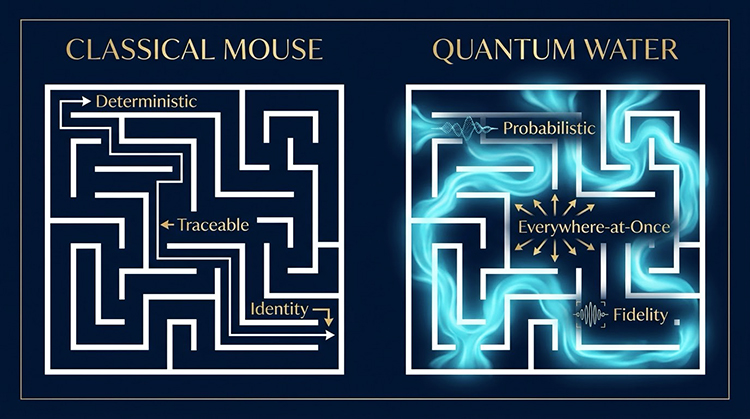
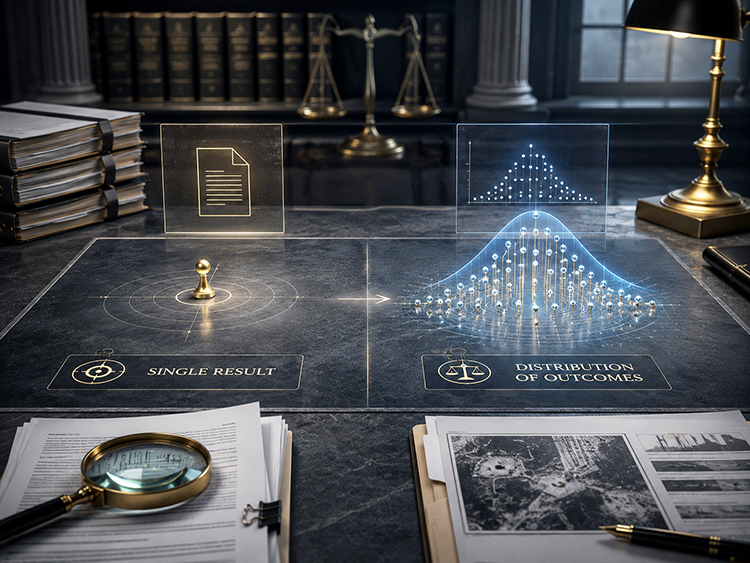
A classical machine often gives the same answer each time. Run the same deterministic process on the same input under the same conditions, and you expect the same output. That is the familiar world of identity. Did the process produce the same thing again? Quantum systems will not work that way.
A quantum or quantum-assisted system may be asked the same question repeatedly. But instead of producing one identical answer every time, it may produce a distribution of answers clustered around a meaningful result. That makes many lawyers uncomfortable, for good reason. We are trained to distrust inconsistency. A witness who gives three different answers to the same question becomes a target for cross-examination. A machine that produces different outputs may look unreliable. A record that refuses to stabilize may look like a problem.
Sometimes it is a problem. But not always.
Law already knows about variation. Human testimony is rarely identical from one response to the next, neither is AI, which is modeled on human speech. A careful witness may express the same memory in slightly different words. A rigid cross-examiner may only hear contradiction. A better lawyer may hear a stable account expressed with ordinary human variation. Quantum evidence is not human testimony, of course. Machines do not get nervous, forget their glasses, or discover at deposition that they should have read the email chain more carefully. But the analogy helps.
Variation is not automatically unreliability. In quantum and quantum-assisted systems, variation may be expected. The legal question becomes whether the distribution is reliable, not whether every output is identical.
Variation is not automatically unreliability. In quantum and quantum-assisted systems, variation may be expected. The legal question becomes whether the distribution is reliable, not whether every output is identical.
Ralph Losey, CEO, Losey AI, LLC.
That points toward a larger evidentiary shift from Identity to Fidelity. Identity asks: did the process produce the same output again? Fidelity asks: did the process behave faithfully within known and acceptable error limits? That is a core concept in quantum law. I will return to it in a later article. For now, the practical point is enough. Reliable does not always mean identical. Probability is not the enemy of proof. Variation is not always unreliability.
Preservation: The Record Underneath the Output
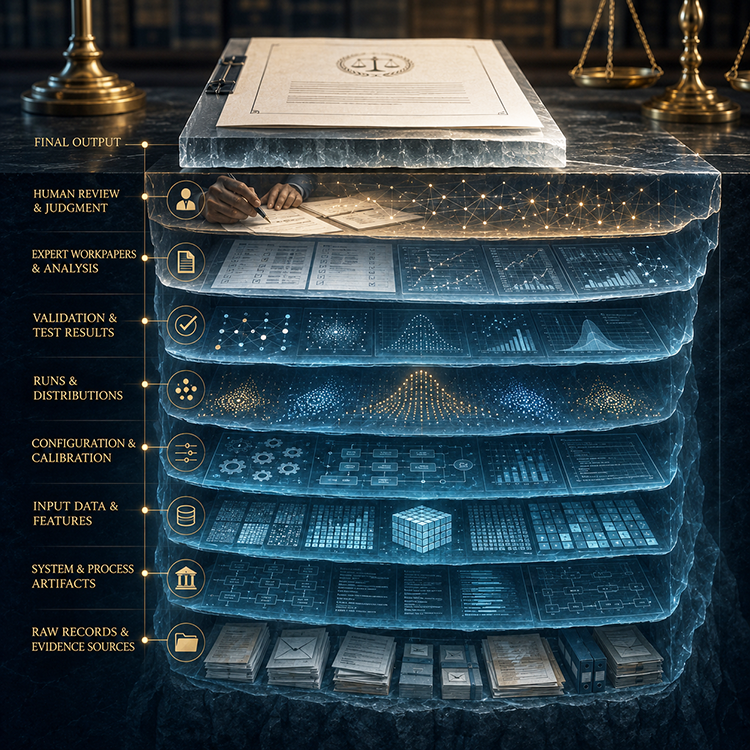
If quantum evidence behaves like water, preservation must change too. The discoverable record may not be limited to a final report, chart, or conclusion. The final output may be only the surface. The evidentiary record lives underneath.
In a contested quantum or quantum-assisted workflow, preservation and discovery may need to include:
- input data;
- workflow descriptions;
- configuration records;
- circuit, model, or algorithm versions;
- calibration logs;
- shot counts and outcome distributions;
- error mitigation records;
- validation reports;
- benchmark comparisons;
- excluded runs;
- expert workpapers;
- human review notes;
- vendor documentation;
- contracts and technical specifications;
- audit trails from classical control systems.
The Quantum Law Course fleshes out this outline of issues and explains the context and reasoning. Yes, this will be very challenging, but we have risen to overcome new challenges like this before and I am confident we will do so again. We must. Technology will not pause for our convenience.
Obviously, the answer is not to preserve everything forever. The answer is to understand early what may be material, unique, volatile, or necessary to test reliability. We have seen this pattern before. Paper discovery became electronic discovery. Then e-discovery adapted to email, metadata, mobile devices, chat, cloud platforms, social media, databases, predictive coding, and generative AI. Each transition forced lawyers to learn new preservation and validation questions. Quantum-generated evidence will be another step in that long story. Not a break from e-discovery. An extension of it.
In my somewhat prejudiced view, e-discovery lawyers and techs will be among the best prepared for the transition to quantum. They already understand that evidence is not just a thing. It is a system of creation, storage, transformation, access, review, production, and interpretation. They know that a “document” may really be a database view, a family relationship, a metadata field, a search result, a log entry, or an export artifact. Quantum evidence asks us to go one level deeper.
Law Cannot Think Only Like a Mouse
Although the quantum water gets most of the attention in the maze analogy, the mouse remains useful. Law still needs trails, logs, custodians, timestamps, records, chain of custody, competent witnesses, and judges willing to ask hard questions. Classical evidence is not going away. Most cases will still involve ordinary documents, ordinary systems, ordinary people, and ordinary mistakes — usually in extraordinary volume.
But some evidence will no longer be tested by asking only whether the same path can be retraced step by step. Some evidence will have to be tested by asking whether the pattern is reliable, whether the distribution is understood, whether the error boundaries are disclosed, and whether the human beings using the machine knew what they were doing.
Some evidence will have to be tested by asking whether the pattern is reliable, whether the distribution is understood, whether the error boundaries are disclosed, and whether the human beings using the machine knew what they were doing.
Ralph Losey, CEO, Losey AI, LLC.
Law cannot become water. It must remain law. It must demand explanation, preservation, authentication, reliability, fairness, and accountability. But it must also learn to ask questions suited to distributions, validation records, error boundaries, hybrid systems, and human oversight.
AI was the last shock. Quantum may be the next. The multiverse may be optional. Quantum literacy for lawyers is not optional.
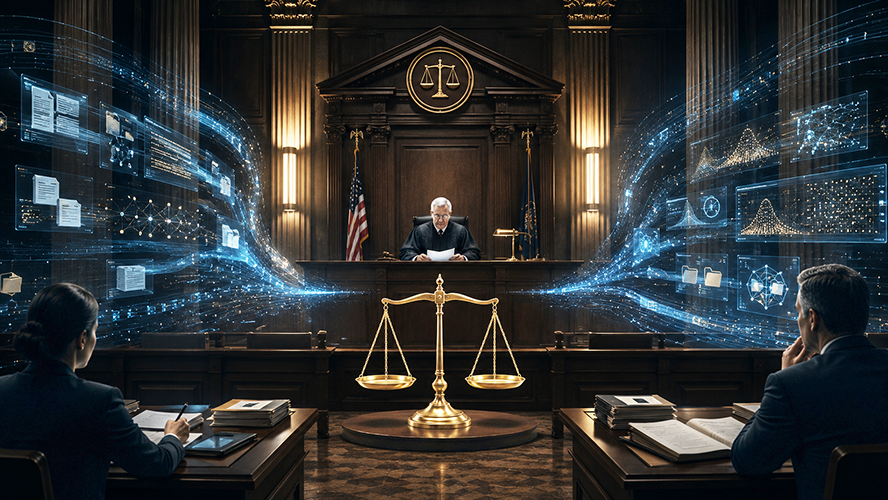
For lawyers, judges, e-discovery professionals, cybersecurity advisors, and legal technologists who want to go deeper, I address these issues in QUANTUM LAW: From Causation to Probability, my self-paced online course on AI, quantum computing, evidence, cybersecurity, privacy, and legal judgment. The course expands this article’s mouse-and-water image into practical legal problems: how to preserve the record underneath the output, how to think about probabilistic proof, how to challenge or defend quantum-assisted evidence, and how to prepare for a world where reliable does not always mean identical.
Educational only. No legal advice provided.
Ralph Losey Copyright 2026. All Rights Reserved.
Assisted by GAI and LLM Technologies per EDRM’s GAI and LLM Policy.