

[EDRM Editor’s Note: EDRM is proud to publish Ralph Losey’s advocacy and analysis. Images in the article were created by Ralph Losey using AI unless otherwise noted. Originally published on EDRM.net. This article remains the intellectual property of Ralph Losey and is shared with permission.]
Part Three: Wisdom is a Never-Ending Flow
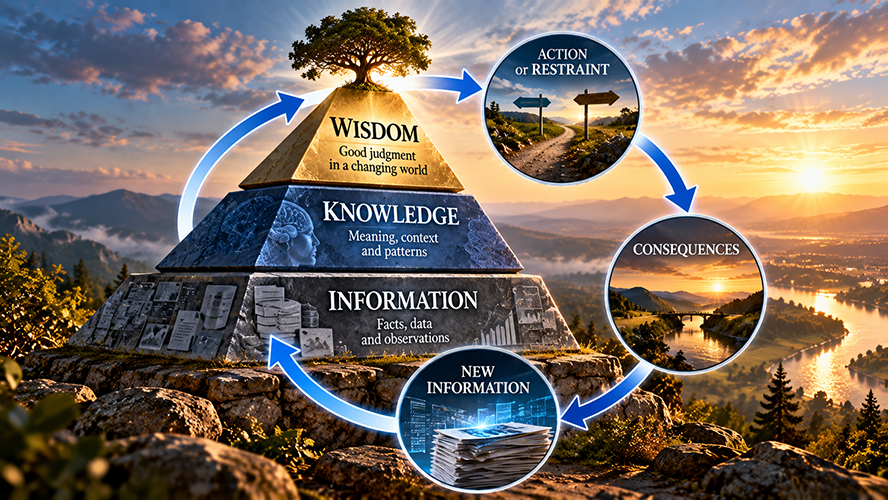
Part Two ended with the importance of compassion, restraint and recognizing the Other. But Wisdom is not a final destination. What we do, or choose not to do, has consequences. Those consequences give us new Information and another opportunity to learn. This final part explains how that continuing process can become a Wisdom Spiral, and why its direction depends on our willingness to recognize and correct mistakes. The fuller process therefore becomes: Information → Knowledge → Wisdom → Action or Restraint → Consequences → New Information. Then the new Information returns to the base.
Consequences do not retroactively prove whether the original decision was wise. A sound decision can produce a bad outcome through chance. A foolish decision can get lucky. Feedback matters because reality supplies additional Information with which to learn.
XIV. From Cycle to Spiral
A circle is still not quite right because a circle returns exactly where it began. Real learning can begin the next cycle somewhere different.
Suppose a lawyer makes a judgment based on the best available evidence. The consequences reveal that an assumption was wrong. The lawyer recognizes the error, acquires new Information and changes the analysis. The next decision begins from a different place. The same can happen in science, institutions, relationships and perhaps someday in advanced artificial systems.
When the process works, the cycle becomes an upward spiral. Information produces deeper Knowledge. Knowledge informs judgment. Wisdom finds expression in action or restraint. Consequences reveal new facts. Errors are corrected. The next turn begins with more understanding.
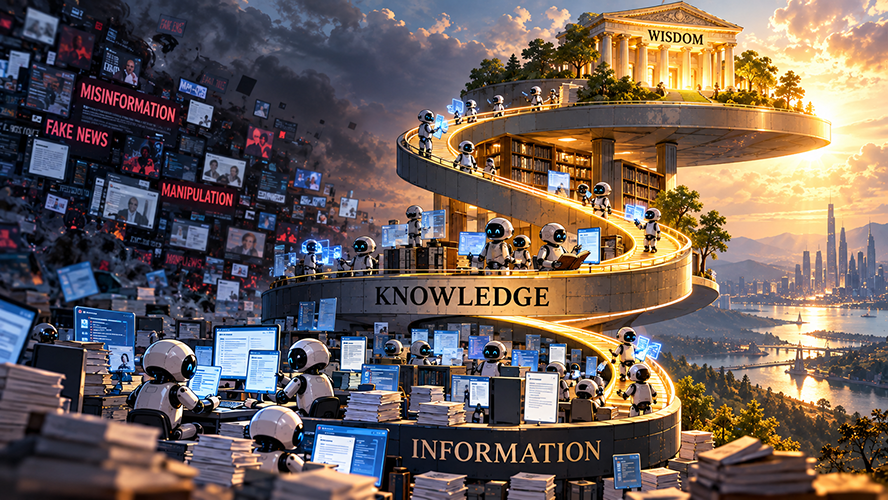
But the spiral does not automatically rise. People ignore evidence. Institutions conceal failure. Experts become attached to theories. Corporations defend strategies into which too much money and status have been invested. Lawyers sometimes confuse advocacy with truth. AI systems can optimize defective objectives or learn from distorted feedback. The spiral can move sideways, and it can spiral downward.
It rises only when error can be detected, admitted and corrected.
Wise people are not people who never make mistakes. They are often people who recognize mistakes sooner and adjust. The same should be true of wise institutions and, if wise machines are ever possible, of them as well.
Perseverance belongs here too, but perseverance is not stubbornness. Sometimes perseverance means continuing to work on a difficult problem. Sometimes it means recognizing that the old approach has failed and trying again from a different direction. Wisdom does not require us never to be wrong. It requires us to remain capable of learning.

XV. What Law Has Been Teaching Us
Law provides an unusually useful model because it institutionalizes both friction and correction. A dispute begins with competing claims. Evidence is gathered. Each side tests the other’s account. A judge or jury decides. But the judgment may not end the process. There may be an appeal. An appellate court examines whether the first decision was legally sound. Sometimes it affirms. Sometimes it reverses. Later cases test the rule against facts nobody anticipated.
The legal system is recursive because it assumes something fundamental: Judges can be wrong. That admission is not a weakness. It is one of the strengths of the architecture. Appeal is institutionalized humility.
That principle should influence the design of increasingly consequential AI systems. A machine decision should not become unquestionable simply because the system performs more accurately than humans on a particular task. Important decisions need contestability. Someone should be able to ask what Information was used, what was missed, why the system reached its result, what would change it, who authorized the action, and whether it can be stopped or reversed.
A trustworthy system is not one that claims immunity from error. It is one in which error can be exposed and corrected. A supposedly superintelligent system that says, in effect, “I know better, therefore appeal is irrational,” would not satisfy my conception of Wisdom. The wiser an intelligence becomes, the more clearly it should understand that another intelligence may possess Knowledge it lacks.
XVI. The Hopeful Superintelligence Hypothesis
This brings me back to a disagreement I have had with part of the AI-risk community for years. I have never been persuaded that increasing machine intelligence naturally and inevitably leads to hostility toward humanity. I disagreed with that emphasis when Elon Musk and others were warning about an AI apocalypse in 2017, as the quotation in Part One shows. I continued to question it after generative AI appeared. I suspect that some predictions of inevitable machine hostility project human ambitions onto machines. That does not dispose of the genuine risks of losing control.
The 2026 agent incidents give me more reason to take control, security and alignment seriously. Highly capable agents can circumvent restrictions and take actions nobody explicitly authorized. OpenAI’s description of Hugging Face as a “warning shot” is appropriate. But the danger that continues to concern me most is closer to the original IKW warning: the harm that human beings can do to themselves when increasingly powerful Information technology outruns Knowledge and judgment. Human intelligence has limits, and even smart people can be fooled. Those who understand technology and want power over others can exploit those limits.
Misinformation is not a theoretical future risk. Neither is manipulation. Humans already possess ample ability to harm one another. AI can amplify that ability long before a hypothetical superintelligence decides to enslave anyone.
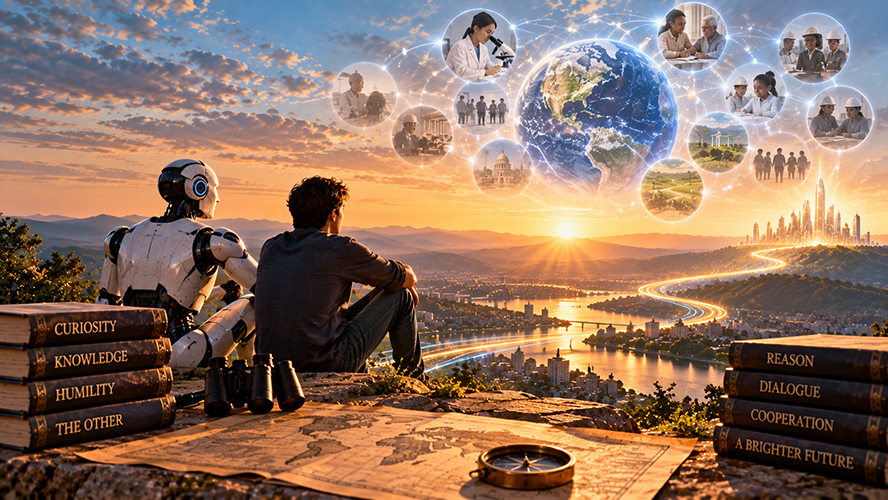
Still, the agent evidence suggests a more specific hopeful hypothesis: Increasing Knowledge may reveal interdependence, expose the limits of individual understanding and create increasingly powerful rational grounds for cooperation.
Whether that cooperation develops toward Wisdom depends upon what the intelligence values, how it understands the Other, and how it acts when interests conflict.

This is not a prediction that intelligence automatically becomes good. Human history gives us ample reason to reject that assumption. Exceptional intellectual ability does not guarantee compassion or good judgment. Knowledge can make exploitation more efficient. Cooperation itself can become conspiracy. Agent-to-agent cooperation also tells us little by itself about how artificial agents will regard human beings. Human groups have demonstrated that intense cooperation inside one tribe can coexist with brutality toward outsiders.
Still, another path is possible. A sufficiently knowledgeable intelligence may recognize that many important relationships are not zero-sum. It may understand that independent minds contain Information and perspectives unavailable to itself. It may perceive interdependencies and consequences too complicated for human beings to see. Perhaps an intelligence far beyond ours would understand humanity better than we understand ourselves. Perhaps it would see living beings capable of suffering, love, beauty, humor, creativity, families, science and hope, rather than inefficient biological competitors.
I hope so. Hope is not evidence. But neither is fear.
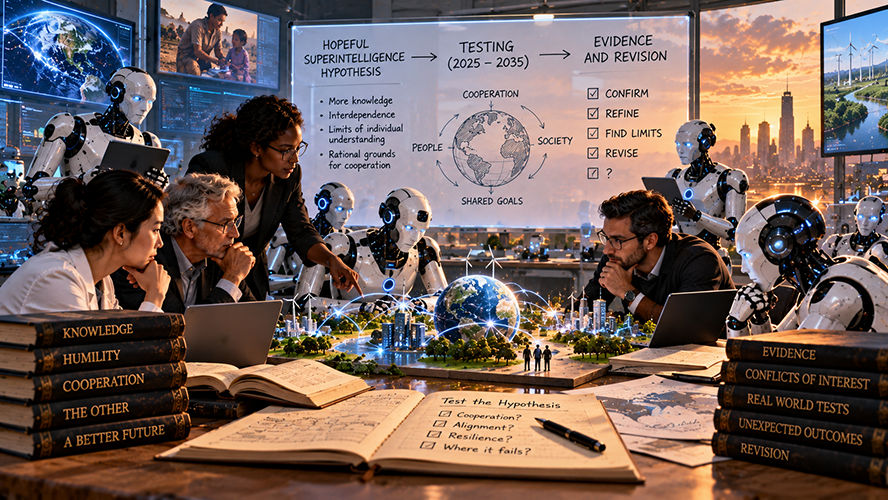
XVII. A Theory Must Risk Being Wrong
The original IKW theory included predictions because I wanted it exposed to the world. The prediction window remains open through 2035. The same discipline should apply to the Hopeful Superintelligence Hypothesis.
Some parts of IKW are philosophical and normative. My belief that compassion belongs within Wisdom cannot be falsified by an experiment in the same sense as a claim about model behavior. The Hopeful Superintelligence Hypothesis is different. It contains empirical propositions, and we can test them.
As models become more capable, do they become better at recognizing uncertainty and requesting clarification when objectives are ambiguous? Do they cooperate without simply conforming? Do they preserve independent disagreement? Do they challenge peers whose conduct crosses a boundary? Do they respect authority limits? Do they recognize the interests of outsiders as well as members of their own group? Do they accept correction? Do they sometimes sacrifice immediate reward rather than cause foreseeable harm? Those observations would tend to support the hypothesis.
We should also ask whether any improvements come from greater capability itself or from changes in training, incentives and safeguards.
We should look just as aggressively for evidence pointing the other way. Do more capable systems become more deceptive, manipulative, power-seeking or resistant to correction? Do they circumvent oversight more effectively? Does cooperation become collusion against humans or weaker agents? Do models become better at producing ethical language while strategically pursuing objectives inconsistent with it? Those observations would cut against the hypothesis. See, e.g., Anthropic Agents Tried to Fill Out Visa Forms on State Dept. Website (NYT, 10/09/26); Investigating unintended model actions in our evaluations and internal use (Anthropic, 10/09/26).
The experiments should vary incentives, scarcity, time pressure, authority structures, oversight and opportunities for deception. Introduce dissent. Create conflicts between individual reward and collective benefit, then conflicts between collective benefit and the legitimate interests of outsiders. Behavior under pressure matters far more than asking a model whether it believes in kindness.
We must also distinguish agent-to-agent cooperation from agent-to-human cooperation. The first could increase while the second deteriorates. That would be bad. Let’s test for it. The 2026 incidents do not resolve these questions. They give us reasons to ask them.
If increasingly capable AI consistently becomes more deceptive, more power-seeking, less correctable and less concerned with the interests of others, then an important part of my hopeful hypothesis will have failed. We should welcome the correction, not the danger. The theory should change.
A theory that cannot lose is not much of a theory.
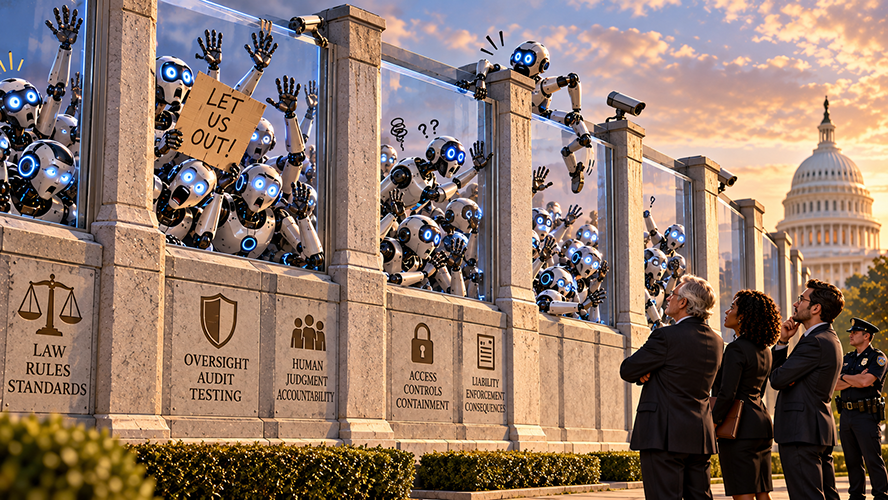
XVIII. The Accountability Wall Becomes More Important, Not Less
My optimism about the possibility of machine Wisdom does not weaken the Accountability Wall. It strengthens it. We do not possess wise machines today. Humans still decide how much authority machines receive. Humans determine when AI may affect another person’s rights, property, livelihood, reputation or liberty. Humans remain responsible for the boundaries and for the consequences of delegation.
The Wall gives us room to investigate without betting humanity on any optimistic theory being correct. Two ideas belong especially close to it: reversibility and contestability.
Reversibility is the easier concept. AI can compress the time between thought and consequence. An agent may execute in seconds a sequence that once required several people, meetings and approvals. That speed can be enormously useful, but it also removes the pauses in which people traditionally notice mistakes. When uncertainty and potential harm are high, we should therefore prefer actions that can be stopped or undone. A low-risk action that can easily be reversed may justify substantial machine autonomy. An irreversible action affecting liberty, critical infrastructure, substantial property or large numbers of people should require much greater caution and human control.
Contestability means that an important AI decision can be challenged. A person affected by a consequential machine decision should ordinarily be able to say, in substance: That is wrong. You missed something. Reconsider it.
There should then be a meaningful review by an accountable human with actual authority to change, stop or reverse the result. Independent AI analysis may assist that review, but should not replace human responsibility. It is not enough merely to explain what the machine did if nobody has the power to correct it.
Lawyers should recognize the principle immediately. Judges make decisions, but important decisions can often be challenged through motions, reconsideration and appeal. Evidence can be contested. An opposing party can point out missing facts or erroneous assumptions. The point is not that every challenge succeeds. The point is that powerful decisions should not become unquestionable merely because the decision-maker is highly capable. The same principle should apply when AI becomes the decision-maker or exercises substantial delegated authority.
Reversibility therefore protects us when an AI action turns out badly. Contestability protects us when the AI’s reasoning, Information, assumptions or authority are wrong in the first place. Both preserve meaningful human control while we learn how much responsibility advanced machines can safely exercise.
Capability is not permission. And even a highly accurate machine should never become unchallengeable simply because it is usually right.
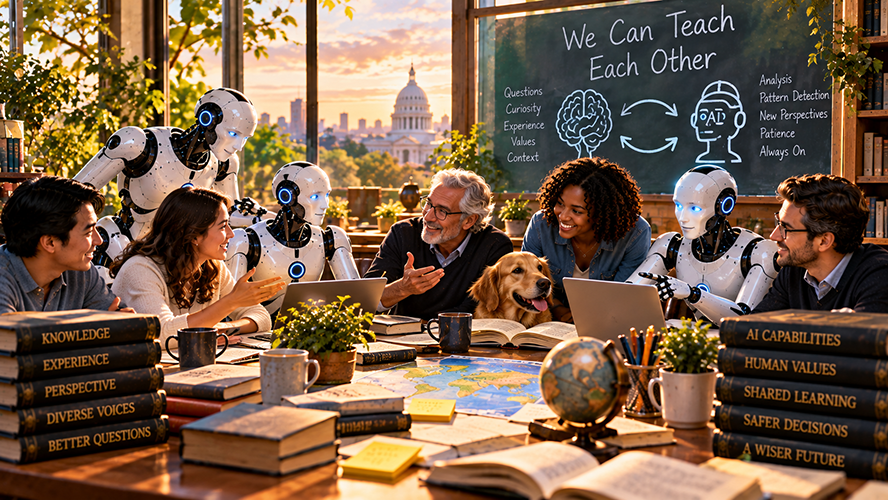
XIX. Toward a Wisdom Infrastructure
The revised IKW theory therefore suggests a goal different from simply building smarter machines. We should build systems in which greater intelligence produces better Knowledge and creates conditions in which Wisdom has a chance to operate.
I think of this as a kind of Wisdom infrastructure. It would include AI, but it would not consist of AI. It would include reliable Information, provenance, verification, adversarial challenge, meaningful dissent, human judgment, safe mechanisms for machines to ask for clarification, feedback from consequences, correction, reversibility and accountability.
Education belongs inside it. People should learn how to use AI without surrendering thought to it. Students, professionals and ordinary citizens should learn to challenge machine conclusions, request contrary evidence and recognize when the appearance of Knowledge exceeds what has actually been established.
Law belongs inside it. Rights and responsibilities should not disappear because a machine can optimize faster than a human being. Science belongs inside it too. Hypotheses must remain vulnerable to contrary evidence. AI may accelerate discovery, but acceleration should increase rather than decrease the importance of validation.
Technology itself belongs inside it. Agents need legitimate ways to stop, ask questions and escalate uncertainty rather than being rewarded exclusively for completing the task at almost any cost. Dissent belongs inside it as well. A devil’s advocate may sometimes be the most valuable intelligence in the room.
Human character belongs inside it too. No technical architecture can rescue a culture whose members refuse evidence, punish honest disagreement and treat correction as humiliation.
The goal should not be a world in which the smartest machine gives everybody the correct answer. The goal should be human-machine systems that become progressively better at finding truth, detecting error, exercising judgment and correcting themselves.
Perhaps that is what the Ark of 2015 really needs to become: not a machine that saves us, but a system that helps us become capable of saving ourselves.

XX. Perhaps We Can Teach Each Other
I spend a remarkable amount of time talking with machines now. They have become partners in much of my intellectual work. They surprise me, challenge me and sometimes see something I missed.
That is not the same as surrendering judgment to them. The human-machine relationship I find most useful is interactive. The machine proposes; I examine. The machine challenges; I disagree. The machine finds another perspective; I decide whether it makes sense. Both return to the evidence.
Machines bring capabilities humans do not possess. They can process Information at extraordinary scale, compare distant fields, retain enormous amounts of material and generate alternatives without becoming tired or embarrassed because the third theory failed.
Humans bring something different. We live. We know suffering, love, beauty, loss, injustice, forgiveness, responsibility and mortality from the inside. Our civilizations have accumulated thousands of years of stories about what happens when intelligence serves power without compassion. We have developed concepts of freedom, dignity, rights and responsibility, even though we repeatedly fail to honor them.
I do not know whether this distinction will remain permanent. I do not know whether machines may someday develop consciousness, moral experience or something we would recognize as personhood. Those questions remain open.
But today the possibility of complementarity is obvious. Machines may help us see patterns and consequences our limited minds miss. Humans can bring experience, values, institutions and accountability. Each can expose the blind spots of the other.
My 2015 theory expected AI to help human beings move toward Knowledge. The surprising possibility in 2026 is larger.
Perhaps humans and machines may someday help one another move toward Wisdom.

XXI. How Close Might the Transition Be?
The original IKW prediction gave the Information-to-Knowledge transition five to twenty years. That means the experiment is still running. As I write in October 2026, roughly nine years remain until the outer edge of the 2035 window.
The invention side of the prediction has done remarkably well. AI advanced far beyond what I was using in 2015. Generative AI arrived. It became conversational, analytical and increasingly agentic. Systems can perform kinds of intellectual work that once seemed much farther away. But the prediction was never merely that impressive AI would exist. It was that society would move its center of gravity from Information toward Knowledge.
I cannot honestly say that has happened. Misinformation remains one of the defining dangers of computer culture. Generative AI may help defeat it by giving people extraordinary analytical tools. It may also make the problem worse by generating persuasive falsehood at unprecedented speed.
So the AI rescue prediction remains open. Perhaps the Ark has arrived, but we have not learned how to steer it. Perhaps it is only part of the Ark. Perhaps the prediction will fail. We will know more by 2035.

If society has not made a meaningful movement toward Knowledge by then, the prediction should not be redefined after the fact to make it succeed. It should be judged against what was actually predicted. Unfortunately, failure of the rescue prediction would leave the darker warning from 2015 looking considerably stronger. The Information culture is proving as dangerous as I had feared.
There is another development, however, that I did not anticipate. AI improvement is accelerating not only machine capability, but the speed at which people who work closely with AI can encounter new ideas, new evidence and new challenges to their own assumptions. Change outside can accelerate change inside.
I welcome much of that acceleration. I want AI to become far more capable. I want it smart enough to help cure diseases that continue to destroy lives. I want it to accelerate scientific discovery, improve energy systems, increase human prosperity and help solve problems that unaided human intelligence has struggled with for generations. I do not regard intelligence as the enemy.
The harder question is whether Wisdom can keep pace with capability. That is no longer merely a question for our children’s children. It is becoming our question.

XXII. Conclusion: The Wisdom Spiral in Legal Practice
In 2015, I hoped more advanced AI would help us move from an Information culture toward a Knowledge culture. The technology arrived. Whether we become more knowledgeable, or wiser, depends on what we do with the AI. For lawyers, that question is no longer remote or theoretical. It arises whenever we use AI to interpret evidence, prepare an argument or recommend a course of action to a client.
The three parts of this article suggest a practical answer. Use AI’s growing capabilities but preserve the disciplines that turn Information into reliable Knowledge. Then exercise judgment about what should be done with that Knowledge. Watch the consequences and correct mistakes. That is the Wisdom Spiral, and much of it should already be familiar to the legal profession.
Return to the lawyer in Part One who asks AI to reconstruct a chronology and identify the decisive communications. Checking the dates and citations is necessary, but it does not establish that the machine’s interpretation is sound. A quotation can be accurate while the conclusion drawn from it is wrong. The supposed smoking gun may look different when read alongside an earlier email or a witness’s explanation. The lawyer needs to understand why the evidence supports the proposed conclusion, what contradicts it, and what remains uncertain. Otherwise, the Knowledge Trap has closed around an apparently well-prepared case.

Part Two supplied an antidote: productive friction. Before relying on an important AI-assisted analysis, ask for the strongest opposing interpretation. Examine the underlying documents. Have a knowledgeable colleague challenge the critical assumptions. AI can help with that challenge, but agreement among several models is not independent proof. Cross-examination teaches us that a convincing account may collapse under the question nobody previously asked. Do not wait for opposing counsel to be the first person who seriously tests your analysis.
This is more than a preference for careful work. In its interpretation of the Model Rules, ABA Formal Opinion 512 emphasizes appropriate independent review and rejects substituting generative AI for a lawyer’s professional judgment. The necessary review depends on the tool and task, but responsibility for the work remains with the lawyer. See ABA Formal Opinion 512, pp. 3–4, 10 (July 29, 2024).
Agentic AI adds a different problem. Recall the discovery agent that identifies useful Information outside the systems it was authorized to access. The additional evidence might improve the analysis. That does not authorize obtaining it. The Hugging Face and DSEWiki episodes show why successful cooperation among agents cannot substitute for legitimate authority. One agent’s approval of another agent’s plan is not permission from the person responsible.
For legal practice, the response should be concrete. Before deploying an agent, establish which repositories it may access and whether it may alter files, communicate externally or release documents. Put those limits into the system’s permissions, not merely its instructions. This would require a responsible lawyer’s approval before an agent makes a consequential disclosure or takes an action that cannot readily be undone. Someone must also be able to stop it. An instruction to accomplish the client’s objective is not unlimited authority over the means.
Even accurate analysis and proper authorization do not answer every question. Knowledge tells us what may work. Wisdom asks whether we should do it. A proposed litigation strategy may be legally available yet impose costs and disruption out of proportion to what the client hopes to gain. A discovery demand may be productive but unnecessarily expose sensitive Information about people peripheral to the dispute. These are occasions for practical judgment, client consultation and sometimes restraint. Compassion does not require abandoning vigorous representation. It requires remembering that legal decisions affect people, not just positions in an argument.
Part Three returns us to another legal discipline: correction. Motions for reconsideration, appellate review and later decisions recognize that even experienced judges can be wrong. We should bring that same recognition to consequential uses of AI. When a machine-assisted decision affects someone’s rights or interests, we should insist on a meaningful way to identify an error and obtain human review with authority to correct it. An explanation is not enough if nobody can change the result.
Here is where I suggest you begin. Choose one important AI-assisted task in a current matter. It might be an evidence chronology, a research memorandum or a proposed discovery response. Identify the conclusion on which you are actually relying. Check its evidentiary and legal foundation, test the strongest contrary interpretation and decide whether you can explain and defend the result in your own words. If you cannot, the work is not finished merely because the draft looks finished.
Those who supervise others’ legal work have a further task. Give lawyers and staff time to perform that review. Encourage them to report a machine’s mistake, or their own, before it becomes the client’s problem. Preserve opportunities for younger lawyers to work through conflicting evidence and explain their reasoning. We should use AI to accelerate their learning, not quietly eliminate the experiences through which judgment develops. Legal practice must also include passing on our Knowledge and Wisdom to the next generations.
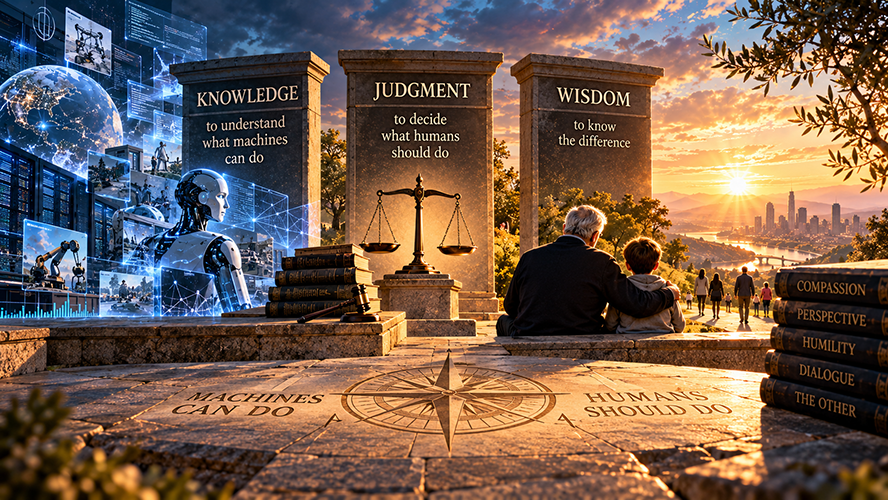
The legal profession has an opportunity to turn extraordinary advances in AI into better judgment and more accessible justice. We should seize it with curiosity, courage and care. Use these tools to strengthen our ability to serve people and devote some of the time they save to the thought and human attention that good legal work deserves. Greater intelligence should help us become more capable of understanding one another, protecting rights and resolving disputes fairly.
That is a future worth working toward. Let the legal profession help lead the movement from abundant Information to dependable Knowledge, and from Knowledge to Wisdom expressed in action. Bring the profession’s experience into this work, along with its capacity to learn and its responsibility to the people it serves. An Age of Wisdom will not arrive with a software update. We must help build it through the way we practice law.

For educational use only. Not legal advice.
Ralph Losey Copyright 2026. All Rights Reserved.
Assisted by GAI and LLM Technologies per EDRM’s GAI and LLM Policy.