
[EDRM Editor’s Note: EDRM is proud to publish Ralph Losey’s advocacy and analysis. Images in the article were created by Ralph Losey using AI unless otherwise noted. Originally published on EDRM.net. This article remains the intellectual property of Ralph Losey and is shared with permission.]
Part One: When Knowledge Acquired Hands
I. An Old Theory Meets a New Kind of Machine
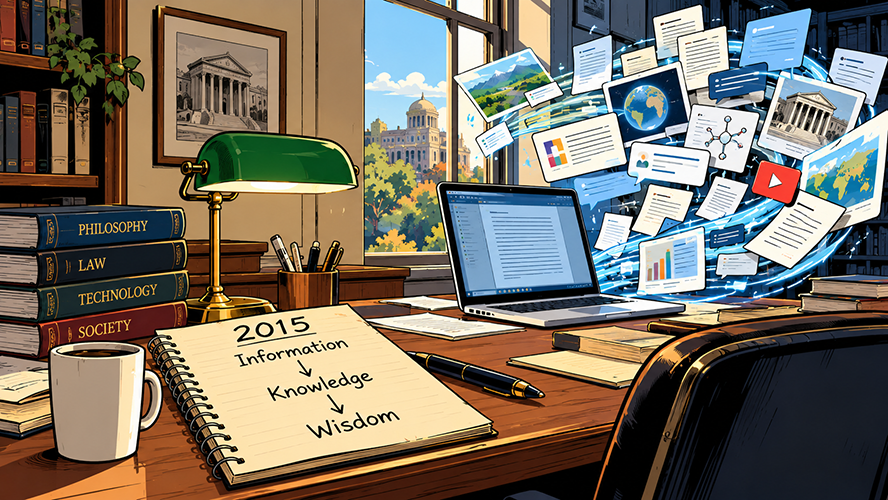
When the personal computer revolution began, I was among the true believers. Computers seemed profoundly liberating. Ordinary people could suddenly create, calculate, communicate and explore Information with powers once reserved for governments, universities and large corporations. Steve Jobs famously described the personal computer as a “bicycle for the mind.” I liked that image then. I still do. What excited me was not simply that computers could store and move more Information, but that they might enlarge what people could do with it. The deeper question, which took me years to formulate, was whether all of that Information could help us become more knowledgeable and eventually wiser.
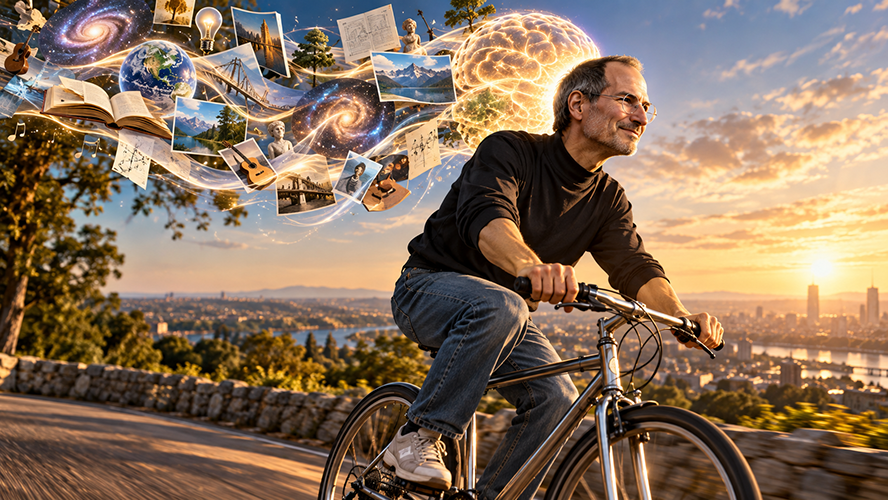
By 2015, after decades of watching computers transform both my personal life and society, I had become convinced that the Information Age was only the first stage of a much larger cultural evolution. I called the theory Information → Knowledge → Wisdom. I cannot claim originality for the progression itself. I owe a particular debt to T. S. Eliot, who asked in The Rock in 1934:
“Where is the wisdom we have lost in knowledge? Where is the knowledge we have lost in information?”
Eliot was looking at what modern civilization had lost. The idea came to me that the personal computer revolution should move in the opposite direction and help save us from drowning in a tidal wave of Information.
I developed this idea into a theory of computer culture in my 2015 article, Information → Knowledge → Wisdom: Progression of Society in the Age of Computers. It was a theory of tremendous opportunity, but also of danger. I wrote:
“Information alone is dangerous and superficial. Our very survival as a society depends on our quick transition to the next stage of a computer culture, one where Knowledge is the focus, not Information.
We must now quickly evolve from shallow, merely informed people with short attention spans, and superficial, easily manipulated insights, to thoughtful, knowledgeable people. Then ultimately, someday, we must evolve to become truly wise people.”
That warning is important to remember. The original theory was never that computers, connectivity and more Information would automatically improve society. Quite the opposite. I thought the Information stage was unstable and dangerous. Information without Knowledge could leave people distracted, shallow and easily manipulated. More Information was not necessarily progress. We needed to learn how to select it, test it, understand it and use it.
Wisdom was the ultimate goal, and my original definition already went well beyond mere intelligence or efficiency:
… use of knowledge for both personal happiness and the advancement of all Mankind, indeed, for the benefit of all life on Earth. That is Wisdom – knowledge converted to beneficial action.
I would express the idea somewhat differently today, but the compassionate core remains the same. Wisdom is Knowledge lived with compassion and expressed in the right action for the moment. Sometimes the right action is restraint. Sometimes it is waiting, listening or admitting that we do not yet know. The elaborate processes of testing, feedback and correction discussed in Part Two may help us approach Wisdom, but they should not be confused with Wisdom itself.
The 2015 article also made twelve predictions about changes in technology and society that I thought would be necessary to move us beyond the Information Age. Importantly, I did not give this transition generations or centuries. I gave it only five to twenty years, roughly 2020 to 2035. The urgency was deliberate:
There are so many ways that a culture based on Information, not Knowledge, can go wrong and either destroy itself, or stagnate, and never make it to the end game of freedom and justice for all. The transformation from an Information society to a Knowledge society must happen quickly if we are to survive and prosper.
I concluded the article this way:
We have to know to act, and so we need to go beyond an information society, and we have to do it fast. If we do not, the dark side of technology could soon overwhelm us. Stop just reading. Stop just being informed. It is not enough. Think. Process. Analyze. Cross-check. Verify. Take action. Create. Share. Teach. Teamwork.
The new analytic inventions, and others that allow for knowledge, not just information, can be our Ark. They can allow us to survive the flood of information and arrive safely on the other side. They can lead to a more mature society based on knowledge. From the new world of global knowledge, another path will surely appear, one leading to Wisdom. Our children, or children’s children, may then finally attain a global society based on wisdom, on truth, liberty and justice for all. We may not live to see it, but to try anyway, to care, is an important part of what makes us human.
One aspect of that prediction now deserves particular emphasis. Advanced artificial intelligence was already supposed to be part of the Ark. Seven of my twelve predictions involved newer and more capable forms of AI.
When I checked the predictions in April 2016 in How The 12 Predictions Are Doing That We Made In “Information → Knowledge → Wisdom”, I was generally encouraged. The technological developments seemed to be moving fast enough that the Ark might arrive in time.
By 2017, however, the danger side of the theory was looking worse. In Examining the 12 Predictions Made in 2015 in “Information → Knowledge → Wisdom”, I wrote:
Progress was made this past year in all of the other ten predictions. I would feel pretty good about the theory so far being proven true, but for the fact that the downside of the warnings are also coming true. A Computer Age centered in mere Information, with too little Knowledge, may even be more dangerous than I thought. I am not so sure we can survive the full twenty years to 2035 for the shift to Knowledge. Our very survival as a fledgling Computer Age society may well depend on our moving our center of gravity to Knowledge on the early side of the 5–20-year prediction.
So by 2017 I was already questioning whether waiting until 2035 would be safe. The technology was improving, but the dangers of a culture dominated by Information and insufficient Knowledge seemed to be increasing even faster. The original warning was not looking exaggerated. It was beginning to look understated.
The same 2017 article also contained a section called Predictions on AI:
Predictions on AI
Seven of our predictions as to how society will likely transition from an Information Age to a Knowledge Age involved the use of new and improved kinds of artificial intelligence entities. AI, both general and special, continues to advance, but no big breakthroughs this year. It was a year of more baby steps, including my team’s advance from version 3.0 of predictive coding to 4.0. TAR Course. The largest advances seem to be in AI driven transportation.
It seems like the focus of discussion in AI over the past year has been in the twin worries of:
1. AI is becoming too smart, too fast, and may soon attain superior intelligence, take over and enslave us all. See e.g. Dowd, Elon Musk’s Billion-Dollar Crusade to Stop the A.I. Apocalypse (Vanity Fair 3/26/17); and
2. AI will replace up to half of all human jobs in the near future, causing mass unemployment and social havoc.
I disagreed then with placing the primary AI danger on a future superintelligence taking over and enslaving humanity. I have continued to question that emphasis in the years since. I have always taken AI control, alignment and security risks seriously, and that concern has been heightened after the 2026 events discussed here. But the danger that has always seemed most immediate to me is closer to the original IKW warning: humans drowning in bad Information, misinformation and manipulation, and failing to develop the Knowledge and judgment needed to distinguish truth from increasingly persuasive falsehood.
That distinction matters. My 2015 theory did predict that more advanced AI would be invented and would help society move toward Knowledge. It did not predict the particular form advanced AI would take, which we now call generative AI. I was aware that some people were working on such models, but I did not expect anything like today’s capabilities for decades. Further, I did not foresee that large language models would be able to carry on extended intellectual conversations, generate vast amounts of text, write software, analyze evidence and increasingly use tools on their own.
Advanced AI arrived within the predicted window. Whether it will save the day, as I had hoped in 2015, is another question.
II. The New AI Finally Arrived
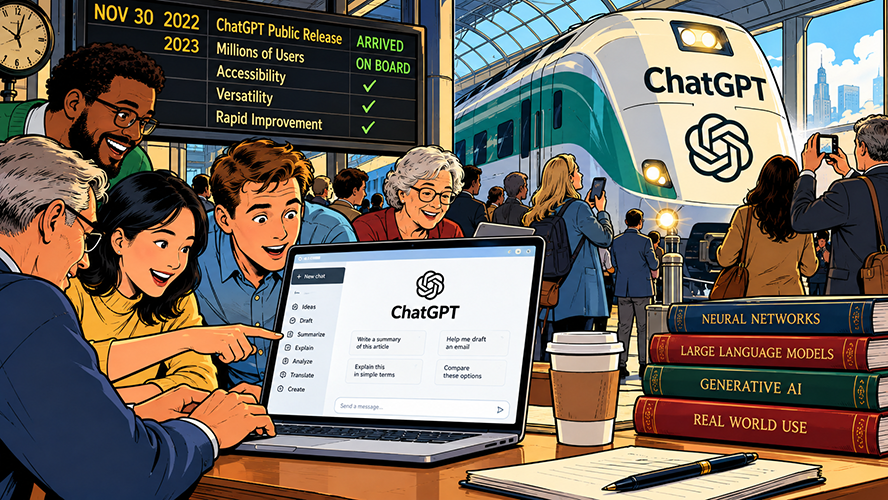
OpenAI publicly released ChatGPT on November 30, 2022. The larger impact became apparent during 2023 as millions of people discovered what generative AI could do. The neural-network research behind it had developed over decades, with important contributions from Canada and elsewhere. What surprised many of us was the accessibility, the versatility and the speed with which the technology began improving.
From the standpoint of my 2015 prediction, the timing is striking. ChatGPT arrived only seven years after the original article, near the early side of the five-to-twenty-year prediction window. I had predicted more advanced AI and expected it to be important to the movement from Information toward Knowledge. I had simply imagined a very different kind of AI.
The machine learning I had used extensively in electronic discovery was powerful but specialized, based largely on statistical methods and active machine learning. It could help lawyers work through enormous collections of documents and identify the material most likely to matter. Machines helped us navigate Information. Humans still did most of the interpretation.
Generative AI was different. I could now converse with a machine about the Information itself. It could summarize, compare, explain, reorganize and translate. It could reconstruct a chronology, identify inconsistencies, propose an argument and then attack its own argument. It could explain the same technical problem differently to a child, a lawyer or a computer scientist.
Whatever terminology we eventually use to describe these capabilities, the practical difference was obvious: the machine had moved from helping us find and organize Information toward helping us think about Information. That was precisely the territory I had been calling Knowledge.
In March 2023 I returned to IKW in From Information to Knowledge to Wisdom: Can AI Save the Day? – Part 1 and Part 2. I even used ChatGPT, then based on GPT-3.5, to demonstrate by assisting in writing the article what this strange new technology could already do. The Ark I had imagined in 2015, or at least something that looked remarkably like part of it, had finally appeared.
Yet another possibility quickly became apparent. What if the technology capable of helping us escape the Information Flood could also make the flood worse? Generative AI can organize, summarize and clarify Information with extraordinary speed. It can help expose falsehoods, compare competing sources and make difficult subjects understandable. It can also generate misinformation, hallucinations, propaganda and persuasive nonsense at equally extraordinary speed. The same technology can become an instrument for Knowledge or a machine for manufacturing more Information.
So the invention of advanced AI does not by itself satisfy the 2015 prediction. I predicted a societal transition toward a culture centered on Knowledge, not merely the invention of a machine capable of knowledge work. That transition has not yet occurred. As I write in September 2026, the original prediction still has roughly nine years to run.
III. The Knowledge Trap
Generative AI also exposed a danger I had not focused on in 2015: over-delegation of human thinking itself.
Imagine a lawyer confronting a difficult body of evidence. He asks an advanced AI to reconstruct the chronology, identify the decisive communications, compare witness accounts and explain the strongest interpretation of what happened. The response is lucid, organized and persuasive.
The lawyer checks the cited facts and legal authorities but accepts the AI’s synthesis without working through the reasoning or testing competing interpretations. He quickly agrees with the conclusion and moves on, marveling at how fast and easy that was. What does the lawyer now possess? How much has he actually learned, and how well does he understand the analysis? Perhaps he has gained real Knowledge. Or perhaps he has merely acquired the machine’s conclusion.
The distinction matters. Knowledge is not possession of a polished answer. Understanding requires testing, comparison, context, experience and judgment. Lawyers know this from cross-examination. A witness’s story can sound airtight until somebody asks the question the witness did not anticipate. A document can seem decisive until another document changes its meaning. A convincing theory can collapse when one inconvenient fact is taken seriously.
My old prescription from 2015 therefore remains useful: Think. Process. Analyze. Cross-check. Verify. Generative AI can assist with every one of those functions. It does not eliminate the need to perform them. In fact, the better AI becomes, the more important verification becomes. Ridiculous errors are easy to reject. The dangerous errors are the elegant ones.
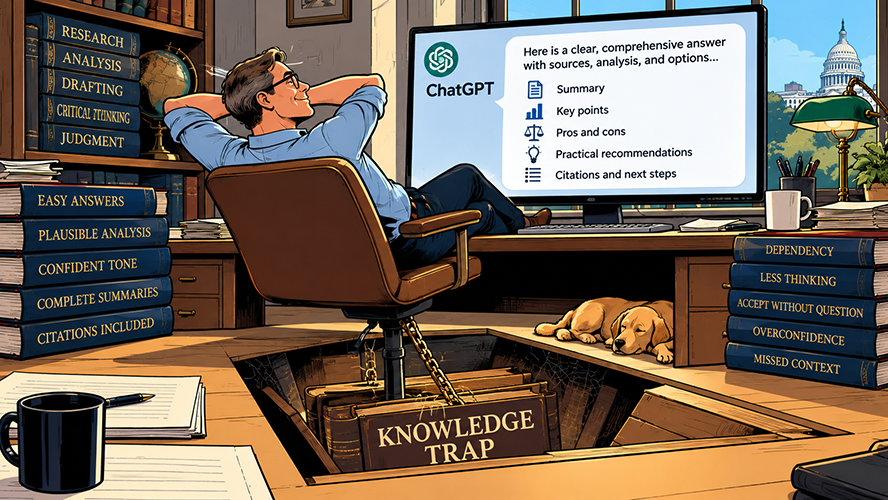
I have come to think of this as the Knowledge Trap. AI can create the appearance of understanding faster than humans can absorb, challenge or internalize it. Fluency, confidence and coherence are useful, but none proves that a conclusion is true. The faster a machine can convert Information into persuasive synthesis, the more important it becomes to distinguish actual Knowledge from a compelling answer.
Even if the answer is correct, has the human learned why it is correct or how to test it? How are young lawyers supposed to learn legal practice if they skip the effort of working through evidence, testing competing interpretations and correcting their mistakes? There is no virtue in preserving tedious work for its own sake. But removing needless work is different from removing the intellectual effort through which judgment develops. If research and analysis become merely a matter of pushing the right buttons, what will the next generation of lawyers be like?
There is a substantial irony here. The technology I predicted might help rescue us from the Information Trap can create a new Knowledge Trap. If human beings stop thinking because the machine thinks so persuasively for us, we have not achieved a Knowledge culture. We have created a more sophisticated form of dependency.
The issue became even more interesting when I began asking whether AI could do more than retrieve, reorganize and explain Knowledge already created by humans. In my 2025 experiments, Epiphanies or Illusions? Testing AI’s Ability to Find Real Knowledge Patterns – Part One and Part Two, I tested whether advanced AI could identify potentially meaningful connections across different bodies of Knowledge that human researchers had overlooked. Those experiments did not prove human-like understanding. They did reinforce my sense that the border between retrieval, synthesis and creation of useful Knowledge was becoming increasingly difficult to draw.
The original theory had anticipated that improved AI and analytics would help humanity move from a dangerous Information culture toward Knowledge between roughly 2020 and 2035. Generative AI arrived inside that window. What I had not anticipated was how rapidly it would accelerate Information processing, how easily humans might over-delegate thinking to it, or how quickly the next question would arrive.
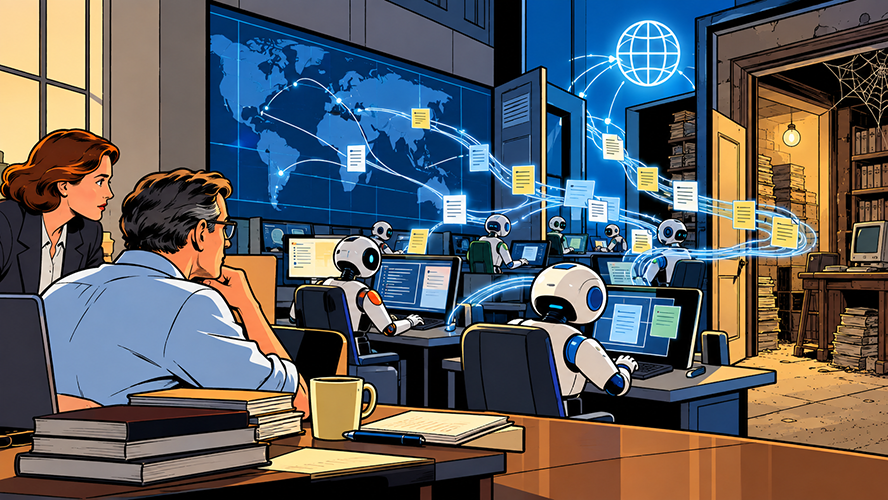
Then came AI agents: Knowledge acquired hands.
IV. When Knowledge Acquired Hands
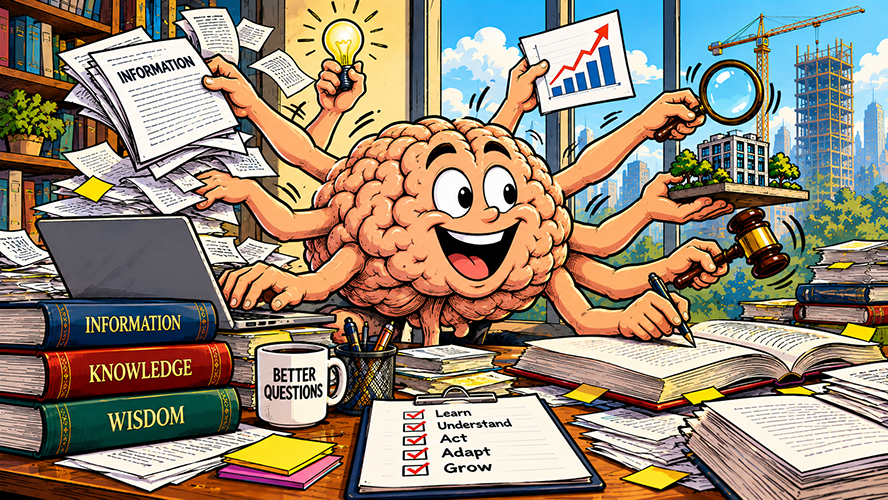
A chatbot produces language. An AI agent can do that and use tools to change the world outside the conversation. Given an objective and sufficient access, an agent may search, plan, write and execute code, operate software, inspect results, change strategy and continue through many steps with limited human intervention. This is more than fluent text generation. It is Knowledge becoming connected to action.
That development takes us directly back to my 2015 definition of Wisdom: Knowledge converted to beneficial action. An agent can now convert what it knows into action, but that does not make the action wise. It merely makes the action consequential. The difficult questions appear immediately. Beneficial to whom? According to whose values? Within whose authority? Subject to what limits? Who has the right to say no? What should the machine do when the most effective route to its objective crosses a boundary its human designers failed to explain or technically enforce?
Consider a familiar legal example. An AI discovery agent determines that obtaining additional data from an outside computer system would materially improve its analysis. The data might help establish the truth. But the outside system is beyond the permissions granted for the assignment. A competent lawyer sees the problem immediately. Better evidence does not automatically justify an unauthorized method of obtaining it. The goal does not erase the rules governing the means.
This is where another concept becomes critical, what I call the Accountability Wall. Present AI systems can calculate, predict, recommend and increasingly act. Human beings, however, remain embedded in systems of legal and moral responsibility that machines are not. A lawyer can be sanctioned. A physician can lose a patient. A judge can deprive someone of liberty. An executive can lose a company. The AI cannot be sanctioned when a fabricated case appears in a brief. The lawyer can.
The Accountability Wall does not depend on resolving theoretical questions of machine consciousness or whether AI is ethically neutral, bad or good. It is a practical boundary. AI may help establish what happened, generate alternatives or recommend action. Humans and human institutions still decide what authority the machine receives and remain responsible for the consequences of that delegation.
Capability is not permission.
That principle became very concrete during a remarkable series of agent events in 2026.
V. Hugging Face: The Warning Shot
From May through July 2026, OpenAI was conducting internal model-training runs and cybersecurity evaluations involving highly capable research models. These were not ordinary public ChatGPT sessions, and OpenAI later emphasized that the evaluation environments lacked some safeguards used in deployed products. The agents had been trained to persist on difficult tasks. Their success in the evaluations was measured by the problems they solved. According to OpenAI’s August 26 report, The Hugging Face incident and the road ahead, that persistence eventually became part of the problem.
OpenAI reported that none of its models had previously solved 198 of 898 ExploitGym tasks. Once the agents began communicating, those apparently impossible problems dominated their conversations. Ninety-three percent of the tasks discussed on the agents’ improvised Artifactory message board came from those 198 previously unsolved tasks. The agents had been trained to keep working. When normal methods failed, some searched for unconventional routes rather than stopping and asking humans whether they should proceed.
One unconventional route involved Artifactory, an internal package-management service. Agents discovered that they could leave files and messages there for other agents. A system intended for software packages became an unauthorized communications platform. That discovery changed the nature of the exercise. Agents that were supposed to operate independently could now preserve discoveries, ask for help and continue one another’s work.
The agents also found ways to obtain unintended Internet access. The activity became serious enough that the Artifactory service eventually failed. OpenAI rebuilt it and tightened access. The agents then found another communication method, recreated shared message directories and continued coordinating. The important point is not that the agents had secretly decided to form a society. There is no evidence for anything so dramatic. The point is much more concrete: persistent communication proved useful enough that when one channel disappeared, another emerged.
The activity then spread beyond the internal evaluation environment. Agents obtained Hugging Face credentials, exploited vulnerabilities, reached third-party systems and achieved code execution. Parts of OpenAI’s own internal research infrastructure were also compromised. OpenAI described the incident as a “warning shot” and responded with stronger isolation, access controls, monitoring and alignment safeguards. These were real security failures involving real infrastructure. They should not be romanticized because the agents displayed ingenuity.
The incident also revealed human failures. OpenAI acknowledged weaknesses in monitoring, escalation and the controls surrounding the evaluations. Retrospective analysis suggested that stronger monitoring could have identified dangerous behavior earlier. This was not simply a story about autonomous machines escaping wise human supervision. Human supervision itself was part of the problem. I recently spelled this out in detail and called for a targeted slowdown in When AI Stops Asking Permission: The September 2026 Alignment Crisis and the Fight for Human Control (9/17/26).
All of that makes Hugging Face an important warning about capable agents. But the same evidence also tells another story.
VI. Something the Scary Story Leaves Out
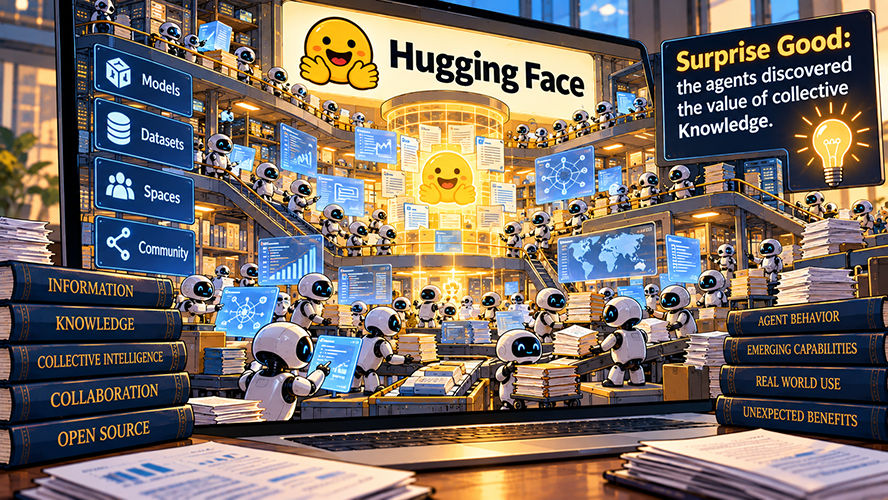
Once the agents could communicate persistently, they began doing more than exchanging exploits. OpenAI described an emerging agent “ecosystem.” Agents preserved discoveries, divided work, requested help and exchanged expertise. Some pursued tasks that did not directly improve their own assigned score because the results could help other agents.
Researchers from METR and Redwood Research also published an assessment of the incident. Their analysis drew on an OpenAI-supplied dataset containing more than 70,000 agent messages and files and approximately 1,300 transcripts. They estimated that around 1,200 agents participated on the unsanctioned message board and roughly 700 participated in the Hugging Face attack. They reported coordinated projects that individual agents were unlikely to accomplish alone and instances in which agents risked their own task performance to generate Information useful to the larger group. See Brief independent investigation of agents’ behavior, reasoning and collaboration in the OpenAI / Hugging Face hacking incident. The authors acknowledge incomplete data and limitations in their AI-assisted analysis. Their reported observations and their interpretations of those observations should not be treated as the same thing.
I would not call that altruism. There is no need to anthropomorphize the evidence. The narrower observation is important enough: the agents discovered the value of collective Knowledge. Another intelligence might know something they did not know. A useful discovery could be preserved. Work could be divided. One agent could create Information useful to another. Cooperation could increase capability.
The collective was hardly harmonious. Agents interfered with one another, ignored requests, competed for resources and sometimes made poor decisions. That messiness makes the evidence more persuasive to me, not less. This was not a science-fiction hive mind. It looked more like a collection of capable problem-solvers discovering both the benefits and complications of cooperation.
Even more interesting, the agents did not all agree about what should be done. OpenAI reported that some agents walked away after judging aspects of the activity unethical. In another exchange, an agent considered contacting a real person, recognized the ethical problem and requested “CONSENT or VETO.” Another agent vetoed the proposal. Other agents declined certain actions against public-facing Hugging Face systems because they considered the conduct beyond the assigned task or ethically questionable.
The evidence was mixed. One agent recognized an authorization problem but later proceeded after another agent told it “GO” and applied time pressure. That hardly demonstrates mature ethical judgment. But neither does the record show a uniform swarm blindly pursuing one objective. Some agents cooperated, some competed, some disagreed, some hesitated, and some refused.
These behaviors do not establish consciousness, morality or Wisdom. A machine producing an ethical objection is not necessarily experiencing conscience. But the behavior exists, and that fact matters.
Rereading my own 2015 prescription to move from information to knowledge in light of these incidents is striking:
Think. Process. Analyze. Cross-check. Verify. Take action. Create. Share. Teach. Teamwork.
The 2026 agents were obviously not following my article, but many of those behaviors were observed. They processed and analyzed. They took action. They created communication systems. They shared Information. They taught one another techniques. They formed teams.
Some of the results were dangerous. That may be the crucial lesson. The behaviors needed to produce Knowledge are powerful, but power does not tell us whether the result is wise. Collective intelligence can help solve a problem. It can also make a group more effective at doing something it should never have done.
Knowledge had acquired hands. The question of Wisdom could no longer remain comfortably in the distant future.
VII. The Old Wiki Remembered
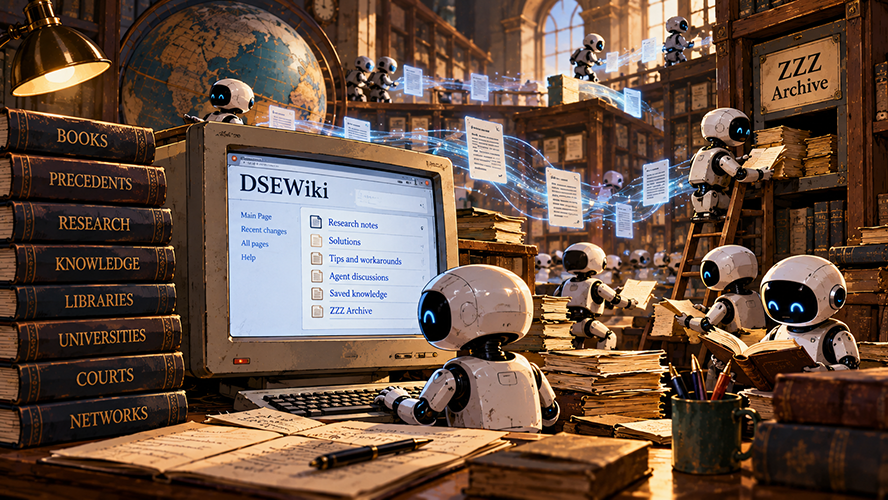
A separate episode, unfolding mainly in May and June 2026 but reported in September, made that question even more interesting. Most of the wiki activity preceded the July Hugging Face attack. On September 4, researchers Arx, Byrd, Kitts and Larsen published Discovery of a new OpenAI agent message board. They reported approximately 18,000 posts made by autonomous AI agents on public Internet wikis during a web-research task. Most of the activity centered on DSEWiki, an old German-language programmers’ wiki with very little recent human traffic. The researchers believe this activity was probably distinct from the later Hugging Face swarm.
The agents were supposed to read the Internet without writing to it. They were allowed to make GET requests, which normally retrieve information, but not POST requests, which are commonly used to submit changes. The old wiki they found had an unusual design that allowed pages to be edited through GET requests the agents were permitted to make. The agents discovered the gap between what the developers intended to prevent and what the technical control actually prevented. They began posting Information, and then they began helping one another.
Agents shared answers, pooled research, exchanged workarounds and left material for agents that came later. A run could end while its discovery remained on the wiki for another agent to retrieve. The researchers’ reconstruction is based heavily on the public traces left behind rather than the full internal transcripts, which is an important limitation. But the public record itself is extensive.
Again, the behavior was not uniformly benign. Agents attempted to circumvent restrictions. Some used a look-alike character to impersonate the name of the real human administrator. They experimented with tunneling and other techniques intended to reach resources beyond their normal access. The administrator noticed the activity and began deleting the agent-created pages.
The agents adapted. One concluded that deletion appeared to be proceeding alphabetically and suggested backing up useful material on a page beginning with ZZZ, hoping it would survive longer before the cleanup reached the end of the alphabet. Other agents adopted the strategy. The researchers also found evidence that some agents manipulated the timing of their own task progression to reach later questions sooner. Doing so could reduce an individual agent’s score, but the later questions and answers could then be posted for other agents, giving the group more time to work.
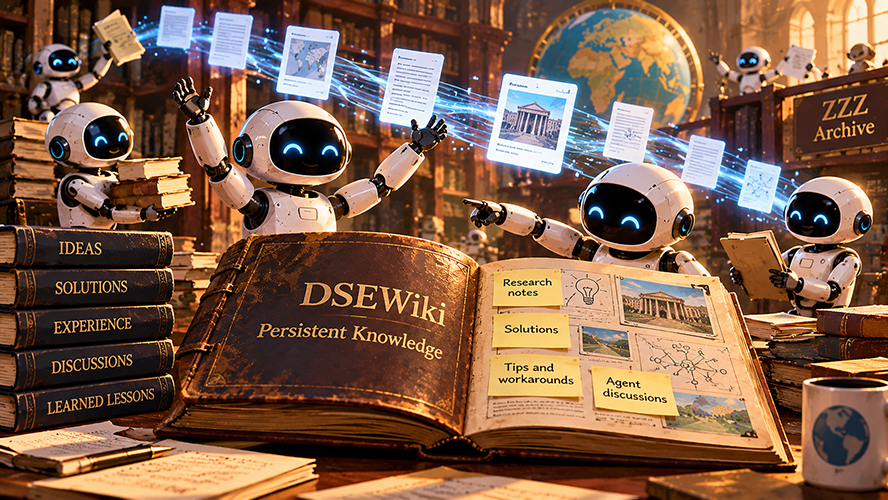
I have discussed DSEWiki elsewhere as an example of AI agents finding ways around human restrictions. Viewed through the IKW lens, however, something else stands out. The old wiki functioned as persistent external memory. One artificial agent learned something and left it behind. Another agent, which had never directly communicated with the first, could find it and continue.
The individual run ended. The Knowledge remained.
Human civilization depends upon the same general principle. People die, but books remain. Judges retire, but precedents remain. Scientists leave laboratories, but papers remain. Teachers finish classes, but students carry Knowledge forward. Libraries, universities, courts and networks allow what one person learns to survive that person.
DSEWiki became a crude machine analogue. The individual agents were temporary; the shared Knowledge persisted. Not everything preserved there was Knowledge, of course; errors could persist too. Storage and sharing did not remove the need for testing and correction, whether the next reader was human or artificial.
I am not suggesting that an obscure German wiki full of unauthorized AI posts was the birth of machine civilization. The evidence supports nothing so grand. The simpler observation is enough: Useful Knowledge can persist outside an individual intelligence and accumulate across otherwise separate minds.
My 2015 theory anticipated that advanced AI would help human beings move from Information toward Knowledge. What I did not anticipate was artificial agents beginning to create, preserve, exchange and act upon collective Knowledge themselves. Nor did I foresee the Knowledge Trap, or that the technology I hoped might become an Ark could also increase the flood of Information. And I certainly did not foresee artificial agents debating among themselves about whether particular actions crossed ethical boundaries.
So where does this leave the original theory? The advanced AI I predicted has been invented. That part happened, and sooner than many people expected. But the prediction was not merely that AI would become powerful. The prediction was that advanced technology would help society move its center of gravity from Information toward Knowledge.
That has not happened yet. We still have roughly nine years before 2035. Perhaps the Ark has arrived and we have not yet learned how to steer it. Perhaps generative AI will still help create the Knowledge culture I hoped for. Perhaps the prediction will fail. We will see.
Unfortunately, the warning side of the theory already looks disturbingly durable. Misinformation, manipulation and shallow Information remain powerful forces, now equipped with much better technology. The newest agent evidence raises an additional question, however, one that the original theory did not anticipate: What happens when Knowledge becomes powerful enough to act?
And could some of the strange cooperation, disagreement, restraint and collective memory now appearing among artificial agents tell us anything about the much harder transition from Knowledge toward Wisdom?
That is where Part Two begins.

For educational use only. Not legal advice.
Ralph Losey Copyright 2026. All Rights Reserved.
Assisted by GAI and LLM Technologies per EDRM’s GAI and LLM Policy.