

[EDRM Editor’s Note: The opinions and positions are those of Rachi Messing.]
For the past few years, the prediction in eDiscovery has been simple: generative AI is coming for first-level review, and the contract reviewer is living on borrowed time.
That isn’t what we’re seeing. Not at Altorney, and not among the law firms, providers, and corporate legal teams I talk to every week. Human reviewers are busier than ever. The Altorney platform had a strong 2025, and we’re on track to double that side of the business this year.
Our GenAI review engine, MARC, is growing too. If AI were really replacing reviewers, those two trends shouldn’t coexist. Here’s my read on why they do.
The settlement math
Take a matter that once would have needed 15 reviewers. With AI doing much of the heavy lifting, that same matter might now need three. That’s the part of the story everyone tells.
The part that gets left out: when review gets faster and cheaper, matters that never would have justified a review suddenly do. Cases that would have settled early, been resolved on search terms alone, or simply been too expensive to review properly are now worth doing right. If ten of those matters each need two or three reviewers, the total isn’t three. It’s 25 or 30.
The numbers are illustrative, but the pattern is real. Lowering the cost per document hasn’t shrunk demand for review. It has expanded the number of matters where review makes sense.
The human work AI creates
AI doesn’t take people out of review. It changes what they do. Someone still has to validate the results, QC the production, and stand behind the process when opposing counsel or a regulator asks how it was done.
The line between what AI can and can’t handle also keeps moving. Not long ago, images, handwritten notes, and poor-quality scans were a reliable reason to route documents to people, and privilege was seen as too nuanced to trust to a model. Today’s AI handles all of these well, and the list of exceptions keeps shrinking.
But each step forward has changed the work rather than removed it. Reviewers touch fewer documents per matter, while validating, QCing, and owning the result matter more. So far, every improvement in the technology has moved reviewers to a different part of the workflow, not out of it.
The shift nobody is talking about
One shift I didn’t expect: organizations that built internal review teams are rethinking them. Two years ago, a number of them told us they would never use an outside platform because they staffed review in-house. Several are now revisiting that decision.
The reason is the math above. When a matter that used to need 15 people now needs three, the next one needs two, and the one after that needs 20 for two weeks, a large standing review team gets hard to justify. Fixed overhead doesn’t fit workloads that are smaller, more numerous, and far less predictable.
What they want now is flexibility: the ability to staff each matter for what it actually needs, then scale back down without carrying the overhead between matters.
That’s the real story. Not fewer reviewers overall, but fewer reviewers per matter, far more matters, and much more volatility.
AI and people aren’t competing for the same work
We see this from both sides. Altorney builds GenAI review technology and also runs a platform for staffing human reviewers. Both are growing, and that isn’t a contradiction. It reflects how the work is splitting.
AI is taking on more and more of the analysis: scale, speed, prioritization, privilege, and surfacing what matters across huge volumes of data. People are concentrating on validation, QC, and accountability for the result, along with whatever falls outside what the technology handles today.
The matters AI makes viable still need people. Just fewer of them per matter, for shorter stretches, with sharper skills.
The organizations adapting fastest aren’t choosing between technology and people. They’re rethinking how the two fit together on each matter, and building staffing models flexible enough to change as the mix does.
Long live review
None of this means review looks the same in five years. The technology will keep improving, and the share of documents a person touches on any given matter will keep falling.
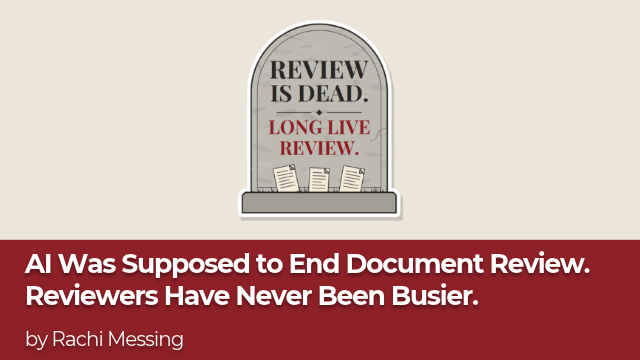
But “fewer documents per reviewer” and “fewer reviewers” are not the same prediction, and so far only the first one is coming true. Review isn’t dead. It’s being redistributed: fewer people per matter, far more matters, and a lot less predictability about when and where the work shows up.
That’s a harder market to staff for, but a bigger one. And for now, the people doing the work have never been busier.
Assisted by GAI and LLM Technologies per EDRM’s GAI and LLM Policy.