


Chair of the Project Trustees:
David R. Cohen
Partner, Reed Smith, LLP
David is a Partner at Reed Smith, LLP and Chair of the Records & E-Discovery Group. He has 30 years of commercial litigation experience in a variety of subject matters. David serves as special e-discovery counsel in many cases, represents companies in complex litigation matters, and also counsels clients on records management and litigation readiness issues.
David has been involved in setting up the E-Discovery Special Masters (EDSM) program in the U.S. District Court for the Western District of Pennsylvania, and he has been appointed to serve as an EDSM in three separate cases by three different Federal judges. He also served on the Pennsylvania E-Discovery Rules Subcommittee, chaired by Allegheny County, PA Common Pleas Judge Stanton Wettick.
In addition, David has designed and presented e-discovery training programs for judges and neutrals around the country; has authored numerous legal publications; and is a frequent presenter at continuing legal education seminars regarding e-discovery, technology, and litigation tactics.
EDRM provides a forum for leaders in the e-discovery space to propose and initiate projects. The following projects have Project Trustees (leaders) and are in various stages of completion.
Active participation by team participants contribute to the body of community created work product hosted on the EDRM.NET website. The work product is held as Creative Commons share and share alike (unless otherwise marked by a participant).
To contribute to or participate in a project, send an email with your contact information and the name of the project to Info@EDRM.NET.
Completed Projects
Artificial Intelligence
Artificial Intelligence is a wide ranging and pervasive methodology reaching all areas of life. The project concluded its exploration of its use in litigation and how it will continue to develop. The project explored and developed opportunities to educate lawyers and judges on the role of AI in litigation. The AI project, led by Trustee Kelly Atherton, senior manager of cyber incident response at Norton Rose Fulbright, has published their paper in Wiki format here.
Download the complete paper in PDF format here.
Data Mapping
This project is designed to document community standards around data mapping in response to the Senior Executive Accountability Regime (SEAR) in Ireland. The project is championed by A&L Goodbody’s Rachel McAdams, Legal Technology and eDiscovery Senior Manager and Eoghan Kenney, Data Projects Manager. Last year, the EDRM Data Mapping project conducted a survey to learn more about the EDRM community’s experiences and needs with regards to data mapping. Data mapping can be a wide-ranging subject, with stakeholders from IT to Records, Legal and many other departments within an organization. The goal of the survey was to establish how often our community engages with data mapping, and where the gaps in available resources might be. Survey results are posted here.
EDRM Revision
Recognizing that the EDRM model has not had a refresh in some time, the project focuses on updating the underlying documentation of the EDRM model to reflect changes in technology, process, and the law. Project Trustee is Tara Emory, Director of Consulting at Driven.
Sub-Projects:
- Identification
- Preservation
- Collection
- Review
- Analytics
- Production
- Presentation
Privilege Logs
A privilege log is a record of the responsive or relevant documents that are being withheld from production on a claim that they contain attorney-client communications or work-product. The purpose of the project is developing best practices that most efficiently accomplish the task, including consideration of possible rule amendments. The project has published Version 2.0 of the EDRM Privilege Log Protocol.
Processing Guidelines
This project was launched to update the processing stage of the EDRM. Organized in concert with the Merlin Foundation, this EDRM project will build processing specifications such as de-NISTing, de-duping and other functions. Project Trustees include John Tredennick, CEO of Merlin Digital Magic and Craig Ball of Craig D. Ball, PC.
Active Projects
Analytics and Machine Learning
The project’s goal is to increase the adoption of analytics and machine learning in eDiscovery and in the legal field generally. There are four active subgroups meeting on aspects of analytics and machine learning, with the overall project stewarded by Project Trustees Jan Scholtes and George Socha, with gratitude to Lilith Bat-Leah for her contribution.
Sub-Projects:
- Analytics and Machine Learning Glossary
- Analytics and Machine Learning Validation
- AI Ethics & Bias
- Demythigator
Discovery Workflow
The mission of this Team is to take a closer look at the full discovery workflow—not just in terms of traditional and updated document review protocols but then moving forward to follow-on stages of case and story building, deposition preparation, dispositive motions and trial preparation—stages of discovery that often do not get the same amount of attention as initial document review and production. The ultimate output of this Team would be decided by the Team (as with all teams) but could include one or more white papers, illustrative charts, reviews of available technology, or other reference materials useful to litigation parties, their counsel and their other service providers.
DupeID
During discovery, disclosure or an investigation, it is often useful to identify duplicate emails in data exchanged between parties, allowing legal teams to rapidly triage emails already reviewed.
While current approaches effectively identify email duplicates within native datasets, they do not enable duplicate identification across emails processed by different tools or produced in different formats. Currently no means of cross platform email duplicate identification exists.
The goal of the EDRM Duplicate Identification project is to develop a specification that will enable cross platform email duplicate identification in order to improve efficiencies.
This project is being championed by Beth Patterson, Director, ESPconnect
eDiscovery in APAC Region
eDiscovery practices and procedures in the Asia Pacific (APAC) region vary greatly depending on the origins of a given jurisdiction’s legal system. Countries with common law systems, such as Australia, New Zealand, Hong Kong and Singapore, have well-established eDiscovery practices and procedures in their respective court rules. In jurisdictions based on civil law or hybrid legal systems orders and/or directions for discovery are less common. However, discovery processes in the APAC region are commonly used in international arbitrations, for document production pursuant to notices or subpoenas to produce documents in foreign regulatory investigations, and for internal investigations.
EDRM 2.0
The iconic EDRM Model will be looked at with fresh eyes in the emerging EDRM 2.0 project. Roles are available for leaders, drafters, editors and quality control. Contact info@edrm.net to volunteer.
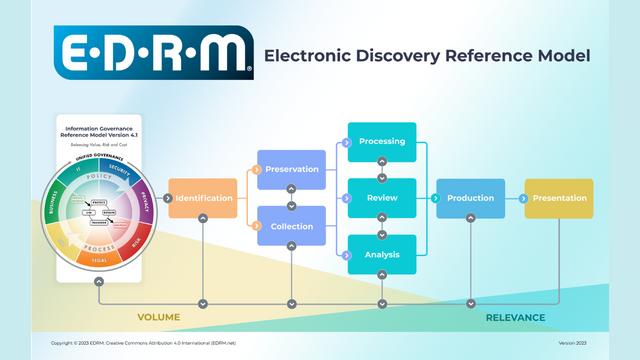
The new EDRM 2.0 project team will build on the work of the EDRM Revision team led by project trustee, Tara Emory, Senior Vice President of Strategic Growth, Redgrave Data, the IGRM 2.0 team led by Eric Mandel of Innovative Driven and the Processing Specifications led by John Tredennick of EDRM Trusted Partner, Merlin Search Technologies and Craig D. Ball. The IGRM and Processing teams’ work product is available on the EDRM website. The marketing team led by Doug Kaminski of our EDRM Trusted Partner, Cobra Legal Solutions, generated the newest IGRM Model. The EDRM Revision team reviewed and updated the supporting material for each aspect of the EDRM model.
Special thanks to Rob Robinson of ComplexDiscovery for his keen eye and assistance on the fine details of the refreshed model and to Robert Keeling and Dave Cohen for their review of the diagram.
Download the detailed 2023 EDRM model here: https://edrm.net/download/164414/?tmstv=1679073250
Download the simplified 2023 EDRM model here: https://edrm.net/download/164411/?tmstv=1679073536
ESI Protocol
The main goal of this Committee is to develop a model ESI Protocol that can be adapted and adopted for multiple cases so that case teams do not have to “reinvent the wheel” for each case. We want a model that will be palatable to most courts and parties on both sides of the “v.”—which means if you more often represent parties that do the bulk of the requesting (often the plaintiffs) rather than parties that do the bulk of the producing (often defendants), we particularly need your voices to be included, because many of our active EDRM participants work with big firms or companies that are more often on the defense side. We also recognize that there is no “one size fits all” when it comes to ESI protocol, so any model protocol developed by this project team can include optional provisions that parties can negotiate to include or not include for any particular cases. The protocol may also reference and incorporate the recently published EDRM Privilege Log Protocol, as well as a TAR Protocol that comes out of the work of the team described below.
Generative AI
Chat GPT and other Generative Artificial Intelligence Products and advances are taking the world by storm, and the legal world is no exception. This team would build on the work of prior EDRM Teams, including the Team that drafted and published the Use of Artificial Intelligence in Discovery white paper in 2021, and the recently released Professional Responsibility Considerations in AI for eDiscovery. An initial project of this Team would be to develop guidelines for the use of generative AI by legal professionals, and the Team could then determine whether to work on other related materials—or just let the AI take it from there.
GDPR Project
The project team is working toward developing a code of conduct for cross-border discovery under the EU General Data Protection Regulation. EDRM formed the team in August 2017 to examine GDPR and develop guidance for becoming GDPR compliant, particularly with an eye toward the regulation’s impact on cross-border discovery. Initially focused on data transfers from Ireland to the U.S., the guidance is aimed at mitigating some of the risk that international litigation teams and e-discovery practitioners face when balancing U.S. discovery obligations against European data privacy laws. Project Trustees are Dave Cohen, Partner at Reed Smith and Yelizaveta Kotova, Reed Smith.
Gigabyte Metrics (ESI File Size Project)
A common question for eDiscovery professionals is “How many documents/files per gigabyte?” The answer can vary widely depending on the type of file at issue. Emails and text files are typically small, which means more files per GB. PowerPoint and video files can be quite large, lowering the files per GB count. Wouldn’t it be nice to have industry averages across large files sets to acquire this information?
IGRM
The Information Governance Reference Model was initially created to frame the discussion of information management, in the same way the Electronic Discovery Reference Model functions for e-discovery. The project focuses on updating the IGRM model as well as recognizing the interconnection between this project and the Maturity Assessment project. Maturity is measured in part by reviewing the level of collaboration among key stakeholders which is at the very core of excellent information management. Project Trustees Eric Mandel, Consultant at Driven and Lynn Molfetta, Information Governance Specialist for MC Bernstein Data, building on the work of Eric Sedwick.
Special Masters and eDiscovery Mediation
There are several state and federal courts around the country that have implemented a discovery facilitative mediation program over the last 5 or 6 years. This project involves identifying all such programs and determining how successful they have been. By comparing and evaluating such programs, we learned that there are certain factors/components that distinguish a highly successful program from a less successful program.
Download the EDRM Special Masters and Discovery Mediation Bench Book Final 2022 Version and give feedback to be incorporated into the 2023 version from the project page.
Jay Yelton, Partner at Warner, Norcross + Judd is the Project Trustee.
State Rules
The State Rules Project, with Suzanne Clark and Janice Yates as Project Trustees, seeks to gather, organize and publish a cross reference of State eDiscovery Rules with the US Federal Rules of Civil Procedure.
The following states are covered by these EDRM leaders, and the project team welcomes those from other states to participate:
| Name | Organization | State(s) |
| Karen Bridges | Schwartz & Kanyock, LLC | Illinois |
| Vince Carnevale | Milberg Coleman Bryson Phillips Grossman | Pennsylvania, West Virginia, Puerto Rico |
| Suzanne Clark | eDiscovery CoCounsel, pllc | Florida |
| Tammy Dahl | Mesch Clark Rothschild | Arizona |
| Darcy Deibele | Lane Powell | Washington, Oregon, Alaska |
| Ryan Duplechin | Beasley Allen | Alabama, Nevada, Wisconsin |
| Sheila Grela | Procopio, Cory, Hargreaves & Savitch LLP | California |
| Dana Hollenbeck | Klinedinst PC | California |
| John Hopkins | Searcy Denney Scarola Barnhart & Shipley | Florida |
| Cynthia Johnson | Hogan Lovells | New York |
| Alex Khoury | Balch & Bingham LLP | Georgia, Mississippi, Alabama |
| Mark Lyon | Williams & Connolly | D.C., Mississippi |
| Doug Matthews | Vorys, Sater, Seymour and Pease LLP | Ohio |
| Alexzandria Neumiller | Prime Therapeutics LLC | Minnesota |
| Kristen Perkins | Pullman & Comley | Connecticut |
| Arshia Sajedi | Practice Aligned Resources | California |
| Janice Yates | Prism Litigation | Michigan |
| Stephanie Zaleskin | Office of General Council, University of North Texas System | Texas |
| Colleen Zea | Computer Forensic Resources | South Dakota |
TAR Protocol
Similar to the ESI Protocol Team but this one would focus specifically on predictive coding and take a shot at developing a generally accepted protocol for the use of technology assisted review to reduce the burden and costs of more traditional linear document review, while still maintaining or improving accuracy. The above comments about representation from both sides, and the ability to include optional provisions, also apply to any model TAR protocol. This Team would build on the EDRM TAR Guidelines published in 2019 by an earlier EDRM Team. Ability to remove your advocacy/preferred platform hat is essential.
Testimony Evidence Reference Model (TERM)
This team is dedicated to addressing the differences between managing documentary and testimonial evidence in legal cases. Most of the documentary evidence produced in a case consists of documents that were generated before (sometimes years before) the initiation of a matter, and many of those documents may have only tangential relevance to the case. In contrast, most of the testimonial evidence deemed relevant to a case is generated after the initiation of the matter and tends to be specifically focused on the matters in dispute. This project aims to create a model that bridges this gap. Michael Okerlund, CEO of CloudCourt, an EDRM Trusted Partner, and Sheila Grela, paralegal at Buchalter, are leading the initiative.
Text Message Metadata Primer 1.0
A frequent eDiscovery pain point is the absence of education regarding metadata that is available for text message data that can be found on phones. The project will tackle educating legal, litigation technology and corporate investigative professionals on the metadata that is available for text message data. Monica Harris, Product Business Manager, Cellebrite Enterprise Solutions, and Matt Rasmussen, founder and CEO of ModeOne, are the co-Project Trustee.