

What happens when AI stops being a search tool and starts working the case with you
[EDRM Editor’s Note: EDRM is grateful to Trusted Partner Merlin Search Technologies for permission to publish. The opinions and positions are those of the authors. All images in the article are from Merlin Search Technologies.]
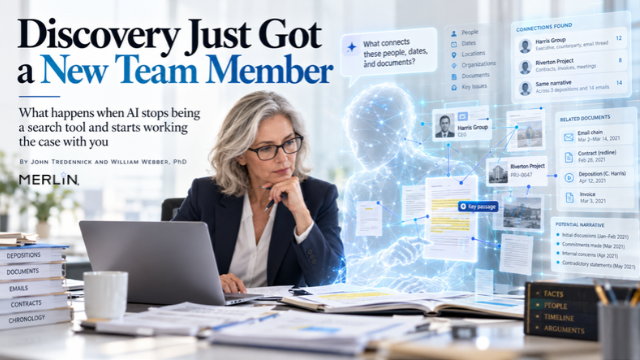
Imagine starting a new matter and finding that, before you have written a single search term, a member of your team has already read the first thousand documents. It has flagged the three people who seem to matter most, found a project code nobody mentioned in the kickoff meeting and drafted a list of questions you had not thought to ask.
That team member is not a junior associate. It is AI.
This is not hypothetical. William Webber and I have been building and testing this way of working, and we believe it represents an even bigger change in discovery than technology-assisted review (TAR), the machine learning approach I helped bring to document review more than a decade ago. TAR changed how we reviewed documents. AI changes how we work the matter. Discovery just got a new team member.
How Discovery Has Always Started
I spent the first 20 years of my career as a trial lawyer. Every case came down to the same questions. Who knew what? When did they know it? What did they say when they thought nobody important was listening?
But discovery never let us start there. It started with a guess. What words might the people in these documents have used? We built keyword lists, negotiated them with opposing counsel and hoped we had guessed right. Then a review team spent weeks reading the results, and only after that could the senior lawyers begin to see the shape of the case.
The machine found words. People did everything else. For 30 years, that was the deal.
What Changes When AI Joins the Team
Generative AI breaks that deal. For the first time, the technology does not stop at finding documents. It can read them, connect them and tell you what they appear to show.
That changes where a matter begins. Instead of a search string, you start with the question you actually care about. Suppose you were investigating the Post Office Horizon scandal, in which hundreds of British subpostmasters were wrongly prosecuted on evidence from a faulty computer system. Your question would be: What did Fujitsu know about the problems, when did it know, and what did it do?
That is not a search. It is an assignment. And it is exactly the kind of assignment you would give a capable colleague.
From there, your AI teammate goes to work. It explores an early set of documents to learn the vocabulary, the players and the issues. It asks clarifying questions. It runs keyword, semantic and machine learning searches underneath, choosing the right tool for each part of the job. Then it reads what it finds and comes back with an account: what appears to have happened, where the evidence conflicts, what is still missing and which documents support each point.
Then the real work starts. You push back. What points the other way? Was the fix ever tested? Did the litigation team know what the engineers knew? Each question sends your teammate back into the collection. You are no longer reviewing a list. You are running an investigation.
Don’t miss our EDRM webinar on November 3, 2026, at 1 PM ET. We have a great panel of speakers who will be talking about this new era of discovery where AI becomes an integral part of the team.
John Tredennick and Dr. William Webber, Merlin Search Technologies.
Learn more about the webinar and register here.
What We Learned Building It
Getting here taught us three things that surprised us.
First, the old tools still matter. When we gave semantic search, the natural language technology that is supposed to replace keywords, the code name “Project Checkmate,” it found nothing useful. To a language model, “checkmate” means chess. Plain keyword search found 34 relevant passages in its first 50 results. An AI teammate has to use every tool, not just the newest one.
Second, AI can teach the search. We had a large language model read and judge the first 50 results of a search, then used its most confident calls to train Continuous Active Learning, the machine learning method behind TAR 2.0. The search immediately got sharper. The share of relevant documents in the next 50 rose from 66 percent to 77 percent, without a lawyer training anything by hand.
Third, and most important, the output changed. Once AI could search, read and learn, a ranked list of documents started to look like the wrong product. Lawyers do not want documents. They want to know what happened.
A Better Division of Labor
Few lawyers went to law school to write Boolean strings or read thousands of marginally relevant emails. We did that work because it stood between us and the work that mattered.
An AI teammate takes on much of that burden: searching broadly, reading at scale, sorting, connecting facts and drafting the first account. The lawyer does what only a lawyer can do. Decide which questions matter. Judge which witness to believe. Spot the answer that is plausible but wrong. Build the strategy and advise the client.
That does not make lawyers less important. It means they spend more of their time being lawyers.
Trust, but Verify
A teammate who writes persuasive reports can also be persuasively wrong. William has spent his career asking one question about search: how do we know it worked? That question matters more now, not less.
We work by three rules. Every conclusion must point back to the documents behind it, so a lawyer checks the evidence instead of trusting the summary. The search underneath still has to be measured, because an account is only as complete as what the system read. And someone has to hunt for what is missing: sample what the system ranked low and look for the people and terms that never surfaced.
None of this is new. It is the same discipline that made technology-assisted review defensible, applied to a new kind of work product.
What Comes Next
Most of the profession still begins discovery with a keyword list. That will not change overnight, and keywords will keep their place. But the firms that bring AI onto the team will see the shape of a matter in days instead of months. They will follow leads that used to be too expensive to chase. And smaller matters will be able to afford the kind of investigation that once only the biggest cases could.
For 30 years we asked our tools which keywords to use, because that was the only question they could answer. Now we can ask a teammate the question every trial lawyer has always wanted answered.
What happened?
EDRM Webinar – Beyond Search: From Keywords to AI Integrated Discovery
Don’t miss our EDRM webinar on November 3, 2026, at 1 PM ET. We have a great panel of speakers who will be talking about this new era of discovery where AI becomes an integral part of the team.
Learn more about the webinar and register here.
Assisted by GAI and LLM Technologies per EDRM’s GAI and LLM Policy.