

Author: Dr. William Webber
← Back to Blog
Search
Authors
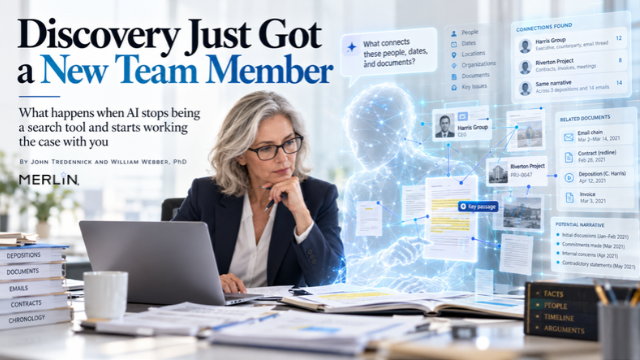
Discovery Just Got a New Team Member
Imagine starting a new matter and finding that, before you have written a single search term, a member of your team has already read the first thousand documents. It has flagged the three people who...
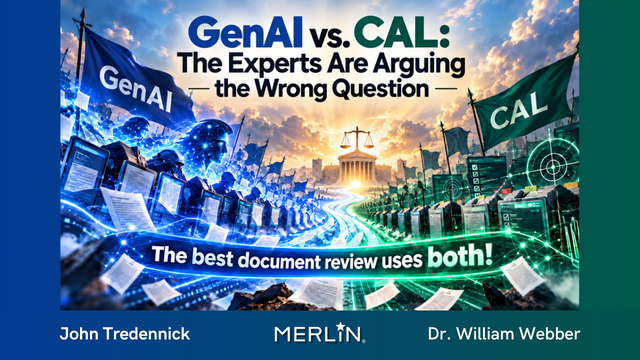
GenAI vs. CAL: The Experts Are Arguing the Wrong Question
In June, researchers at Redgrave LLP threw down the gauntlet in a debate that has been building across discovery for years. Their study compared Relativity’s generative AI review tool with a conventional review team using...
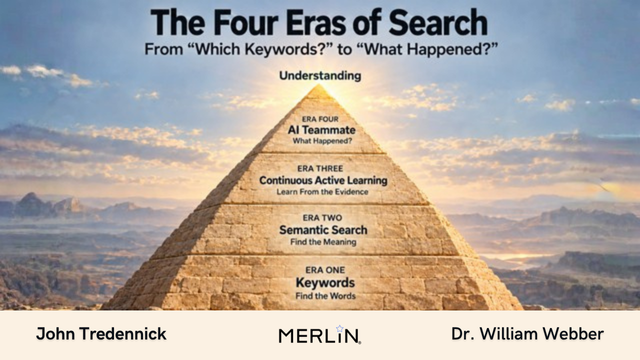
The Four Eras of Search: From “Which Keywords?” to “What Happened?”
For the first 20 years of my career, I asked questions for a living. As a trial lawyer, I wanted to know what really happened. Who knew about the problem? When did they know? What...
Beyond Search: From Keywords to AI-Integrated Discovery
John Tredennick and Dr. William Webber’s fourth article in a series that began with Hybrid Search and now turns to AI-Integrated Discovery.
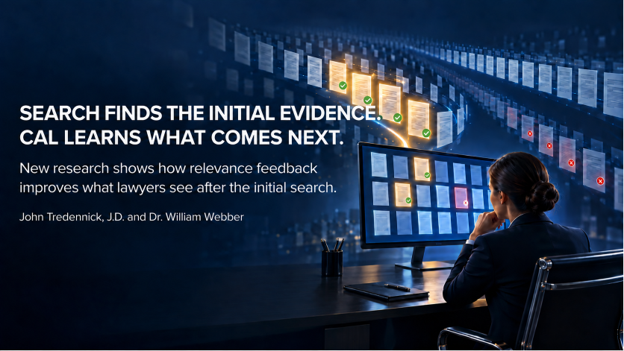
Search Finds The Initial Evidence. CAL Learns What Comes Next.
The results of LLM hybrid search are explored in Merlin Search Technologies’s Hybrid Search series conclusion, exploring what the system should do after the search engine finds the first few relevant documents, continue with search,...
AI Search Can Find the Meaning. But It Can Still Miss the Evidence.
Semantic search can uncover meaning that keyword queries miss, but opaque project names, codes, and distinctive phrases can expose its blind spots. Using the “Project Checkmate” test, John Tredennick and Dr. William Webber explain why...
Keyword Search Isn’t Dead. Searching With Keywords Alone Should Be.
Keyword search remains indispensable, but it is no longer sufficient. John Tredennick and Dr. William Webber explain how keyword search, semantic search, and continuous active learning can work together to uncover evidence that any one...
Generative AI for Smart Discovery Professionals
The 4th edition of Generative AI for Smart Discovery Professionals shows how legal teams can leverage AI for document review, deposition synthesis, and investigative reporting—while aligning with emerging ethical standards.
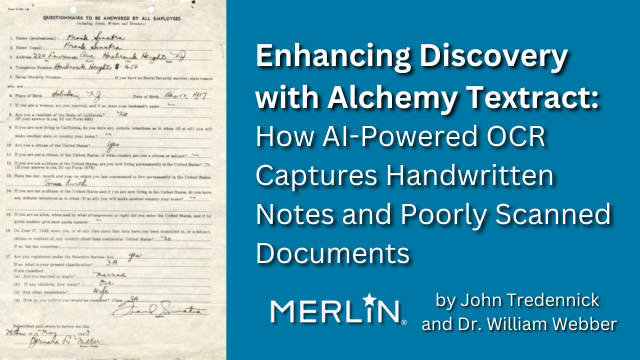
Enhancing Discovery with Alchemy Textract: How AI-Powered OCR Captures Handwritten Notes and Poorly Scanned Documents
Alchemy Textract uses AI to overcome traditional OCR limitations by accurately extracting handwritten notes and complex elements from legal documents. This advanced approach empowers legal teams with more reliable data for investigation and AI-driven analysis.

The Final Challenge: How GenAI Crafted BP’s “Impossible” Closing Argument
This article explores how generative AI tackled one of the most challenging legal arguments—BP’s defense in the Deepwater Horizon trial. Using advanced AI models, the team at Merlin Search Technologies demonstrated how AI can analyze...

Creating a Compelling Argument in the BP Trial: Government Plaintiffs’ Closing
This article explores how generative AI transformed trial preparation by crafting a sophisticated closing argument for the government in the BP Deepwater Horizon case. It highlights AI’s ability to analyze evidence, build legal narratives, and...

Creating a Compelling Argument in the BP Trial: Halliburton’s Closing
This article explores how Generative AI, using DiscoveryPartner, crafted Halliburton’s closing argument in the BP trial by analyzing extensive trial materials and providing an evidence-based defense.