[EDRM Editor’s Note: EDRM is proud to publish Ralph Losey’s advocacy and analysis. Images in the article were created by Ralph Losey using AI unless otherwise noted. Originally published on EDRM.net. This article remains the intellectual property of Ralph Losey and is shared with permission.]
Confidentiality, Quantum Evidence, AI-Quantum Systems, and Human Judgment
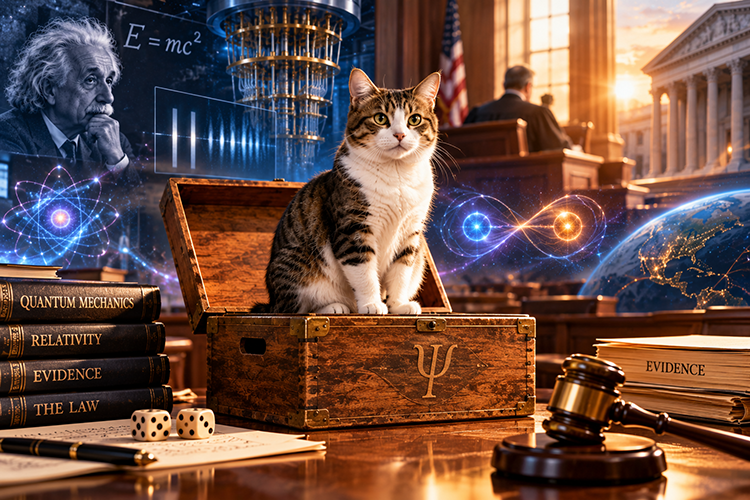
At the end of Part One, Schrödinger’s Cat had left the box, crossed from the laboratory into the courtroom, and, with a little artistic license, acquired counsel. The image was whimsical. The transition was not.
Part One followed the Cat from Schrödinger’s 1935 thought experiment through the double-slit experiment, Einstein’s dice, entanglement, Bell, and finally into modern quantum computing. The legal lesson was not that lawyers need to master the foundations of physics. It was that a definite result can emerge from a chain:
process → interaction → measurement → record → interpretation → judgment.
In modern computing, that chain may include a quantum processor, conventional computers, AI models, cloud platforms, software layers, vendors, experts, and human decision-makers. By the end of Part One, we reached a proposition that will become increasingly important to law:
The legally important object may be the entire decision-producing system.
Part Two follows that system into the legal world. One problem is already here: protecting information that must remain confidential long enough to survive the transition to post-quantum cryptography. Another is still developing: what lawyers and courts should demand when quantum-generated results are offered as evidence.
The subjects sound exotic. The legal questions are surprisingly familiar.
Quantum Law Is Already Here
The evidence problem is developing. The confidentiality problem is already here.
A sufficiently capable quantum computer, often called a cryptographically relevant quantum computer, or CRQC, would threaten important public-key cryptographic systems now used for key establishment and digital signatures. RSA, a widely used public-key cryptographic system, and elliptic-curve systems are among the principal technologies at risk. They are woven throughout modern digital infrastructure, including certificates, authentication, secure communications, software signing, virtual private networks (“VPNs”), and other mechanisms used to establish trust between computers and users. NIST, What Is Post-Quantum Cryptography?
That does not mean that every form of encryption suddenly becomes useless when sufficiently powerful quantum computers arrive.
Symmetric encryption is a different problem. The National Institute of Standards and Technology (“NIST”) currently states that applications can continue using the Advanced Encryption Standard (“AES”) with 128-, 192-, or 256-bit keys. Known quantum attacks affect these systems differently from the attacks that threaten RSA and elliptic-curve public-key cryptography. NIST, Post-Quantum Cryptography: Frequently Asked Questions.
Passwords are different again. A password ordinarily controls access to an account or system. Encryption protects information through cryptographic algorithms and keys. Making a password longer does not repair an RSA or elliptic-curve system that has become vulnerable to a quantum attack.
Nor would Q-Day mean that a quantum computer could simply sit at a live login screen and try trillions of passwords every second until one worked. Online systems can still limit repeated attempts, lock accounts, require multifactor authentication, and use other defenses. A more serious password problem arises when an attacker has already stolen password hashes and can test guesses offline without those restrictions. Quantum computing can theoretically speed certain brute-force searches, but that is a very different problem from the quantum attack on RSA and elliptic-curve cryptography. Quantum computers do not make passwords and public-key encryption fail in the same way.
These distinctions matter because Q-Day is easily misunderstood.
Q-Day is useful shorthand for the future point at which quantum computing becomes capable of defeating important deployed public-key cryptography at an operationally useful scale. It may never arrive as a single dramatic date announced on television. A government or sophisticated intelligence service might possess a capability before making that capability public.
The range of possible outcomes is therefore wide.
In a best-case scenario, a CRQC arrives slowly enough that governments, businesses, law firms, courts, cloud providers, and other organizations have already migrated their important systems to post-quantum cryptography. Q-Day then becomes less a catastrophe than the end of a long and difficult technology transition.
In a worst-case scenario, a government or other sophisticated actor develops the capability earlier than expected and keeps it secret. Previously harvested encrypted information could become readable while vulnerable RSA and elliptic-curve systems remain widely deployed. Digital signatures, certificates, authentication systems, secure communications, and other parts of the infrastructure of digital trust could also become vulnerable. If that capability were exploited broadly before critical systems had migrated, cascading failures could disrupt banking, communications, government services, transportation, health care, energy, and other essential infrastructure. At the outer edge of the risk, widespread infrastructure failure could produce severe economic disruption and social disorder.
The actual result will probably be uneven. Some systems will have migrated. Some legacy systems will remain exposed. Some stolen information will no longer matter. Other information, including privileged communications, trade secrets, health information, source code, and national-security material, may still be enormously valuable.
More importantly for lawyers, part of the risk arrives before Q-Day.
That is the significance of harvest now, decrypt later, or HNDL.
An adversary can steal or intercept encrypted information today, retain it while the encryption remains secure, and hope to decrypt it years later when better capabilities become available. No CRQC is needed to begin harvesting the data. NIST expressly identifies HNDL as one reason organizations should begin protecting long-lived information now. See NIST, What Is Post-Quantum Cryptography? The joint Cybersecurity and Infrastructure Security Agency (“CISA”), National Security Agency (“NSA”), and NIST guidance likewise urges organizations to begin inventories, risk assessments, migration planning, and vendor engagement before a CRQC exists. See CISA, NSA & NIST, Quantum-Readiness: Migration to Post-Quantum Cryptography.
For lawyers, the practical question is not simply, When will Q-Day occur?
It is:
How long must this particular secret remain a secret?
Some information loses value quickly. Other information may remain sensitive for ten, twenty, or thirty years: trade secrets, health and genetic information, privileged communications, source code, internal investigations, intellectual property, litigation archives, and national-security information.
Now combine the secrecy period with migration time.
Suppose information must remain confidential for fifteen years. Suppose it takes five years to identify vulnerable systems, replace products, renegotiate vendor arrangements, test new cryptography, and re-protect important legacy data. If usable quantum decryption arrives within ten years, the organization did not have fifteen years to prepare.
For information already harvested that must remain secret for fifteen years, the risk already exists.
No one knows the date of Q-Day. Uncertainty about the date is therefore not a reason to ignore the problem. In some circumstances, it is a reason to start earlier. NIST notes that movement from a new cryptographic algorithm to widespread implementation has historically taken 10 to 20 years. NIST, What Is Post-Quantum Cryptography?
Preparing for Q-Day means migrating before vulnerable cryptography becomes a crisis.
Why Lawyers Need to Prepare Before Q-Day
That is why post-quantum cryptography, or PQC, has crossed the boundary from research into implementation. For an introduction to PQC, see the NSA’s page, Post-Quantum Cryptography: Primer (10/01/26). The NSA Primer starts simple.
Post quantum cryptography (PQC) is designed to be the safeguard against attacks targeting both standard and quantum computers. Using this system of cryptographic algorithms is critical for securing critical networks against the novel capabilities of quantum computers.
While traditional encryption protects networks from adversaries today, a powerful quantum computer could break through those defenses exponentially faster. As stable quantum computers get closer to reality, the transition to PQC is critical for public key infrastructure security.
“Post-quantum” should not be confused with “guaranteed safe forever.” No cryptographic system comes with that promise. New weaknesses may be discovered. Software can be implemented badly. Keys can be stolen. Endpoints can be compromised. The important distinction is more practical: RSA and elliptic-curve cryptography are threatened by a sufficiently capable quantum computer; the new PQC standards were specifically designed to resist known attacks from quantum as well as classical computers.
The federal government has now gone much further.
On June 22, 2026, Executive Order 14412, Securing the Nation Against Advanced Cryptographic Attacks, expressly recognized the danger that adversaries can collect American information now and decrypt it later. For federal High Value Assets and high-impact systems outside National Security Systems, the order calls for migration to PQC for key establishment by the end of 2030 and digital signatures by the end of 2031. It also directs the Federal Acquisition Regulatory Council, commonly called the FAR Council, to develop procurement requirements for covered federal contractors. The FAR Council helps maintain the Federal Acquisition Regulation (FAR), the government-wide rules governing federal procurement. Executive Order 14412, Securing the Nation Against Advanced Cryptographic Attacks.
Two days later, the White House Office of Management and Budget (OMB) issued Memorandum M-26-15, Execution of the Migration to Post-Quantum Cryptography. The memorandum establishes a phased migration extending through 2035, emphasizes cryptographic inventories and risk prioritization, and directs agencies to make their systems cryptographically agile. OMB, Memorandum M-26-15, Execution of the Migration to Post-Quantum Cryptography.
None of these developments means every law firm, corporation, or federal contractor suddenly has the same PQC deadline. They do mean that the direction of travel is no longer theoretical. Post-quantum migration is entering government information systems, national-security systems, cloud architecture, procurement planning, commercial products, and vendor relationships.
That creates legal work now.
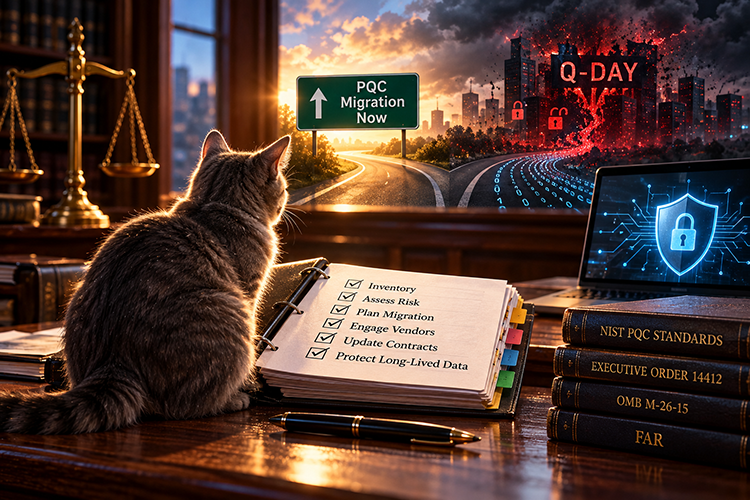
A sensible beginning is a cryptographic inventory:
What important information does the organization possess?
How long must it remain confidential?
Where is vulnerable public-key cryptography used?
The answer may not be obvious because cryptography can be buried inside software, cloud services, authentication systems, VPNs, certificates, application programming interfaces (“APIs”), and key-management infrastructure. NIST’s migration project treats identification of vulnerable cryptography as a foundation for deciding what must be migrated and in what order. NIST National Cybersecurity Center of Excellence, Frequently Asked Questions About Post-Quantum Cryptography Migration.
Then comes cryptographic agility.
Can a system accept new cryptographic algorithms without being rebuilt from scratch? OMB describes cryptographic agility as an architectural principle that permits an organization to switch algorithms with minimal disruption. It can require configurable software, modern cryptographic libraries, flexible protocols, and key-management systems capable of handling different algorithms and types of keys. OMB, Memorandum M-26-15, Execution of the Migration to Post-Quantum Cryptography.
The algorithms selected by NIST have certainly been tested by an international community of cryptography experts for several years, but their implementations are still young. We still lack the hindsight to fully validate their robustness. Organizations must therefore prepare to change cryptographic mechanisms, not just to select a new one.
One post-quantum algorithm under consideration by NIST was successfully attacked by a pre-quantum computer in late July 2026. Anthropic’s Claude Mythos Agents discovered a mathematical flaw in HAWK. It had already reached the third round of NIST’s additional signature standardization process and was immediately withdrawn. Arnaud Dufournet, Crypto-agility: the real question is no longer “which algorithm?” but “how do you change it?” (TheGreenBow, 10/13/26).
The fast changes in this area are where contracts and legal advice become important.
A vendor’s statement that a system is “secure,” “quantum ready,” or “quantum safe” may sound reassuring while telling counsel almost nothing useful. More practical questions are familiar ones:
Has it been tested by the latest AI Agent swarms?
Which NIST standards does the product support?
When will they be implemented?
Can the product support a staged or hybrid transition?
Who controls the keys?
How will migration be tested and documented?
What audit rights exist?
What do subcontractors provide?
Who bears the cost if the product must be replaced?
What happens if the vendor misses its migration commitments?
Cloud computing does not eliminate those questions. It changes their allocation. OMB’s federal guidance similarly requires agencies to address vendor and cloud-provider responsibilities as part of PQC migration planning. OMB, Memorandum M-26-15, Execution of the Migration to Post-Quantum Cryptography.
Outsourcing the technical work does not outsource the need for judgment.
The HNDL problem should also cause lawyers to look again at data retention. Cheap storage encouraged organizations to preserve vast amounts of data indefinitely. Sometimes that is required. Sometimes it is useful. Sometimes it is simply easier than deciding what can be deleted.
But information that remains encrypted and valuable for decades can also become a long-term liability. That does not mean destroying records because quantum computers might someday exist. Legal holds, statutes, regulatory requirements, contracts, records schedules, and legitimate business needs remain controlling. Nor does deleting your copy help if an attacker already has another one.
The better question is more disciplined: What must be retained, for how long, under what authority, and at what continuing confidentiality risk?
Even sealed court records illustrate the distinction. A sealing order is a legal restriction on access. Encryption is a technical protection. One does not replace the other. A sealed record can still move through electronic filing systems, networks, remote-access systems, backups, authentication services, and cloud infrastructure. Quantum computing does not somehow “unseal” a court record, but a sufficiently capable quantum computer could threaten its confidentiality if its protection depends on vulnerable cryptography. Vulnerable cryptography could eventually threaten technical systems used to preserve its confidentiality or integrity.
Professional-responsibility principles already point in the same direction. ABA Model Rule 1.1, Comment [8] states that maintaining competence includes keeping abreast of changes in law and practice, including the benefits and risks associated with relevant technology. ABA Model Rule 1.1, Comment [8] – Maintaining Competence. Model Rule 1.6(c) requires reasonable efforts to prevent unauthorized disclosure of, or unauthorized access to, information relating to a representation. ABA Model Rule 1.6 – Confidentiality of Information. Model Rule 5.3, Comment [3] specifically addresses lawyers’ use of outside nonlawyer services, including document-management companies and internet-based storage services. ABA Model Rule 5.3, Comment [3] – Nonlawyers Outside the Firm.
The ABA Model Rules are models, not themselves binding law in every jurisdiction, and state rules vary. But they illustrate why cryptographic migration cannot simply be dismissed as somebody else’s technical problem.
Years from now, if a confidentiality failure is examined in litigation, an insurance dispute, a disciplinary proceeding, or a client inquiry, the decisive question may not be whether counsel predicted Q-Day correctly. The questions may be far more ordinary. What was known at the time? What standards existed? Was the risk evaluated? Were vendors questioned? Was a migration plan considered? Were competing costs and risks weighed? And was the decision documented?
A good file will not prove that every technical decision was perfect. It may show that the judgment was reasonable, or maybe not.
The Cat reached the witness stand: not just the result, but the entire system must withstand scrutiny.
When Quantum Results Become Evidence
The confidentiality problem is present. The evidence problem is more prospective, but it is no longer difficult to imagine.
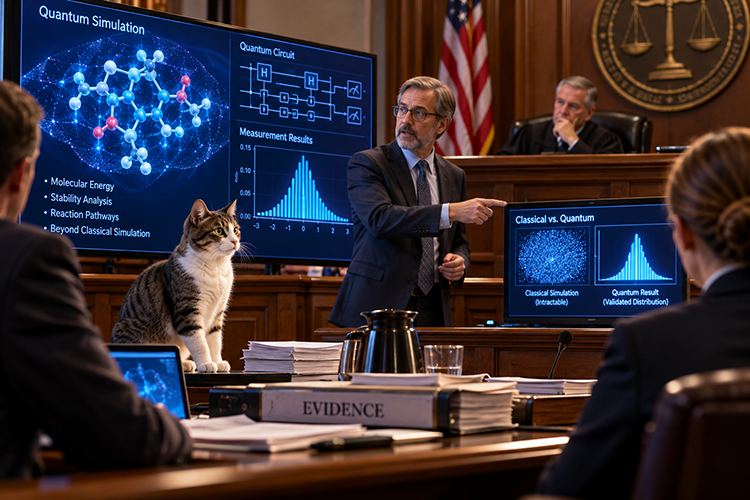
Suppose a party offers expert testimony based on a quantum chemistry computation. The expert says the hybrid Quantum-AI system analyzed a molecular problem beyond the practical reach of available classical simulation and that the result supports an opinion concerning toxicity, molecular stability, patent validity, drug development, or product design.
Opposing counsel asks the obvious question: Can we reproduce the computation on an ordinary computer?
The expert answers that exceeding practical classical computation was part of the reason for using the Quantum-AI system in the first place. In other words: No, not within the practical reach of available classical computing.
That answer does not end the inquiry.
It begins it.
If exact classical replication is unavailable, lawyers and courts will need other ways to assess reliability.
How was the computation validated?
What was the role of AI in the system?
What smaller problems were compared with known classical results?
What quantum hardware was used?
How was it calibrated?
What errors were detected?
Which runs were accepted or rejected?
What software prepared the inputs and processed the measurements?
What assumptions were built into that software?
Did an AI system choose parameters, assist with error control, classify results, or help translate the output into the expert’s ultimate opinion?
And by the time litigation begins, nobody is going to subpoena the original quantum state. It is gone. What remains will largely be ordinary electronic evidence about an extraordinary computational process.
That evidence may include source code, software versions, circuit descriptions, input data, model assumptions, calibration histories, error-correction or error-mitigation settings, shot counts, measurement records, configuration files, API logs, rejected-run records, preprocessing code, post-processing code, operator notes, vendor documentation, validation studies, and expert workpapers.
That is why quantum evidence is likely to become system discovery.
Producing only the final answer could be the computational equivalent of producing an expert’s conclusion while withholding the instruments, tests, assumptions, calculations, and data used to reach it.
The Cat gives us a useful structure:
process → interaction → measurement → record → interpretation → judgment.
Each link presents a different question. What process was selected? What physical interaction produced the measurements? What did the hardware actually record? What happened to those records afterward? What software transformed them? What assumptions entered the process? What uncertainty remained? And who finally decided what the result meant?
The important point is that the evidentiary object may no longer be a single output. It may be the entire chain that produced, recorded, transformed, validated, and interpreted that output.
That brings us to the next question. If lawyers can discover that chain, how should a court decide whether it is reliable enough to trust?
Quantum evidence may begin in uncertainty, but courts still need a reliable basis for deciding what to trust.
From Identity to Fidelity: How Courts Can Test Quantum Evidence
I call the central distinction Identity versus Fidelity. Lawyers often associate verification with Identity: run the process again and obtain exactly the same result.
That instinct works well in many settings. But exact sameness is not the only form of reproducibility. Classical simulations can be probabilistic. AI systems can be probabilistic. Quantum computation may intentionally produce a distribution of measurement outcomes rather than one identical result on every execution.
Identity asks whether the same output appears again. Fidelity asks whether the system behaves faithfully to the validated process, within known and acceptable limits of error and uncertainty.
Fidelity is not an excuse for unreliability. A litigant should not be permitted to say, “Quantum mechanics is probabilistic, so different answers are normal. Trust us.” Hell no. You always have to verify.
The proponent has to explain what behavior was expected, how the system was validated, how uncertainty and error were measured, which limitations remain, and whether the opinion offered in court stays within what the methodology can actually support.
That sounds like Federal Rule of Evidence 702.
Under Federal Rule of Evidence 702 – Testimony by Expert Witnesses, the proponent must demonstrate to the court that it is more likely than not that the Rule’s requirements are satisfied. Among other things, the testimony must be based on sufficient facts or data, be the product of reliable principles and methods, and reflect a reliable application of those principles and methods to the facts of the case.
The 2023 amendment to Rule 702 is particularly important here. The Committee Note explains that sufficiency of the expert’s basis and reliable application of methodology are questions for the court in determining admissibility; they cannot automatically be dismissed as matters that merely affect weight. The amendment also emphasizes that an expert opinion must remain within the bounds of what the expert’s basis and methodology can reliably support. See the Committee Notes on the 2023 Amendment accompanying the Cornell Legal Information Institute Rule 702 page.
Quantum evidence does not escape that inquiry because the mathematics is difficult. Nor does it escape because a conventional computer cannot reproduce the entire computation. If anything, the absence of straightforward classical replication makes the validation record more important.
That record might include:
comparisons with smaller problems that classical computers can solve;
statistical consistency across repeated runs;
quantified error bounds;
calibration data;
controlled changes to hardware or noise;
tests on different processors;
independent human and AI Agent review of code and methodology; and
evidence that a conclusion remains reasonably stable when legitimate assumptions are varied.
Researchers are already confronting versions of this problem.
In July 2026, IBM and Algorithmiq announced what they described as a demonstration of quantum advantage accompanied by a framework for establishing trust when exact classical verification is unavailable. See IBM and Algorithmiq, IBM and Algorithmiq Demonstrate Quantum Advantage, Establishing a Framework for Trusted Quantum Computation Beyond Classical Verification. That is an IBM-Algorithmiq research claim, not a judicially accepted validation standard. The scientific community can and should continue scrutinizing claims of quantum advantage.
Its significance here is narrower. Researchers are already facing a question that judges may eventually face:
How do you establish justified confidence in a computational result when direct reproduction by the old method is no longer available?
That question becomes still harder when AI enters the system. As Part One discussed, AI is already being used experimentally in quantum control. In July 2026, researchers from Google Quantum AI reported that reinforcement learning could use quantum error-detection signals to adjust control parameters and stabilize quantum error correction while the system was operating. See Volodymyr Sivak et al., Reinforcement Learning Control of Quantum Error Correction, Nature 655, 879–884 (2026). It has yet to be seen what swarms of the latest AI Agents can do.
For discovery, the consequence is straightforward. If AI helped calibrate the hardware, choose parameters, respond to error signals, mitigate errors, interpret measurement records, or transform results into recommendations, then the AI becomes part of the evidentiary history.
An excellent AI model does not by itself establish that quantum hardware was properly calibrated. Still, reinforcement learning can be used to adjust control parameters and address calibration drift during operation. Id.
The legal inquiry therefore follows the whole control loop. Here are the kinds of questions that should be asked:
Who defined the objective?
Who selected the quantum algorithm?
Who selected the AI model?
What system prepared the input?
Which processor performed the quantum operations?
What generated the measurements?
What software stored and transformed them?
What errors were detected?
What role did AI play?
Which human reviewed the result?
What information did that person receive?
And, critically, what authority did that person actually have to reject the recommendation?
Putting a human at the end of the chain does not necessarily create meaningful human control.
If the person cannot understand the important assumptions, examine the validation record, question the system, or reject an unsupported recommendation, the arrangement may amount to little more than human-in-the-loop theater.
The final legal responsibility remains human. Machines may calculate probabilities. Software may organize the results. AI may assist in interpreting them. Experts may explain them.
But lawyers still must advise.
Judges still must decide.
Courts cannot remain in superposition.
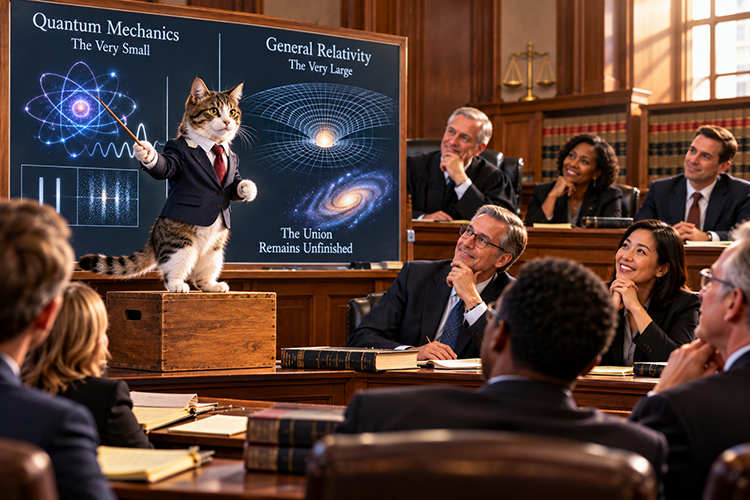
Quantum theory conquered the very small. General relativity conquered the very large. Their union remains unfinished.
Einstein’s Other Unfinished Problem
There is a useful final caution before we leave the founders behind.
Einstein helped create the quantum revolution he later challenged, while his theories of relativity transformed our understanding of space, time, energy, and gravity. Quantum theory and special relativity were successfully brought together in twentieth-century physics. General relativity proved much more difficult.
Quantum mechanics describes the microscopic world with extraordinary success. General relativity describes gravity and the large-scale structure of spacetime with extraordinary success. Yet physics still lacks an experimentally confirmed theory that fully unites gravity with the quantum framework. No gravity particle has ever been found, but they are still looking.
That unresolved problem does not weaken the enormous empirical success of quantum mechanics. It teaches a different lesson.
A theory can predict with extraordinary accuracy and support powerful technologies while still leaving deep questions unanswered about the ultimate nature of reality.
Lawyers working with frontier technologies need the same discipline. We should distinguish what has actually been measured, what has been independently demonstrated, what follows from a validated method, what a vendor or expert claims, and what remains uncertain.
Those categories are easiest to blur precisely when the mathematics is intimidating and the presentation is impressive. Do not be blinded by the math. Ask the hard questions on practical applications.
Complexity is not proof.
Schrödinger’s Cat teaches the lawyers: probability may shape the evidence, but judgment remains human.
Conclusion: What the Cat Still Teaches Lawyers
Schrödinger created his Cat because he wanted to expose a problem, not solve one. Almost a century later, the Cat remains useful for much the same reason.
Quantum computing will not require lawyers to decide whether Bohr, Einstein, Schrödinger, Everett, or anyone else had the final word on the meaning of quantum mechanics. Nor will lawyers need to perform quantum calculations themselves.
They will need to recognize when quantum technology changes the facts relevant to a legal decision.
Sometimes that change will concern confidentiality. Information that must remain secret for decades creates a present planning problem because harvest-now-decrypt-later shifts part of the quantum risk backward in time.
Sometimes it will concern evidence. A result produced by a hybrid quantum-classical-AI system may require discovery of the system that produced it rather than blind reliance upon a final number.
Sometimes it will concern reliability. Identity may be impossible or beside the point, while Fidelity to a validated probabilistic process becomes crucial.
And sometimes it will concern judgment. A sophisticated system can produce a probability, prediction, simulation, or recommendation. That does not decide what a lawyer should advise, what risk a client should accept, what evidence should be admitted, or what judgment a court should enter. That remains the human part of the system.
The history of generative AI should make lawyers cautious about assuming that unfamiliar technology will remain somebody else’s problem until it is mature. AI moved rapidly from research laboratories into legal research, drafting, discovery, client systems, expert work, and court filings.
Quantum computing may develop differently and probably more slowly. Or maybe not. Some forecasts will prove exaggerated. Some proposed applications will fail. Useful fault-tolerant quantum computing may take longer than optimists expect. On the other hand, quantum computers may surprise everyone, much like generative AI did. If I had to predict an outcome, I’d go with that one. Just consider what the swarms of AI Agents are already doing.
The uncertainty about exactly what will happen, and when, is good cause to avoid both complacency and hype.
The confidentiality transition has already begun. NIST standards exist. Federal migration programs are underway. National-security timelines are being implemented. Hybrid classical-quantum systems are being built, and AI is intimately involved in quantum control research. The evidentiary questions can therefore be seen well before the first major quantum-generated expert opinion reaches a courtroom.
That is enough reason for lawyers to begin learning the questions. Not because lawyers should become quantum physicists. Because lawyers have always worked at the boundary between specialized knowledge and human judgment.
We do it with AI companies, physicians, engineers, accountants, forensic scientists, statisticians, economists, cybersecurity experts, and software systems. Quantum computing adds a new kind of expertise and some new forms of uncertainty. It does not eliminate the lawyer’s traditional responsibility to understand enough to ask the right questions, identify what remains unknown, test claims against evidence, and decide what deserves reliance.
That is also the reason I created Quantum Law: From Causation to Probability. The free public Short Summary introduces the legal implications of quantum computing for confidentiality, cybersecurity, evidence, AI, contracts, privacy, insurance, causation, probability, and judgment. The full course goes further into Q-Day, harvest-now-decrypt-later, post-quantum migration, Identity versus Fidelity, system discovery, Rule 702, AI-quantum systems, probabilistic causation, and the continuing responsibility of human decision-makers.
The legal profession has just learned from generative AI that waiting until a technology becomes unavoidable is not a sound competence strategy. Quantum computing is the continuation of that lesson, not an unrelated subject.
Schrödinger put the Cat in the box to expose a question that quantum mechanics could not make disappear: How do several possibilities become one definite recorded result? That question now has a legal counterpart. When a quantum or AI-quantum system produces probabilities, simulations, and machine-generated conclusions, how does that output become evidence on which a lawyer can advise, a client can act, or a court can decide?
The answer cannot be simply to trust the machine. Lawyers will have to protect the data, discover the system that produced the result, test its fidelity, understand its limitations, and insist on a record that can be challenged.
Schrödinger’s Cat began as a problem of measurement. In court, it becomes a problem of judgment.
The machine may calculate the possibilities. The law still has to decide.
The box is open. The judgment remains ours.
For educational use only. Not legal advice. Ralph Losey Copyright 2026. All Rights Reserved. Assisted by GAI and LLM Technologies per EDRM’s GAI and LLM Policy.
Ralph Losey is the creator of QUANTUM LAW: From Causation to Probability, a self-paced course on AI, quantum computing, evidence, cybersecurity, privacy, and legal judgment, and author of the e-Discovery Team blog, established in 2006. Ralph Losey is a lawyer, tech researcher, educator and writer. After 45 years of legal practice with several local and national law firms, Ralph retired in 2026. He continues his service to the profession as CEO of Losey AI, LLC, providing non-legal educational services on AI and quantum law. Ralph has long been a leader among the world's tech lawyers. He has presented at hundreds of legal conferences and CLEs around the world and written over two million words on AI, e-discovery, quantum and other tech-law subjects, including seven books. Ralph has been involved with computers, software, legal hacking, and the law since 1980. Ralph had the highest peer AV rating as a lawyer and was consistently selected as a Best Lawyer in America in four categories: E-Discovery and Information Management Law, Information Technology Law, Commercial Litigation, and Employment Law - Management. For his full resume and list of publications, see his e-Discovery Team Blog. Ralph has been married to Molly Friedman Losey, a mental health counselor in Winter Park, since 1973 and is the proud father of two children and grandfather of two more.
With deep sadness, we share the loss of Kaylee Walstad, Chief Strategy Officer of EDRM and an extraordinary advocate, mentor, and friend to so many in the eDiscovery and legal technology community. Kaylee’s generosity, encouragement, and compassion touched countless lives, and her legacy lives on in the people and organizations she lifted.
To honor Kaylee’s remarkable life and lasting contributions, we invite you to share your own memories, reflections, and images. Your tributes will help celebrate the joy she brought to others and the light she shared so freely with everyone she encountered.