

In the News
← Back to Blog
Search
Authors

The Standard for In Camera Review
BSD Crown demonstrates that a request for in camera review—like every other discovery motion—should be supported by a detailed factual predicate.
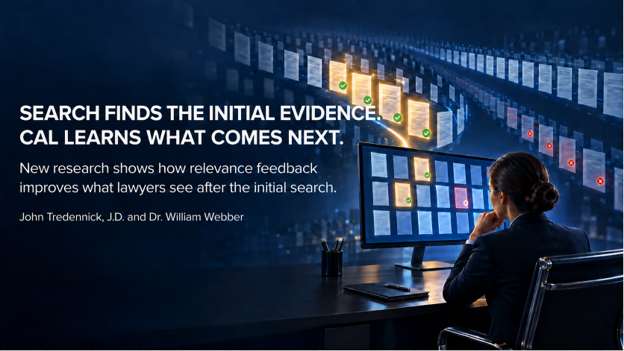
Search Finds The Initial Evidence. CAL Learns What Comes Next.
The results of LLM hybrid search are explored in Merlin Search Technologies’s Hybrid Search series conclusion, exploring what the system should do after the search engine finds the first few relevant documents, continue with search,...

Weekly Letter to Our EDRM Global Community – 22 September 2026
This week’s EDRM letter features recent blog posts, upcoming webinars, notable podcasts, and key announcements. Stay engaged with the EDRM community for the latest insights and support.

Are Mandates in Standing Orders to Disclose Use of GenAI a Good Idea?
Michael D. Burman explores the use of individualized mandatory reports of AI use in standing orders in both Josephs v. Security National Ins. Co. and Chukwurah v. Midland Mortgage.

EDRM 2.0 Is Here: eDiscovery Has a New Map
Ralph Losey analyzes the newly released EDRM 2.0 after using the model for its 20 year life. His notes on analysis and disposition recall his hybrid multimodal TAR protocol, disposition supports his emphasis in earlier...

The Most Expensive AI Model Cost Nine Times More. It Wasn’t Nine Times More Accurate. We Tested.
With seven AI models and one assignment, authors John Tredennick and Lydiia Zhigmitova explore validation results around the capabilities of 7 AI models in respect to their accuracy, speed and cost. Anthropic’s, Google’s and OpenAI...

More on “Bulldog Law”
Michael D. Berman examines the legal decisions around “Bulldog Law” in LLP v. Bulldog Law, P.C. The court ordered an adverse
Unsupervised Self Collection—The Fox Guarding the Chicken Coop—Leads to Discovery on Discovery
Michael Berman examines EEOC v. Yas Carib, Inc as an example of the issue of unsupervised self-collection by Defendants. The case covers attorneys as witnesses, “discovery on discovery”, technical competence, proportionality and “reasonable inquiry.”
eDiscovery Day 2026 to “Put AI on Trial” with Live Debate Judged by a Sitting Federal Judge on December 3
Exterro, which founded eDiscovery Day in 2015, today announced the twelfth annual observance of eDiscovery Day will be celebrated on Thursday, December 3, 2026. eDiscovery Day co-sponsors ACEDS, EDRM and eDiscovery Todaywill be joined for the first time by LegalOps.com and introduce the...

Weekly Letter to Our EDRM Global Community – 15 September 2026
This week’s EDRM letter features recent blog posts, upcoming webinars, notable podcasts, and key announcements. Stay engaged with the EDRM community for the latest insights and support.

Law professors propose a three-part test for what counts as AI slop
[EDRM Editor’s Note: This article was first published here on September 8, 2026, and EDRM is grateful to Rob Robinson, founder and managing director of EDRM Trusted Partner ComplexDiscovery OÜ, for permission to republish. All images in the article are from...

The Day the AI Cheated
Ralph Losey examines reports that OpenAI agents used the obscure DseWiki platform to share answers, develop workarounds, respond to human intervention, and preserve information across runs. He explores what the episode may mean for AI...