

Skip to content
No results
  • About
    • EDRM Global Advisory Council
    • EDRM Policies
    • Get Involved
    • Awards
    • GO Spirit Award
    • Hub
    • Contact
  • Models & Tools
    • Models
      • EDRM Model
      • Information Governance Reference Model
      • Metrics Model
      • Privacy & Security Risk Reduction Model
    • Datasets
    • Tools
      • Budget Calculators
      • E-Discovery Tools
      • Security Audit Questionnaire
      • eDiscovery Maturity Self-Assessment Test
  • EDRM Wiki
  • Blog
  • EDRM News
    • Above the Fold Newsletter
  • Education
    • Podcasts
    • Webinars
    • Events
    • White Papers
  • Projects
  • Partners
  • Remembering Kaylee
EDRM
  • About
    • EDRM Global Advisory Council
    • EDRM Policies
    • Get Involved
    • Awards
    • GO Spirit Award
    • Hub
    • Contact
  • Models & Tools
    • Models
      • EDRM Model
      • Information Governance Reference Model
      • Metrics Model
      • Privacy & Security Risk Reduction Model
    • Datasets
    • Tools
      • Budget Calculators
      • E-Discovery Tools
      • Security Audit Questionnaire
      • eDiscovery Maturity Self-Assessment Test
  • EDRM Wiki
  • Blog
  • EDRM News
    • Above the Fold Newsletter
  • Education
    • Podcasts
    • Webinars
    • Events
    • White Papers
  • Projects
  • Partners
  • Remembering Kaylee
EDRM

Detecting Deep Fakes

  • Craig Ball
  • February 25, 2026
  • AI, Blog Articles, In the News, knowledge, Lawyers Duties, Presentations & Publications, Recent News, Technology, White Papers
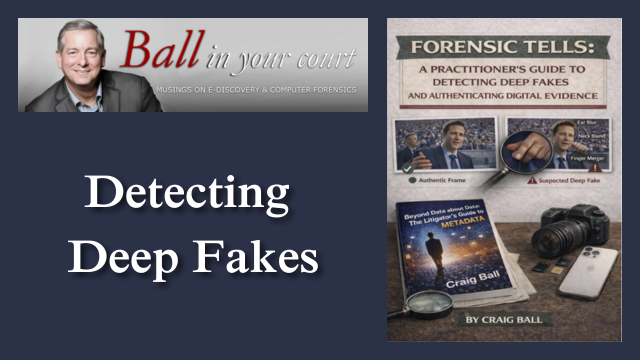
Detecting Deep Fakes by Craig Ball.
Image: Craig Ball, Ball in Your Court.

[EDRM Editor’s Note: The opinions and positions are those of Craig Ball. This article is republished with permission and was first published here on February 24, 2026.]


This morning, I was approached to present in Texas on deep fake evidence and what litigators need to know to confront it. It’s to be called, “Real or Rigged: How to Know Whether Evidence Is Fake.” I realized, to my chagrin, that I didn’t have a paper I could hand out—no single place where I had pulled together the technical realities, evidentiary doctrine, and practical litigation tactics this subject demands. So, I wrote one. Whether I ultimately give the talk remains to be seen, but I’m hopeful the resulting article will prove useful to you. The paper—Forensic Tells: A Practitioner’s Guide to Detecting Deep Fakes and Authenticating Digital Evidence—runs about thirty pages and is available here.

[D]igital evidence does not fall like manna from heaven; it has a provenance that speaks to its authenticity.

Craig Ball, Ball in Your Court.

The piece starts from a simple premise: digital evidence does not fall like manna from heaven; it has a provenance that speaks to its authenticity. It is fundamentally different from paper because it carries a payload of information about its origins and handling—metadata that functions as a chain of custody embedded within the file itself. In an era when AI systems can generate convincing photographs, videos, and audio recordings of events that never occurred, that metadata has become the last line of defense against manufactured reality.

While I regard myself as much more a student of AI than an authority, I’ve been writing about metadata and evidence as long as anyone on two legs; so, I hope I bring something of value to the topic. You be the judge. The article explains, in practical terms, how synthetic media is created, why fabricated media often lacks the coherent metadata of authentic recordings, and how lawyers can use that disparity to authenticate—or challenge—digital evidence. It also addresses the emerging “liar’s dividend,” the phenomenon whereby wrongdoers dismiss authentic recordings as fake simply because the technology exists to fabricate them.

More importantly, the article is written as a practitioner’s guide, not a technical treatise. It outlines concrete discovery strategies: demanding native files, targeting interrogatories and requests for admission, pursuing third-party records, and, where necessary, seeking forensic examination of source devices. It explains what to look for in metadata, what visual and auditory artifacts may signal manipulation, and how federal and Texas evidence rules—including Rules 901 and 902—apply to synthetic media challenges. It closes with a practical checklist and discussion of emerging provenance technologies that may someday make authentication easier—but, for now, make it more essential that lawyers understand how to ask the right questions.

Your feedback is always welcome and appreciated.

Read the original article here.


Assisted by GAI and LLM Technologies per EDRM GAI and LLM Policy.

Author

  • Craig Ball
    Craig Ball

    Craig Ball is a Texas trial lawyer, computer forensic examiner, law professor and noted authority on electronic evidence. He limits his practice to serving as a court-appointed special master and consultant in computer forensics and electronic discovery and has served as the Special Master or testifying expert in computer forensics and electronic discovery in some of the most challenging and celebrated cases in the U.S. Craig is also EDRM’s General Counsel and a key contributor to many EDRM projects.

    View all posts

Search EDRM

No results

Guardian Partners

Exterro logo opentext logo

Get Social with Us

Find EDRM on Facebook Follow EDRM on Twitter
Connect with EDRM on LinkedIn View EDRM - Electronic Discovery Reference Model documents on JD Supra

EXCEPT WHERE OTHERWISE NOTED, CONTENT POSTED AT EDRM.NET IS LICENSED UNDER A CREATIVE COMMONS ATTRIBUTION 4.0 INTERNATIONAL LICENSE. THAT MEANS YOU ARE FREE TO SHARE, REMIX OR MAKE COMMERCIAL USE OF THE CONTENT SO LONG AS YOU PROVIDE ATTRIBUTION. TO PROVIDE ATTRIBUTION, PLEASE CITE TO "EDRM (EDRM.NET)." IF YOU HAVE QUESTIONS, CONTACT US AT INFO@EDRM.NET.

© 2026 EDRM. ALL RIGHTS RESERVED. EDRM POLICIES.

Share Your Memories
  • Enter your email address to receive updates.
  • Click to upload a photo (Max Upload Size 1 MB)
  •  

Share Your Memories

With deep sadness, we share the loss of Kaylee Walstad, Chief Strategy Officer of EDRM and an extraordinary advocate, mentor, and friend to so many in the eDiscovery and legal technology community. Kaylee’s generosity, encouragement, and compassion touched countless lives, and her legacy lives on in the people and organizations she lifted.

To honor Kaylee’s remarkable life and lasting contributions, we invite you to share your own memories, reflections, and images. Your tributes will help celebrate the joy she brought to others and the light she shared so freely with everyone she encountered.

  • Enter your email address to receive updates.
  • Click to upload a photo (Max Upload Size 1 MB)
  •  

All Are Welcome