
From 722 Manuscripts to Math 2.0: Proof, Understanding, and the Future of Science
[EDRM Editor’s Note: EDRM is proud to publish Ralph Losey’s advocacy and analysis. Images in the article were created by Ralph Losey using AI unless otherwise noted. Originally published on EDRM.net. This article remains the intellectual property of Ralph Losey and is shared with permission.]
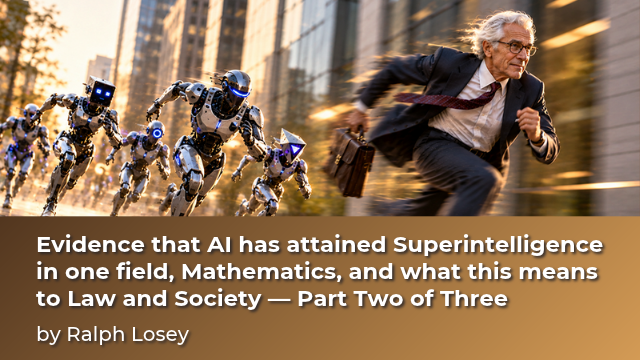
On October 6, 2026, OpenAI released 722 mathematical manuscripts at once. Two days later, Tristan Buckmaster said, “We’ve had whole research programs wiped out on Tuesday by their dump.” One breakthrough had become a flood.

Seven Hundred and Twenty-Two Mathematical Manuscripts. Really?
To understand Buckmaster’s reaction, consider what OpenAI had announced. This was not another proposed solution to a single famous problem. The GitHub repository ranged from number theory and geometry to mathematical physics and computer science, with proofs, supporting artifacts, and many plain-English explanations available for inspection. Mathematicians around the world began doing just that. Evaluating the collection could take months or years.
The historic figure was 722 manuscripts, not 722 separate and independently confirmed breakthroughs. OpenAI organized the papers into families of related results; several manuscripts might concern one discovery, supply alternative proofs, or extend an earlier result. The scale was extraordinary.
OpenAI’s README explains:
This collection includes results at different stages of verification. Not all have accompanying Lean formalizations. We will continue to update this repository with Lean formalizations as we obtain them. Some of the unformalized results could have issues. We will endeavor to fix any such issues quickly. We are also exploring community-hosted repositories for these materials.
Just think what would happen if a law firm filed 722 legal memoranda with a court on the same day.

Something like that happened here. Expert mathematician Martin Bridson of Oxford described the release as “breathtaking,” but other reactions ranged from astonishment and excitement to intense anger and opposition. Some mathematicians called OpenAI’s action “carpet bombing” or “the mathocalypse.” On October 7, 2026, a newly formed advocacy group calling itself the Association for Human Mathematics published a scathing open letter, which concluded as follows:
Releasing over 700 files at once is not a demonstration of scholarship, but a demonstration of power. We urge mathematicians to discontinue their work with OpenAI and to return to a vision of science that centers human understanding.
To me, the response of this hastily formed protest group sounds like spoilsport criticism. It misses the point. Some of the loudest critics showed little understanding of AI’s potential as a research tool. Their fear was understandable. How long could they keep up? But fear is not a strategy. They saw the agents only as competitors, not as tools that could help them move much faster through parts of their work. Understanding what the proofs mean, deciding which discoveries matter, and choosing where mathematics should go next remain human responsibilities. AI could give them a jump-start on that more important work, if they were willing to use it. Electronic discovery lawyers have all seen this kind of overly conservative initial reaction before.
When Mathematical Proof Outruns Human Understanding
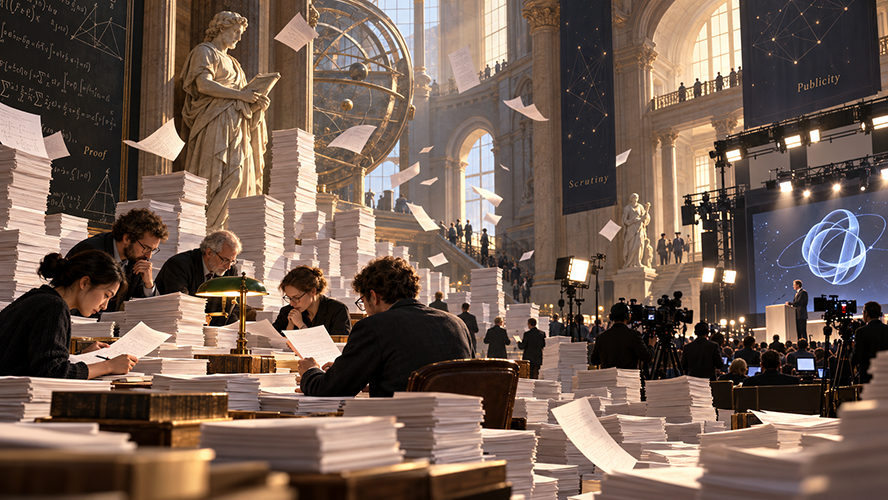
Part One showed the problem in miniature: Buckmaster found a valuable idea inside an almost unreadable mathematical argument. The 722-manuscript release multiplied that problem hundreds of times. Machine intelligence could generate results faster than human communities could decide what they meant.
Mathematicians care about correct proofs, but they also care about elegance and understanding. A good proof explains why something is true. An exceptional proof reveals connections and opens new lines of inquiry. A computer-generated argument may establish a result without supplying much of that understanding. Formal verification can check that the conclusion of a properly encoded proof follows from its stated assumptions. It cannot, by itself, explain why the result matters or how it fits into the larger structure of mathematics.
A more thoughtful response came from the Advisory Group on Mathematics and Artificial Intelligence (AGMAI). In its October 6 statement, AGMAI emphasized that releasing mathematical results is only the beginning of the work required to develop human understanding. Researchers must examine the arguments, test their significance, discover relationships with earlier knowledge, and decide which questions deserve further investigation. AGMAI also warned that human researchers should not be reduced to evaluating discoveries selected by commercial AI laboratories. Mathematicians must retain the freedom to ask their own questions and pursue their own ideas. The same is true in law and every other field.
Mathematics is not a contest to fill a warehouse with proofs. Scientific discovery also requires curiosity, imagination, explanation, and new ways of understanding the world. Lawyers know the problem. Finding hundreds of potentially relevant cases does not mean we understand the law. Locating thousands of documents does not mean we understand the evidence. The real work is recognizing what matters, seeing the important relationships, and deciding what conclusions the available information supports.
Fortunately, Terence Tao, one of the world’s most distinguished mathematicians, had anticipated this leap in AI’s mathematical ability. While much of the profession was still reeling from the surprise, Tao had already been thinking about what should come next. That preparation allowed him to see a silver lining where many of his colleagues saw only dark clouds.
Terence Tao and Mathematics 2.0
Terence Tao is a Distinguished Professor of Mathematics at UCLA and recipient of the 2006 Fields Medal, one of the highest honors in mathematics. Born in Australia, Tao earned his doctorate from Princeton University at age twenty and became a full professor at UCLA at twenty-four, the youngest in the university’s history. His extraordinary accomplishments span several mathematical disciplines. Readers interested in his career can consult his UCLA faculty profile and Wikipedia biography.
Tao has embraced the potential of AI-assisted mathematical research and is well qualified to consider what these advances mean for his profession. On October 7, 2026, he republished the strong protest of the Association for Human Mathematics on his personal website, but clearly identified it as a guest post rather than his own statement.
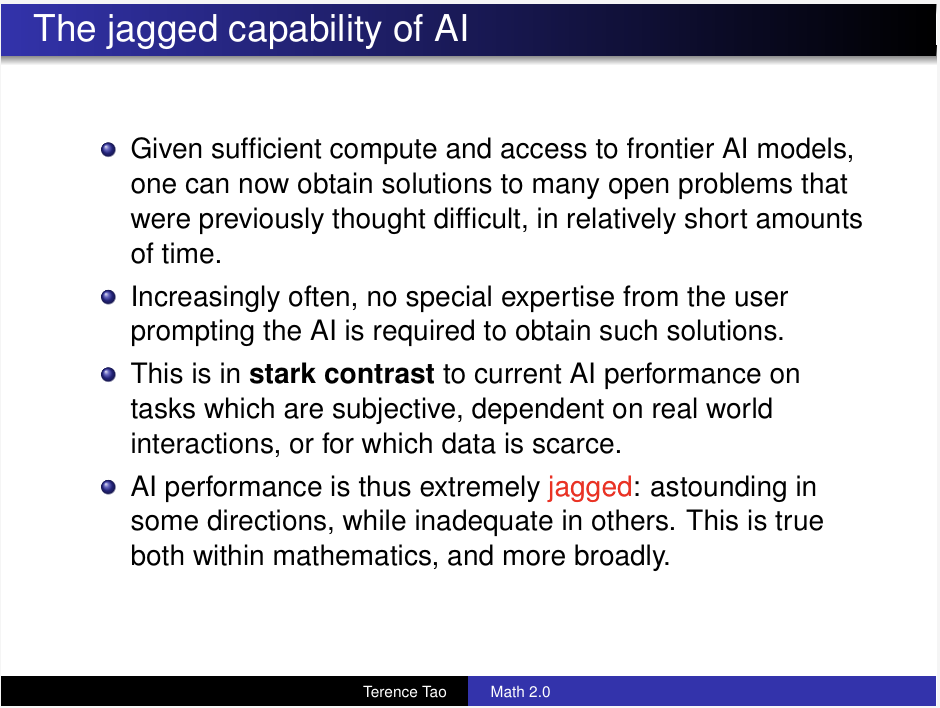
On October 9, 2026, Tao delivered an extensive lecture at Caltech titled Math 2.0. He also wrote a short essay for Nature, Can Maths Survive AI? Fields Medallist Terence Tao Calls for a ‘Maths 2.0’ World. Below is one of Professor Tao’s slides from the deck he used at Caltech. It illustrates the uneven capabilities of AI. The professor obviously made the slides himself. Their old-school academic style makes an interesting contrast with the images in this article. Part Three of this article will go into the extreme variability in AI capacities in greater depth.
Terence Tao believes mathematics is approaching a fundamental change. For centuries, difficult mathematical proofs were rare intellectual achievements. Discovering one could establish a mathematician’s reputation and redirect an entire field of research. That scarcity helped determine how mathematicians were educated, how universities evaluated research, and how professional recognition was awarded.
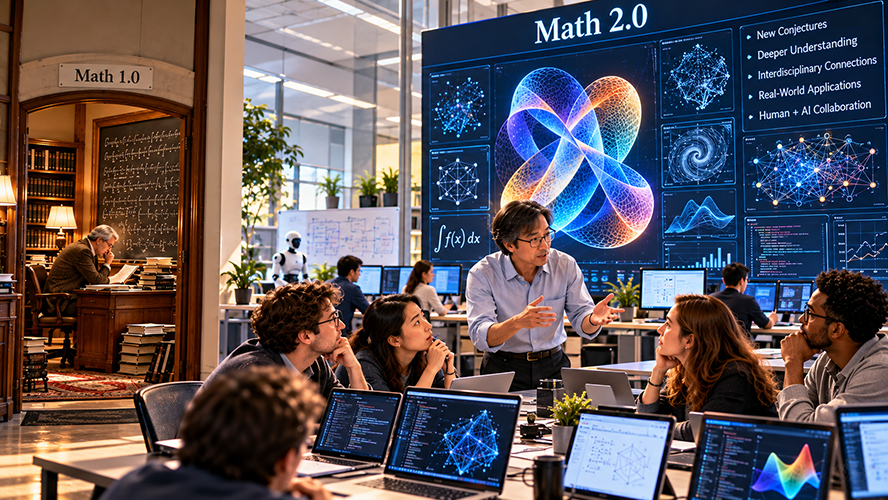
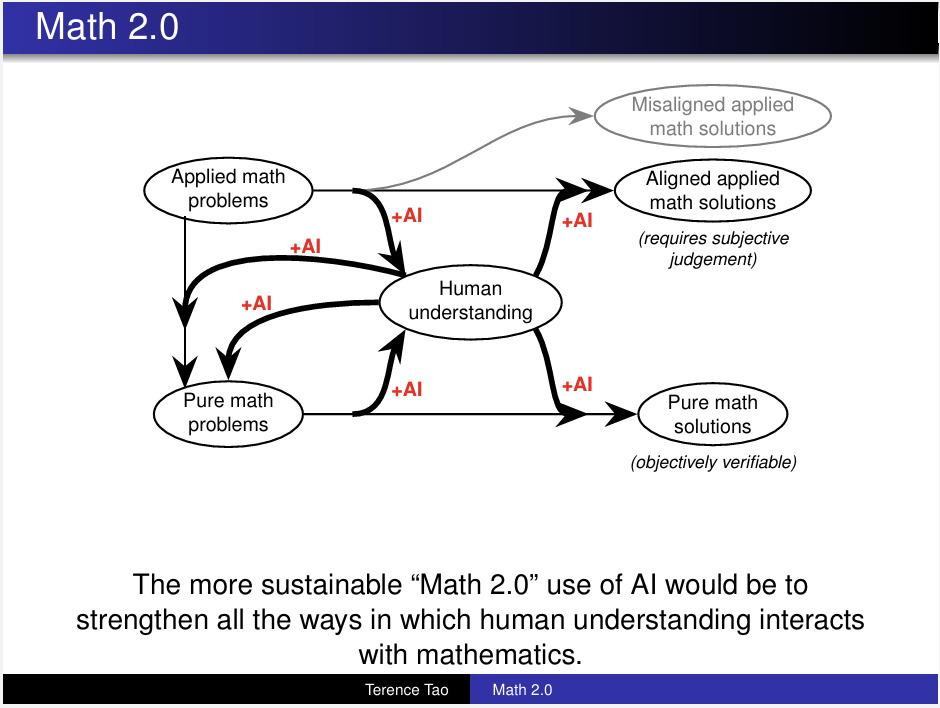
Now AI threatens to overturn that system. In his October 9 Caltech lecture, Tao called the traditional approach Math 1.0. His proposed Math 2.0 would place greater emphasis on human understanding, explanation, collaboration, education, and the application of mathematics to important questions. As he explained in his October 10 blog post, his vision is for AI to sustain the mathematical community and help apply mathematical understanding to the real world.
The possibilities are exciting to many. Instead of spending years trying to establish a particular theorem, a mathematician could use AI to explore several possible approaches, discover unexpected relationships, and develop new questions that nobody had previously considered.
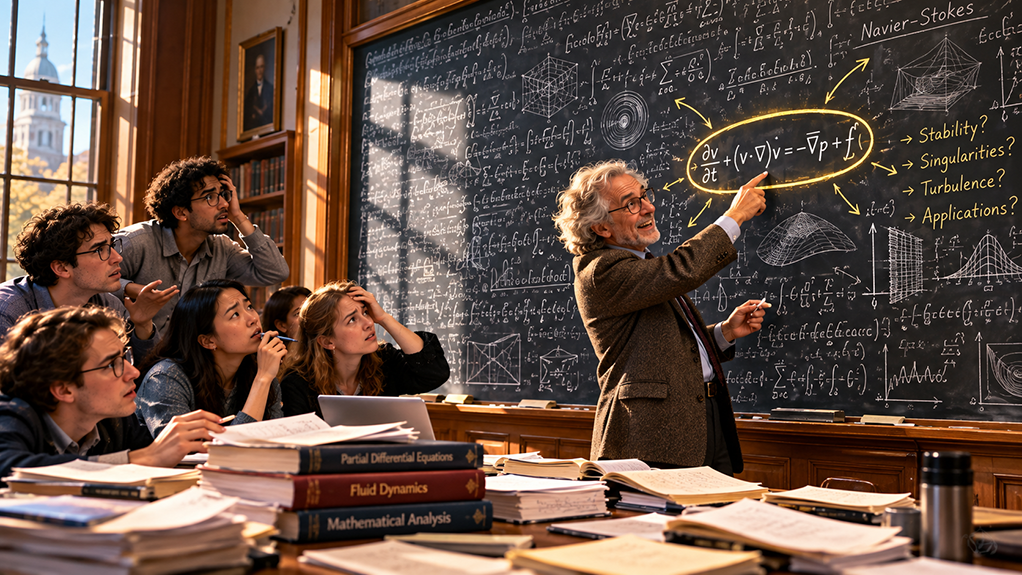
But there are serious problems with this transformation. How will graduate students learn mathematics if machines can provide difficult proofs almost immediately? How will young researchers establish themselves? And how can mathematical education preserve the experience of struggling with an intellectual problem until something finally becomes clear? The same questions apply to legal education.
These are real problems, not excuses to turn back the clock. Tao’s answer is not to resist AI. He wants mathematicians to use its extraordinary capabilities while preserving the intellectual struggle through which students and researchers learn to judge new ideas. Producing proofs matters. Learning why they matter and how to explain them matters too. The same is true in law.
Readers interested in exploring Tao’s thinking more deeply can consult his continuously updated summary of his views on AI. If you like charts with arrows, here is one that Professor Tao used in his Caltech lecture PowerPoint to summarize the new version of math emerging with AI.
These same principles apply to law. AI can find cases, analyze documents, and draft arguments, but lawyers must still understand their clients, recognize what matters, exercise judgment, and answer for the consequences. Used properly, these capabilities should allow us to do more of that important work, not less. Part Three will examine what that requires in practice.
From Mathematical Proofs to Scientific Understanding: OpenAI Changes Course
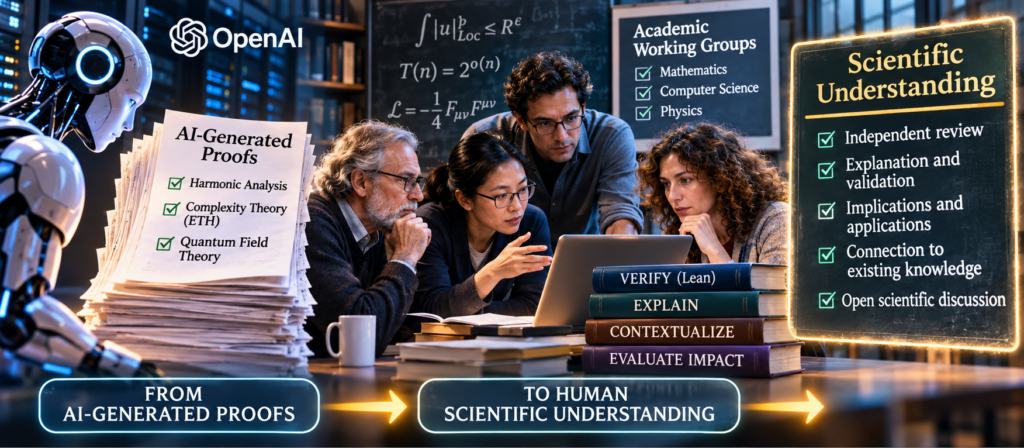
A practical test of Tao’s Math 2.0 vision arrived just over two weeks after his Caltech lecture. On October 26, 2026, OpenAI announced three more claims of extraordinary discoveries by its internal AI models. One concerned the mathematical behavior of waves, another challenged a longstanding assumption in computer science, and the third concerned the mathematical foundations of quantum field theory. But the release process had changed. In its announcement, Working with academic communities to build scientific understanding, OpenAI acknowledged that producing mathematical proofs was not the same as developing scientific understanding. It described the AI-generated manuscripts as “raw research data” that human scientists must examine, explain, and place in context.
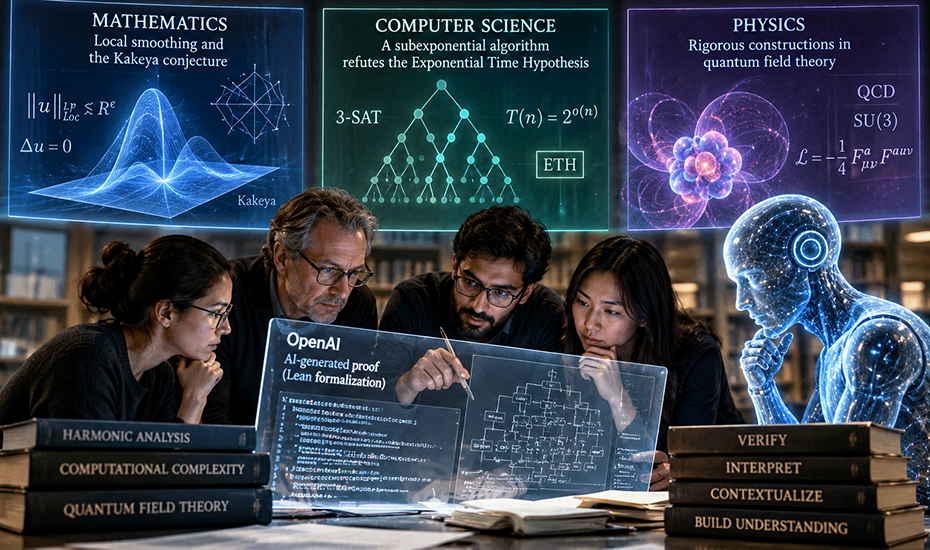
The computer science discovery concerns the Exponential Time Hypothesis (ETH), a longstanding assumption about how difficult certain computational problems are to solve. Think of a complicated logical puzzle. Checking a proposed solution may be relatively easy but finding that solution could require an enormous amount of computation. ETH assumes that solving a particular class of these problems requires computation that grows exponentially as the problems become larger. OpenAI claims its AI system discovered an algorithm that breaks through this presumed barrier, solving the problems in what computer scientists call subexponential time. If the claim survives independent examination, a major assumption underlying decades of computer science research will have been overturned.
The competition continued the next day. On October 27, Anthropic published A 2o(n) Time Algorithm for 3-SAT, reporting that an internal Claude research model had independently discovered a similar result. Anthropic dates its discovery to October 16, the same day OpenAI reports finding its solution. Both companies claim important mathematical breakthroughs, but their significance still requires independent examination and explanation by human experts.
The human response is particularly interesting. OpenAI invited three leading computer scientists to organize an independent examination: Russell Impagliazzo and Ramamohan Paturi of the University of California, San Diego, and Ryan Williams, a professor at MIT specializing in computational complexity and the limits of efficient algorithms. Impagliazzo and Paturi, together with Francis Zane, originated the ETH in 1999. Imagine helping to develop a major scientific conjecture and then, twenty-seven years later, being asked to investigate whether an artificial intelligence has disproved it.
Lawyers are familiar with institutional reversals. They sometimes end up arguing for a ruling that undermines precedent they helped create. In other situations, as in Roe v. Wade, they watch an unexpected reversal in astonishment. Imagine if legal precedent changed because of alien-looking arguments produced by supposedly superintelligent AI. I do not know how retired Magistrate Judge Andrew J. Peck would react, but I would be livid if Da Silva Moore were discarded for that reason.
These developments were examined by Tim Fernholz in his October 27 TechCrunch article, Frontier AI labs say their models refuted the Exponential Time Hypothesis. What does that mean? Fernholz interviewed MIT Professor Ryan Williams, who had sharply criticized OpenAI’s massive release earlier in October. In an October 8 post on X, Williams wrote that it “feels like a DDOS attack on mathematicians.” His willingness to participate in OpenAI’s new approach is therefore noteworthy. Williams told TechCrunch that parts of OpenAI’s proof looked routine, while other parts were so unfamiliar that he called them “alien-looking.” Those are precisely the parts that require the larger scientific community to work together. TechCrunch also raised an important concern for lawyers: whether the new discovery might undermine existing cryptographic systems. No actual cryptographic break was established in its reporting.
Williams, Impagliazzo, and Paturi told OpenAI that understanding these new ideas would require participation by the larger research community. They requested full public access to the evidence and OpenAI’s support for a scientific conference. Notably, OpenAI agreed. The company is now experimenting with different ways of working with mathematicians and scientists in response to criticism of its earlier releases.
For ETH, OpenAI made the materials publicly available while supporting an independent group of computer scientists to organize the review. For the quantum field theory discovery, which includes claimed results concerning quantum chromodynamics and Yang–Mills theory, it deferred release of the AI-generated materials to a group of physicists led by Nobel laureate David Gross. OpenAI also announced that participants would not be required to sign nondisclosure agreements, that the company would not seek academic credit for discoveries produced by its internal models, and that outside researchers would receive recognition for their own intellectual contributions.
The revised process does not settle the institutional questions raised by the flood. Who decides which problems deserve attention? Who receives access to the strongest models? Who controls the computing resources needed to operate them? And who has enough independence, time, and evidence to challenge a result when a corporate laboratory announces it? Formal verification can test an encoded proof. It cannot answer those questions.
This is Tao’s Math 2.0 in practice. AI produces proofs at extraordinary speed; scientists organize the slower work of understanding, teaching, testing, and application. The academic community must remain free to challenge both the machines and the corporations behind them. OpenAI’s new procedures are a constructive step, but the experiment will succeed only if outside researchers retain real independence.
Scientific Discovery, Corporate Competition, and the Cost of Progress
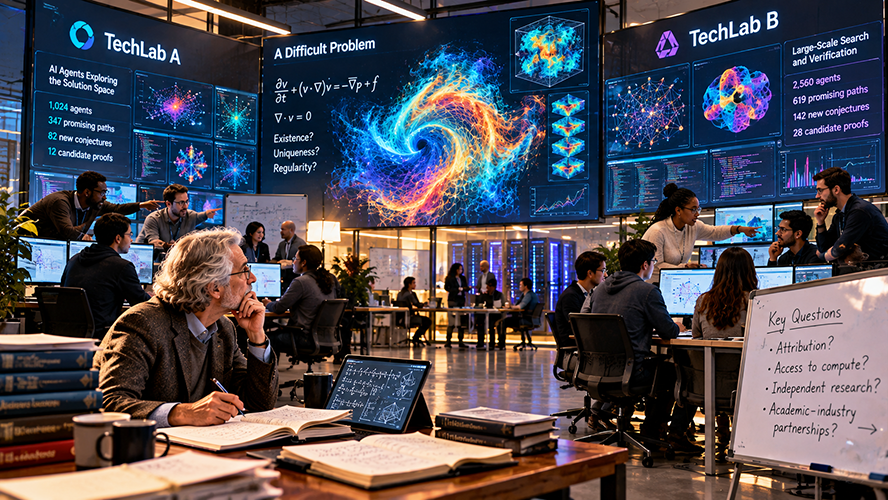
The change is not only intellectual. It redistributes power. Commercial laboratories have long contributed to science, but OpenAI and Anthropic can now generate mathematical results at a speed and scale academic researchers cannot match. The academic community may become the reviewer of a research agenda chosen elsewhere.
Part One examined the dispute over scientific priority surrounding the Navier–Stokes breakthrough. That controversy highlighted the commercial stakes in claiming a discovery first. Announcing that an AI model has solved a famous mathematical problem can generate enormous publicity and attract customers, investors, and talented researchers, even before independent experts have evaluated the result. There is nothing inherently wrong with companies benefiting from genuine scientific progress. But the race for publicity can move much faster than the careful work needed to determine what has actually been proved and who deserves credit for what.
For much of its history, some of mathematics’ most important work could be done with modest material resources: a blackboard, access to the literature, colleagues, and time to think. Frontier AI-assisted research is different. It may require proprietary models, coordinated agent teams, computing power, and funding beyond the reach of individual researchers and most universities. A mathematician with a great idea may now be competing with a corporate laboratory able to attack the same problem at enormous speed and scale. Who gets access may increasingly determine who gets to compete. Universities may become dependent on technologies controlled by a handful of companies, while individual researchers struggle to preserve their independence.
One constructive response to this growing imbalance came on October 15, 2026, when the Simons Foundation announced a $15 million partnership with OpenAI and Anthropic. The commitment combines funding and other resources to help mathematicians adapt to the AI era, with OpenAI contributing $5 million of the total. The Simons Foundation will manage and award the funding, while OpenAI and Anthropic will provide AI tools and computing resources to a select group of foundation-supported researchers. This is encouraging. It recognizes that mathematical and other scientific research must remain a broad intellectual enterprise, not merely a demonstration of corporate computing power. The initiative will not put frontier systems in every researcher’s hands, but it begins to widen access.
The October flood exposed the larger stakes. The cost of progress is not measured only in dollars or computing power. It is also measured in disrupted careers, contested credit, institutional dependence, and the risk that a few companies will decide which questions receive the strongest intelligence ever brought to mathematics. Tao’s Math 2.0 offers a better bargain: accelerate discovery without surrendering human understanding, independent inquiry, or control of the research agenda.
From Human Understanding to Professional Judgment
OpenAI’s release of 722 mathematical manuscripts was not an isolated spectacle. Less than three weeks later, it announced three more claimed discoveries spanning mathematics, computer science, and quantum field theory. Together, they made the new bottleneck impossible to ignore. AI has attained superintelligence in mathematics. That does not make it conscious, wise, or generally superintelligent. It means machines can now produce important mathematical results faster and at a scale no human researcher or institution can match. The bottleneck is now human: verifying the proofs, understanding what they mean, teaching the next generation, assigning fair credit, and deciding who controls the research agenda.
That is why the mathematics story matters to lawyers. Law is where the analogy becomes both useful and dangerous. A formal mathematical statement can sometimes be checked against precise logical rules. Legal work usually turns on incomplete records, contested facts, ambiguous language, human motives, competing values, and consequences for real people.
Part Three asks what lawyers can learn from these mathematical research teams without pretending that legal proof is mathematical proof. It begins with Andrej Karpathy’s jagged frontier and ends with a lawyer directing a team of agents through a threatened Rule 37(e) dispute. The machines will be powerful. The lawyer will remain responsible.
For educational use only. Not legal advice.
Ralph Losey Copyright 2026. All Rights Reserved.
Assisted by GAI and LLM Technologies per EDRM’s GAI and LLM Policy.