

Case Law
← Back to Blog
Search
Authors
Inadvertent Production of Work Product Did Not Waive Protection; However, Recipient Showed Substantial Need and Overcame That Protection
In Aerosonic LLC v. Joby Aero, Inc., the court held that inadvertent disclosure of work product did not waive protection under Rule 502 and the ESI Protocol. However, the receiving party demonstrated substantial need and...
Court Suggests That Opposing Counsel Also Failed to Check Citations
A Seventh Circuit decision raises a critical question for modern litigation: do lawyers have a duty to identify hallucinated or false citations in opposing counsel’s filings? While stopping short of imposing sanctions, the court signaled...
Categorical Privilege Logs Are Not Disfavored
In Thompson v. Seattle Public Schools, the court reaffirmed that categorical privilege logs are not disfavored and may be used without prior court approval under Rule 26. The decision highlights proportionality, burden, and practical limits...
“Hallucinations” by West’s CoCounsel?
In U.S. v. Farris, the Sixth Circuit sanctioned appointed counsel after AI-assisted briefs generated through Westlaw CoCounsel included false quotations and misstatements of precedent. The opinion underscores that even when AI cites real authorities, lawyers...
Hallucination or Old-Fashioned Error? It Doesn’t Matter
In Quandel v. Hunt, the court made clear that lawyers cannot excuse nonexistent case citations and quotations by blaming AI, or anything else. The real issue, the court said, is the duty to verify authorities...
Important A.I. Work Product and Protective Order Decision: Application to Pro Se Litigant and Beyond?
Can using AI in litigation stay protected, or does it risk exposing strategy? A new decision in Morgan v. V2X draws a careful line, protecting AI-assisted work product while placing real limits on how confidential...
When Should a Motion for Sanctions be Filed?
Harris v. Washington County, 2026 WL 813917 (D. Utah Mar. 24, 2026), highlights a recurring procedural problem in federal discovery practice: the Federal Rules do not set a clear deadline for filing sanctions motions. In...
Does Disclosure of Litigation Hold Directive to Preserve “Texts” Waive Privilege?
A recent decision examines whether identifying “texts” in a litigation hold waives privilege and what it takes to compel disclosure of hold notices.
Nonsensical Spellings and Fabricated Authority Signal Improper Use of Artificial Intelligence
A federal court found that nonsensical spellings and fabricated authority revealed improper AI use, resulting in dismissal without leave to amend.
Well-Reasoned “Hallucination” Analysis
A federal court decision in Brownfield v. Cherokee Co. School Dist. clarifies that failing to verify AI-generated citations can trigger Rule 11 sanctions, even for pro se litigants.
Evidence Sufficient to Demonstrate that Audio Recording Was Not a Deepfake
In Burnley v. Valentin (E.D. Va. 2026), the court held that an audio recording was properly authenticated despite a deepfake challenge, emphasizing FRE 901’s low threshold, witness testimony, and voice identification.
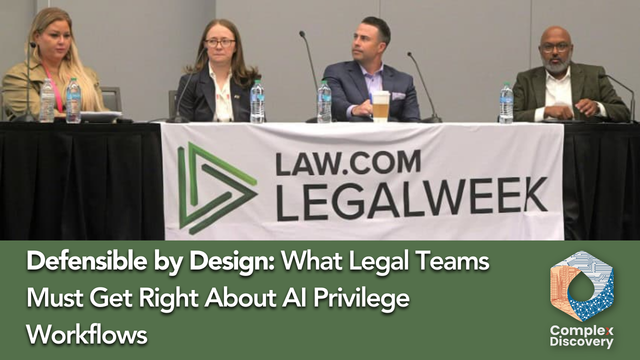
Defensible by Design: What Legal Teams Must Get Right About AI Privilege Workflows
AI is now operational in privilege review, but defensibility remains the standard. Drawing on a Legalweek 2026 panel, this article explores validation protocols, the distinction between classification and logging, and the importance of Rule 502(d)...