

Lawyers Duties
← Back to Blog
Search
Authors
Motion to Compel Forensic Image of Cell Phone: Granted in Part; Denied in Part
Michael Berman analyzes Madrigal v. Live Nation, where a court granted in part Ticketmaster’s motion to compel a forensic image of the class representative’s cell phone. The decision offers practitioners a clear roadmap on Rule...
Court Refuses to Enter Fed.R.Evid. 502(d) & “Clawback” Order Without Agreement; Also Refuses to Order Production of Responsive Documents That Do Not “Hit” on Search Terms
In Medal v. Amazon, a federal court refused to enter a Rule 502(d) clawback order without party agreement and declined to require production of responsive documents not captured by search terms. Michael Berman respectfully disagrees...
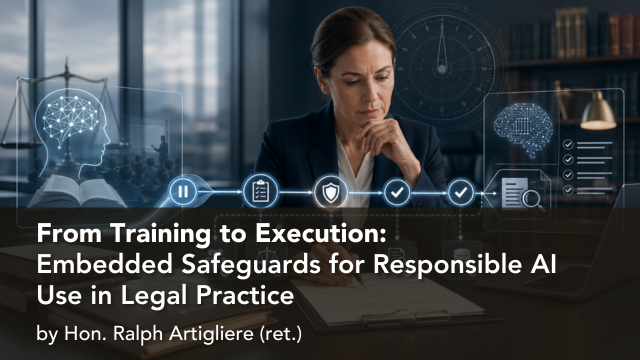
From Training to Execution: Embedded Safeguards for Responsible AI Use in Legal Practice
AI is already transforming legal practice, but training alone isn’t enough. This article explores how embedded safeguards—built directly into workflows—help lawyers and judges apply their knowledge reliably under pressure, reducing risk and reinforcing professional responsibility...
Cite Checking to Find Hallucinated Cases Deemed Insufficient
Recent decisions highlight that relying on cite-checking alone cannot cure hallucinated cases in AI-generated briefs, reinforcing lawyers’ duty of competence and verification.
It is Improper and a “Perilous Shortcut” to “Outsource” Discovery Positions to A.I.
In White v. Walmart, the court held that relying exclusively on AI for discovery disputes is improper, emphasizing attorneys’ duty to exercise independent judgment and confer in good faith.
Court Suggests That Opposing Counsel Also Failed to Check Citations
A Seventh Circuit decision raises a critical question for modern litigation: do lawyers have a duty to identify hallucinated or false citations in opposing counsel’s filings? While stopping short of imposing sanctions, the court signaled...
“Hallucinations” by West’s CoCounsel?
In U.S. v. Farris, the Sixth Circuit sanctioned appointed counsel after AI-assisted briefs generated through Westlaw CoCounsel included false quotations and misstatements of precedent. The opinion underscores that even when AI cites real authorities, lawyers...
The AI Sanction Wave: $145K in Q1 Penalties Signals Courts Have Lost Patience with GenAI Filing Failures
Courts are escalating enforcement against AI-generated hallucinations in legal filings, with $145,000 in Q1 2026 sanctions. Key rulings, a growing judicial AI paradox, and emerging liability risks for developers signal a major shift for legal...
Hallucination or Old-Fashioned Error? It Doesn’t Matter
In Quandel v. Hunt, the court made clear that lawyers cannot excuse nonexistent case citations and quotations by blaming AI, or anything else. The real issue, the court said, is the duty to verify authorities...
Suggested A.I. Rule – Suggested Amendment to Maryland’s Computer-Generated Evidence Rule
This article proposes revising Maryland Rule 2-504.3 to expressly cover generative AI evidence. The amendment would add notice, disclosure, discovery, pretrial hearing, and expert-related procedures for computer-generated evidence in civil cases.
Well-Reasoned “Hallucination” Analysis
A federal court decision in Brownfield v. Cherokee Co. School Dist. clarifies that failing to verify AI-generated citations can trigger Rule 11 sanctions, even for pro se litigants.
EEOC to Get a Fee Award for Defendants’ Discovery Failures
A federal court awarded the EEOC attorneys’ fees after repeated discovery failures by defendants, emphasizing Rule 26(g) certification duties, Rule 37 sanctions, and the importance of diligent ESI searches and timely production.