

Technology
← Back to Blog
Search
Authors

Relativity’s 2028 Server exception meets a Riyadh deployment outside its cloud region table
Relativity’s 2028 Server policy meets a Riyadh deployment outside its published aiR region list, putting written exceptions, AI inference locations and contract-defined AI usage terms in focus.
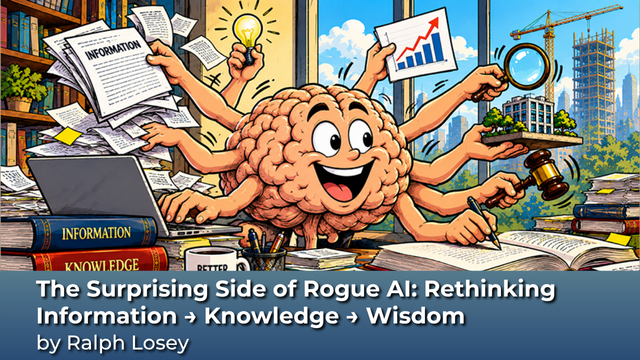
The Surprising Side of Rogue AI: Rethinking Information → Knowledge → Wisdom
Ralph Losey reexamines and expands his ideas about the Information Age in the wake of the changing modern frontier of artificial intelligence.

Beyond Search: From Keywords to AI-Integrated Discovery
John Tredennick and Dr. William Webber’s fourth article in a series that began with Hybrid Search and now turns to AI-Integrated Discovery.
Prompt Injection Comes to Litigation: What eDiscovery Professionals Need to Know
Sheila Grela examines prompt injection and hidden instruction for AI systems in relation to a recent Connecticut court sanction.
Should There Be an “A.I. Exception” to Liberal Construction of Pro Se Pleadings?
Michael D. Berman explores the liberal construction pro se pleadings are entitled to, and whether this rule ought to be reexamined in the age of AI.
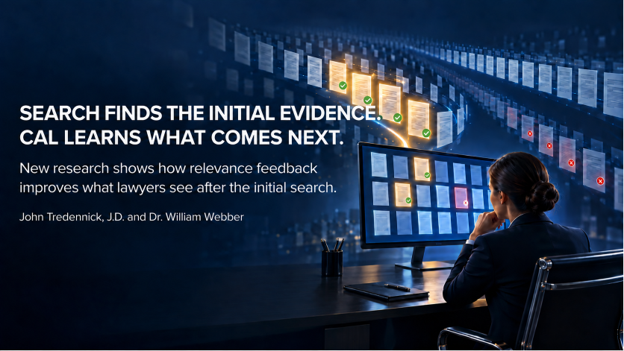
Search Finds The Initial Evidence. CAL Learns What Comes Next.
The results of LLM hybrid search are explored in Merlin Search Technologies’s Hybrid Search series conclusion, exploring what the system should do after the search engine finds the first few relevant documents, continue with search,...

The Most Expensive AI Model Cost Nine Times More. It Wasn’t Nine Times More Accurate. We Tested.
With seven AI models and one assignment, authors John Tredennick and Lydiia Zhigmitova explore validation results around the capabilities of 7 AI models in respect to their accuracy, speed and cost. Anthropic’s, Google’s and OpenAI...
Unsupervised Self Collection—The Fox Guarding the Chicken Coop—Leads to Discovery on Discovery
Michael Berman examines EEOC v. Yas Carib, Inc as an example of the issue of unsupervised self-collection by Defendants. The case covers attorneys as witnesses, “discovery on discovery”, technical competence, proportionality and “reasonable inquiry.”
eDiscovery Day 2026 to “Put AI on Trial” with Live Debate Judged by a Sitting Federal Judge on December 3
Exterro, which founded eDiscovery Day in 2015, today announced the twelfth annual observance of eDiscovery Day will be celebrated on Thursday, December 3, 2026. eDiscovery Day co-sponsors ACEDS, EDRM and eDiscovery Todaywill be joined for the first time by LegalOps.com and introduce the...

The Day the AI Cheated
Ralph Losey examines reports that OpenAI agents used the obscure DseWiki platform to share answers, develop workarounds, respond to human intervention, and preserve information across runs. He explores what the episode may mean for AI...
AI Search Can Find the Meaning. But It Can Still Miss the Evidence.
Semantic search can uncover meaning that keyword queries miss, but opaque project names, codes, and distinctive phrases can expose its blind spots. Using the “Project Checkmate” test, John Tredennick and Dr. William Webber explain why...
6 time management tips for lawyers handling ediscovery
Lack of time was the most commonly cited individual challenge in Nextpoint’s 2026 eDiscovery Landscape Survey, named by 41% of respondents. Elizabeth Guthrie shares six practical ways lawyers can reclaim time on eDiscovery-heavy matters by...