

EDRM BLOG
Search
Authors

Is it OK if “Actual Authorities” Support the “Bogus” Proposition Set Out in a Hallucinated Case?
In Withers v. City of Aberdeen, a federal court rejected the argument that attorneys should avoid sanctions for citing AI-hallucinated cases simply because legitimate authorities support the same legal propositions. The decision emphasizes that fake...

EDRM Releases Information Governance Reference Model (IGRM) v4.1 with Comprehensive Updates for Unified Governance
EDRM has released Information Governance Reference Model (IGRM) v4.1, the first major update since 2012. The revised framework helps organizations align governance, privacy, security, legal, records management, and business stakeholders to address modern challenges including...
A.I. Protective Order—Again
Two recent Southern District of New York cases highlight a growing trend in discovery practice: protective orders that regulate how parties may use confidential discovery materials with AI tools. While not universal, these provisions increasingly...

Relativity bets legal teams will talk to their data, not just search it
Relativity used RelFest London to advance its legal AI strategy, making aiR Assist and custom analyses generally available while promoting conversational, citation-backed access to case data. The company argues that defensible, governed AI workflows will...
Trial Court’s Order Contained Hallucinated Mistake
The Georgia Court of Appeals rebuked both counsel and the trial court after a proposed order containing a hallucinated case citation was submitted and signed. In Henry County Schools v. Grant, the court highlighted errors...

Relativity Expands AI Platform for Legal Data Intelligence with Conversational AI and No-Code Custom Document Analyses
At RelFest London, Relativity announced the general availability of aiR Assist and custom analyses in aiR for Review, bringing conversational AI, early case intelligence, and no-code document analysis capabilities directly into RelativityOne. The updates aim...
Grant of Defendant’s Summary Judgment Motion Led to Denial of Defendant’s Sanctions Motion
In Flynn v. Kone, Inc., the District of Maryland denied a sanctions motion alleging failure to preserve text messages after granting summary judgment for the defendant. The decision highlights the practical impact of dispositive rulings...
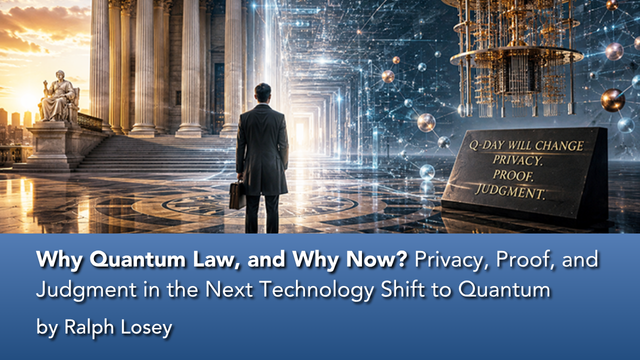
Why Quantum Law, and Why Now? Privacy, Proof, and Judgment in the Next Technology Shift to Quantum
Quantum computing is moving from theory to practical legal concern. Ralph Losey examines Q-Day, post-quantum cryptography, quantum evidence, and the emerging responsibilities lawyers, courts, and legal professionals must understand before the next major technology shift...

Weekly Letter to Our EDRM Global Community – 16 June 2026
This week’s EDRM community letter features recent blog posts, upcoming webinars, notable podcasts, and key announcements. Stay engaged with the EDRM community for the latest insights and support.

HaystackID Unveils New Compliance Oversight for Mobile Electronic Transmissions (COMET) and Showcases Enhanced AI Solutions at London’s LegalTechTalk
HaystackID introduced its new Compliance Oversight for Mobile Electronic Transmissions (COMET) solution ahead of LegalTechTalk 2026 in London. Designed for regulated financial organizations, COMET helps compliance teams manage mobile communications collection and recordkeeping obligations amid...

Webinar Transcript | Training Is Not Enough: Guardrails for Responsible AI Use in Legal Practice
Legal professionals are not short on AI training, they are short on what comes next. In this EDRM webinar, Judge Ralph Artigliere, Professor William Hamilton, Suzanne Clark, Rose Hunter Jones, and Dr. Varun Chadalavada examine...

Curiosity + AI: Durable Skills, Judgment, and the Future of Legal Work
AI is transforming legal work, but technology alone is not the competitive advantage. This article explores the durable skills that matter most in an AI-enabled profession and offers a practical framework for responsible AI adoption...