

Search
Authors
Exterro Launches Industry’s First Autonomous AI Engine to Eliminate Up to 95% of manual Subpoena Work and Reclaim 7,500 Enterprise Hours
Read this press release to learn about Exterro Subpoena Manager, the industry’s first governed autonomous AI solution, which can eliminate up to 9% of the manual subpoena response work and save hundreds of thousands of...

Supervisory Duties vis-à-vis “Hallucinated” Citations
A California federal court sanctioned a supervising partner for AI-hallucinated citations his associate filed, holding that a firm’s silence on citation-checking policy implicates the whole institution.
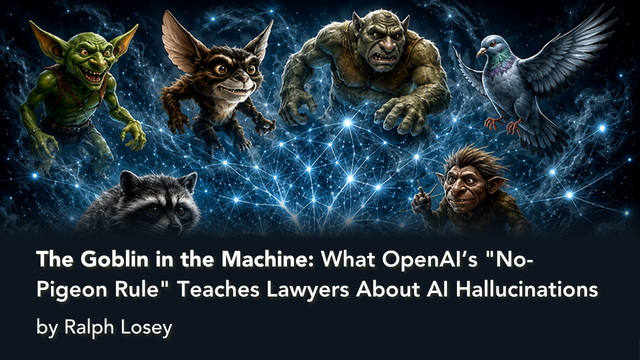
The Goblin in the Machine: What OpenAI’s “No-Pigeon Rule” Teaches Lawyers About AI Hallucinations
OpenAI’s “goblin incident” exposes how training incentives can produce persistent, unintended AI behavior across LLMs. The same root causes drive hallucination, and legal professionals need concrete verification steps before relying on AI output in legal...
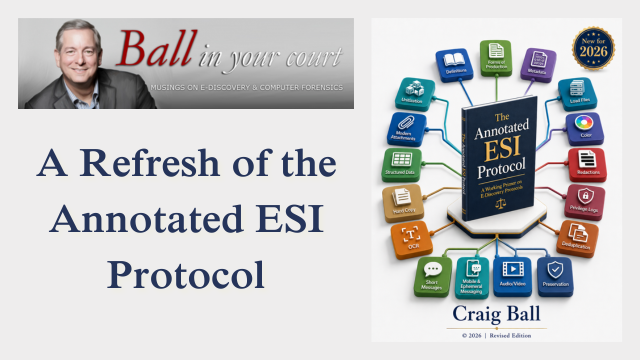
A Refresh of the Annotated ESI Protocol
Craig Ball introduces the 2026 revision of the Annotated ESI Protocol, addressing modern attachments, collaboration data, mobile collection, and generative AI in eDiscovery workflows.
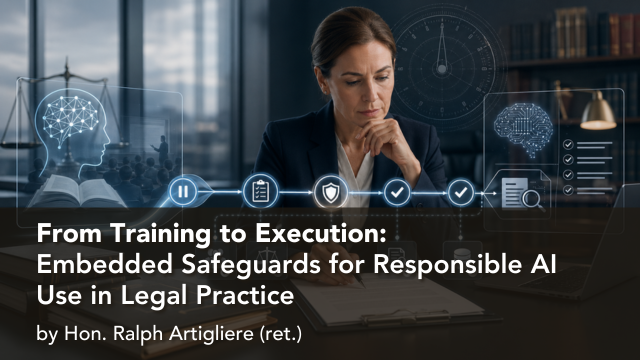
From Training to Execution: Embedded Safeguards for Responsible AI Use in Legal Practice
AI is already transforming legal practice, but training alone isn’t enough. This article explores how embedded safeguards—built directly into workflows—help lawyers and judges apply their knowledge reliably under pressure, reducing risk and reinforcing professional responsibility...
Cite Checking to Find Hallucinated Cases Deemed Insufficient
Recent decisions highlight that relying on cite-checking alone cannot cure hallucinated cases in AI-generated briefs, reinforcing lawyers’ duty of competence and verification.
Andrew Haslam’s eDisclosure Systems Buyers Guide at 14: What the 1H 2026 update reveals
The 1H 2026 update of Andrew Haslam’s eDisclosure Systems Buyers Guide delivers market insights, pricing benchmarks, and new frameworks for evaluating eDiscovery vendors.
Deponent’s Use of A.I. to Answer Deposition Questions Barred; ChatGPT Was Not an Attorney
A federal court ruled that a pro se litigant could not use ChatGPT during a deposition and that such use is not protected by attorney-client privilege, reinforcing limits on AI in litigation.

Relativity to Establish Singapore Entity, Expanding APAC Footprint
Relativity plans a Singapore launch while accelerating AI-driven legal data intelligence adoption across APAC, highlighting innovation at RelFest Sydney.

ComplexDiscovery OÜ Launches 1H 2026 eDiscovery Business Confidence Survey With Expanded AI and Revenue Focus
The 1H 2026 eDiscovery Business Confidence Survey launches with expanded focus on AI governance and organizational revenue, offering deeper insight into industry trends and adoption maturity.
A.I. Protective Orders Are Becoming Routine
Courts are increasingly entering AI protective orders that restrict how parties use generative AI with discovery materials, highlighting growing concerns over confidentiality, privilege, clawbacks, and litigation risk.
It is Improper and a “Perilous Shortcut” to “Outsource” Discovery Positions to A.I.
In White v. Walmart, the court held that relying exclusively on AI for discovery disputes is improper, emphasizing attorneys’ duty to exercise independent judgment and confer in good faith.