

Lawyers Duties
← Back to Blog
Search
Authors
It is Improper to Combine Interrogatories and Document Requests
Michael Berman surveys a consistent line of authority holding that the two discovery tools should be served separately, with some courts concluding that defendants need not respond to requests that combine both forms of discovery.

Is it OK if “Actual Authorities” Support the “Bogus” Proposition Set Out in a Hallucinated Case?
In Withers v. City of Aberdeen, a federal court rejected the argument that attorneys should avoid sanctions for citing AI-hallucinated cases simply because legitimate authorities support the same legal propositions. The decision emphasizes that fake...
A.I. Protective Order—Again
Two recent Southern District of New York cases highlight a growing trend in discovery practice: protective orders that regulate how parties may use confidential discovery materials with AI tools. While not universal, these provisions increasingly...
Trial Court’s Order Contained Hallucinated Mistake
The Georgia Court of Appeals rebuked both counsel and the trial court after a proposed order containing a hallucinated case citation was submitted and signed. In Henry County Schools v. Grant, the court highlighted errors...
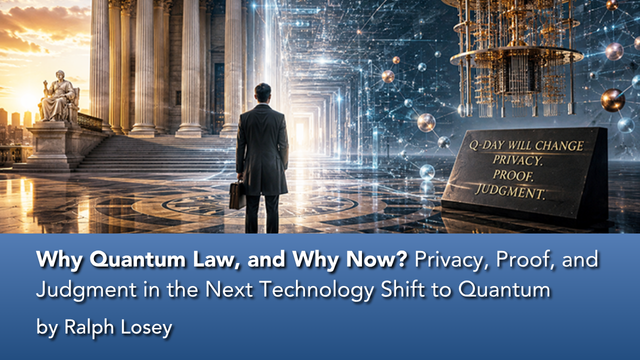
Why Quantum Law, and Why Now? Privacy, Proof, and Judgment in the Next Technology Shift to Quantum
Quantum computing is moving from theory to practical legal concern. Ralph Losey examines Q-Day, post-quantum cryptography, quantum evidence, and the emerging responsibilities lawyers, courts, and legal professionals must understand before the next major technology shift...
Curiosity + AI: Durable Skills, Judgment, and the Future of Legal Work
AI is transforming legal work, but technology alone is not the competitive advantage. This article explores the durable skills that matter most in an AI-enabled profession and offers a practical framework for responsible AI adoption...

Five great reads on cyber, data, and legal discovery for May 2026
This edition of Five Great Reads examines deepfake-driven evidentiary challenges, accelerating synthetic-content regulations, AI-powered antitrust enforcement, legal AI platform disruption, and major EU AI Act developments shaping compliance, privacy, cybersecurity, and eDiscovery.
The Most Significant Ethics Decision of 2026? And it is Only May
The Northern District of California’s sanctions decision in Guardant Health v. Natera may become one of the most consequential legal ethics rulings of 2026. The court adopted findings that multiple attorneys failed to investigate red...
District of Nevada’s Opportunity for Junior Lawyers to Argue Motions
Like most, if not all, federal courts, the District of Nevada has a local rule that permits it to consider motions with or without a hearing. However, there is a novel twist in one Judge’s...
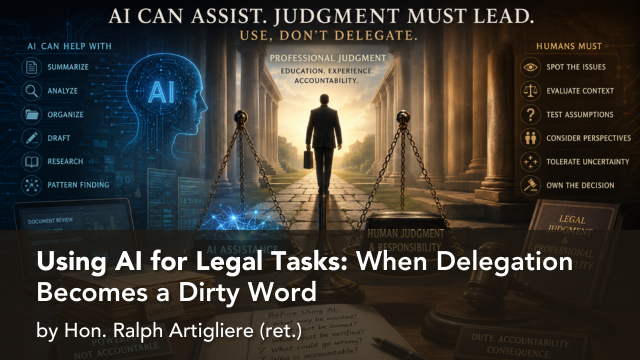
Using AI for Legal Tasks: When Delegation Becomes a Dirty Word
Judge Ralph Artigliere explores the growing tension between AI assistance and professional responsibility in legal practice. This article examines over-delegation risks, automation bias, eDiscovery implications, and the need for real-time human oversight in AI-assisted legal...

Supervisory Duties vis-à-vis “Hallucinated” Citations
A California federal court sanctioned a supervising partner for AI-hallucinated citations his associate filed, holding that a firm’s silence on citation-checking policy implicates the whole institution.
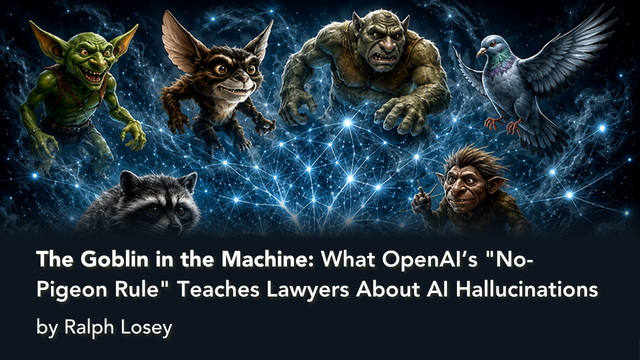
The Goblin in the Machine: What OpenAI’s “No-Pigeon Rule” Teaches Lawyers About AI Hallucinations
OpenAI’s “goblin incident” exposes how training incentives can produce persistent, unintended AI behavior across LLMs. The same root causes drive hallucination, and legal professionals need concrete verification steps before relying on AI output in legal...